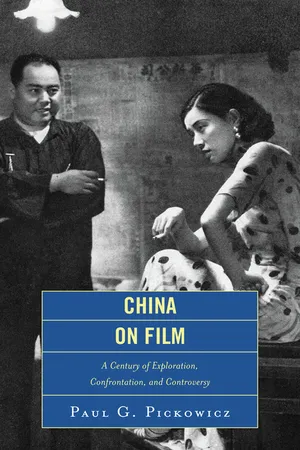
Leading scholar Paul G. Pickowicz traces the dynamic history of Chinese filmmaking and discusses its course of development from the early days to the present. Moving decade by decade, he explores such key themes as the ever-shifting definitions of modern marriage in 1920s silent features, East-West cultural conflict in the movies of the 1930s, the strong appeal of the powerful melodramatic mode of the 1930s and 1940s, the polarizing political controversies surrounding Chinese filmmaking under the Japanese occupation of Shanghai in the 1940s, and the critical role of cinema during the bloody civil war of the late 1940s. Pickowicz then considers the challenging Mao years, including chapters on legendary screen personalities who tried but failed to adjust to the new socialist order in the 1950s, celebrities who made the sort of artistic and political accommodations that would keep them in the spotlight in the post-revolutionary era, and insider film professionals of the early 1960s who actively resisted the most extreme forms of Maoist cultural production. The book concludes with explorations of the highly cathartic films of the early post-Mao era, edgy postsocialist movies that appeared on the eve of the Tiananmen demonstrations of 1989, the relevance of the Eastern European "velvet prison" cultural production model, and the rise of underground and independent filmmaking beginning in the 1990s.
Throughout its long history of film production, China has been embroiled in a seemingly unending series of wars, revolutions, and jarring social transformations. Despite daunting censorship obstacles, Chinese filmmakers have found ingenious ways of taking political stands and weighing in—for better or worse—on the most explosive social, cultural, and economic issues of the day. Exploring the often gut-wrenching controversies generated by their work, Pickowicz offers a unique and perceptive window on Chinese culture and society.
- English
- ePUB (mobile friendly)
- Available on iOS & Android
eBook - ePub
About this book
Information
Subtopic
Chinese HistoryTable of contents
- Acknowledgments
- Introduction: The Sorrows and Joys of Chinese Filmmaking: Political and Personal Contexts
- Chapter 1: Shanghai Twenties: Early Chinese Cinematic Explorations of the Modern Marriage
- Chapter 2: The Theme of Spiritual Pollution in Chinese Films of the 1930s
- Chapter 3: Melodramatic Representation and the May Fourth Tradition of Chinese Cinema
- Chapter 4: Never-Ending Controversies: The Case of Remorse in Shanghai and Occupation-Era Chinese Filmmaking
- Chapter 5: Victory as Defeat: Postwar Visualizations of China’s War of Resistance
- Chapter 6: Acting Like Revolutionaries: Shi Hui, the Wenhua Studio, and Private-Sector Filmmaking, 1949–1952
- Chapter 7: Zheng Junli, Complicity, and the Cultural History of Socialist China, 1949–1976
- Chapter 8: The Limits of Cultural Thaw: Chinese Cinema in the Early 1960s
- Chapter 9: Popular Cinema and Political Thought in Early Post-Mao China: Reflections on Official Pronouncements, Film, and the Film Audience
- Chapter 10: On the Eve of Tiananmen: Huang Jianxin and the Notion of Postsocialism
- Chapter 11: Velvet Prisons and the Political Economy of Chinese Filmmaking in the Late 1980s and Early 1990s
- Chapter 12: Social and Political Dynamics of Underground Filmmaking in Early Twenty-First-Century China
- Additional Work on Chinese Cinema by Paul G. Pickowicz
- About the Author
Trusted by 375,005 students
Access to over 1.5 million titles for a fair monthly price.
Study more efficiently using our study tools.
Frequently asked questions
Yes, you can cancel anytime from the Subscription tab in your account settings on the Perlego website. Your subscription will stay active until the end of your current billing period. Learn how to cancel your subscription
No, books cannot be downloaded as external files, such as PDFs, for use outside of Perlego. However, you can download books within the Perlego app for offline reading on mobile or tablet. Learn how to download books offline
Perlego offers two plans: Essential and Complete
- Essential is ideal for learners and professionals who enjoy exploring a wide range of subjects. Access the Essential Library with 800,000+ trusted titles and best-sellers across business, personal growth, and the humanities. Includes unlimited reading time and Standard Read Aloud voice.
- Complete: Perfect for advanced learners and researchers needing full, unrestricted access. Unlock 1.5M+ books across hundreds of subjects, including academic and specialized titles. The Complete Plan also includes advanced features like Premium Read Aloud and Research Assistant.
We are an online textbook subscription service, where you can get access to an entire online library for less than the price of a single book per month. With over 1.5 million books across 990+ topics, we’ve got you covered! Learn about our mission
Look out for the read-aloud symbol on your next book to see if you can listen to it. The read-aloud tool reads text aloud for you, highlighting the text as it is being read. You can pause it, speed it up and slow it down. Learn more about Read Aloud
Yes! You can use the Perlego app on both iOS and Android devices to read anytime, anywhere — even offline. Perfect for commutes or when you’re on the go.
Please note we cannot support devices running on iOS 13 and Android 7 or earlier. Learn more about using the app
Please note we cannot support devices running on iOS 13 and Android 7 or earlier. Learn more about using the app
Yes, you can access China on Film by Paul G. Pickowicz in PDF and/or ePUB format, as well as other popular books in Media & Performing Arts & Chinese History. We have over 1.5 million books available in our catalogue for you to explore.