The conventional wisdom, based on realist premises, is that nuclear weapons are an irreversible reality in South Asia, and that efforts to denuclearize the subcontinent are a futile endeavor. As a result, real nuclear arms control in South Asia remains elusive and scholars continue focusing their efforts on how to achieve crisis stability and deterrence stability in future Indo-Pakistani confrontations. However, they tend to analyze India and Pakistan's nuclear diplomacy as if the nuclear competition occurred in complete isolation from the changing dynamics of the international social environment.
Using a constructivist model, this study brings nuclear arms control and disarmament back into the debates on the future of Indo-Pakistani relations. Constructivism recognizes the independent impact of international norms, such as the Nuclear Non-Proliferation Norm (NNPN), on India and Pakistan's nuclear behavior. Even though the NNPN does not legally bind them, it is reinforced at the global level, and may lead the South Asian rivals to move in the direction of nuclear arms control and disarmament, thus reducing the costs, dangers, and risks of an eternal strategic rivalry. After examining the main tenets of constructivism in international relations, the works delves into the proliferation debate, discussing nuclear reversal and U.S. policy toward the subcontinent since the G. W. Bush administration. It looks at the prospects for nuclear arms control and disarmament in South Asia after the U.S.-India nuclear deal of 2008, and the nuclear abolitionist wave during the first Obama administration. It concludes with the contribution of social constructivism to understanding how changes in the India-Pakistan nuclear status quo can happen.
eBook - ePub
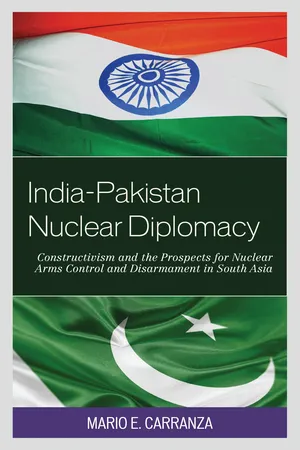
India-Pakistan Nuclear Diplomacy
Constructivism and the Prospects for Nuclear Arms Control and Disarmament in South Asia
- English
- ePUB (mobile friendly)
- Available on iOS & Android
eBook - ePub
India-Pakistan Nuclear Diplomacy
Constructivism and the Prospects for Nuclear Arms Control and Disarmament in South Asia
About this book
Information
Table of contents
- Title Page
- Preface and Acknowledgments
- List of Abbreviations
- List of Tables
- List of Figures
- Maps
- Introduction
- An Impossible Game
- International Relations Theories and Indo-Pakistani Nuclear Relations
- Explaining and Forecasting Nuclear Reversals in South Asia
- A Critique of US Nonproliferation Policy toward South Asia during the Bush and Obama Administrations
- Normalization and the Future of Indo-Pakistani Nuclear Relations
- Conclusion
- References
- Index
- About the Author
Trusted by 375,005 students
Access to over 1.5 million titles for a fair monthly price.
Study more efficiently using our study tools.
Frequently asked questions
Yes, you can cancel anytime from the Subscription tab in your account settings on the Perlego website. Your subscription will stay active until the end of your current billing period. Learn how to cancel your subscription
No, books cannot be downloaded as external files, such as PDFs, for use outside of Perlego. However, you can download books within the Perlego app for offline reading on mobile or tablet. Learn how to download books offline
We are an online textbook subscription service, where you can get access to an entire online library for less than the price of a single book per month. With over 1.5 million books across 990+ topics, we’ve got you covered! Learn about our mission
Look out for the read-aloud symbol on your next book to see if you can listen to it. The read-aloud tool reads text aloud for you, highlighting the text as it is being read. You can pause it, speed it up and slow it down. Learn more about Read Aloud
Yes! You can use the Perlego app on both iOS and Android devices to read anytime, anywhere — even offline. Perfect for commutes or when you’re on the go.
Please note we cannot support devices running on iOS 13 and Android 7 or earlier. Learn more about using the app
Please note we cannot support devices running on iOS 13 and Android 7 or earlier. Learn more about using the app
Yes, you can access India-Pakistan Nuclear Diplomacy by Mario E. Carranza in PDF and/or ePUB format, as well as other popular books in Politics & International Relations & Arms Control. We have over 1.5 million books available in our catalogue for you to explore.