This book argues that post-Keynesian theories of endogenous money can be combined with Marxian analysis in order to give insight into the changing power relations between the state, finance sector and real economy since WW2. A key theme is that financial power, derived from the control of money-issue and its purchasing power, is determined by the state and market in varying proportions (depending on context) but that state sovereignty has been lost in recent decades. In addition, the growth of financial markets in recent decades, so-called financialization, has led many to assume that private finance is an important proximate driver of economic affairs in general. In contrast, the book argues that this provides insufficient explanation of events. To discuss financial factors as causes of financial crisis risks describing the phenomena without illustrating the root causes. Instead, the book argues that systemic drivers of capitalism (rooted in production), probably best understood by Marx, actually do provide a more plausible explanation of the causes of the financialization and erosion of state sovereignty. In addition, the Post-Keynesian descriptions of monetary processes are considered to best reflect the actual reality of the monetary system. This represents an interesting synthesis of the classical Marx with modern money theory. The interpretation of Marx used to explain this financial transformation has been named the Temporal Single System Interpretation, which illustrates Marx's value theory across periods and identifies a tendency towards falling profit rates. It is claimed that falling profits, in turn, are an underlying driver of the systemic propensity towards financialisation, crisis and stagnation. The empirical findings presented, taken from case studies of the UK and Germany, appear to support this view.
The central argument is that the response of agents (including the state) to the profit tendency has been a significant driver of the observed financial transformation. The book then concludes that this synthesis provides a more appropriate explanation of the historical transformation of the financial system since the Great Depression, than much of the financialization literature, and illustrates the source (and operation) of financial power in the modern capitalist state and market.
eBook - ePub
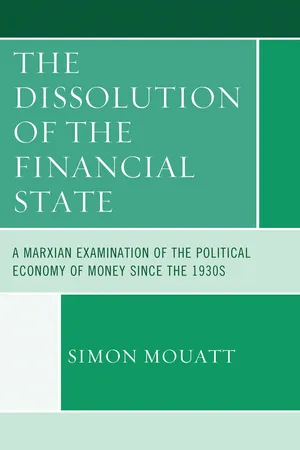
The Dissolution of the Financial State
A Marxian Examination of the Political Economy of Money Since the 1930s
- English
- ePUB (mobile friendly)
- Available on iOS & Android
eBook - ePub
The Dissolution of the Financial State
A Marxian Examination of the Political Economy of Money Since the 1930s
About this book
Information
Table of contents
- Cover-Page
- Half-Title
- Series
- Title
- Copyright
- Contents
- Acknowledgments
- Figures and Tables
- Acronyms and Abbreviations
- Preface
- 1 Market and State
- 2 A Monetary Economy
- 3 The Mainstream View of Money
- 4 Heterodox Monetary Traditions
- 5 Marx’s Political Economy
- 6 Marx and Money
- 7 The Financial State
- 8 The Golden Age of Steam
- 9 German Monetary Policy
- 10 UK Monetary Policy
- 11 Capitalist Development
- 12 Concluding Analysis
- Appendix 1
- Appendix 2
- Appendix 3
- Appendix 4
- References
- Index
- About the Author
Trusted by 375,005 students
Access to over 1.5 million titles for a fair monthly price.
Study more efficiently using our study tools.
Frequently asked questions
Yes, you can cancel anytime from the Subscription tab in your account settings on the Perlego website. Your subscription will stay active until the end of your current billing period. Learn how to cancel your subscription
No, books cannot be downloaded as external files, such as PDFs, for use outside of Perlego. However, you can download books within the Perlego app for offline reading on mobile or tablet. Learn how to download books offline
Perlego offers two plans: Essential and Complete
- Essential is ideal for learners and professionals who enjoy exploring a wide range of subjects. Access the Essential Library with 800,000+ trusted titles and best-sellers across business, personal growth, and the humanities. Includes unlimited reading time and Standard Read Aloud voice.
- Complete: Perfect for advanced learners and researchers needing full, unrestricted access. Unlock 1.5M+ books across hundreds of subjects, including academic and specialized titles. The Complete Plan also includes advanced features like Premium Read Aloud and Research Assistant.
We are an online textbook subscription service, where you can get access to an entire online library for less than the price of a single book per month. With over 1.5 million books across 990+ topics, we’ve got you covered! Learn about our mission
Look out for the read-aloud symbol on your next book to see if you can listen to it. The read-aloud tool reads text aloud for you, highlighting the text as it is being read. You can pause it, speed it up and slow it down. Learn more about Read Aloud
Yes! You can use the Perlego app on both iOS and Android devices to read anytime, anywhere — even offline. Perfect for commutes or when you’re on the go.
Please note we cannot support devices running on iOS 13 and Android 7 or earlier. Learn more about using the app
Please note we cannot support devices running on iOS 13 and Android 7 or earlier. Learn more about using the app
Yes, you can access The Dissolution of the Financial State by Simon Mouatt in PDF and/or ePUB format, as well as other popular books in Economics & Government & Business. We have over 1.5 million books available in our catalogue for you to explore.