There are two oppositional narratives in relation to telling the story of indigenous peoples and minorities in relation to globalization and intellectual property rights. The first, the narrative of Optimism, is a story of the triumphant opening of brave new worlds of commercial integration and cultural inclusion. The second, the narrative of Fear, is a story of the endangerment, mourning, and loss of a traditional culture. While the story of Optimism deploys a rhetoric of commercial mobilization and "innovation," the story of Fear emphasizes the rhetoric of preserving something "pure" and "traditional" that is "dying." Both narratives have compelling rhetorical force, and actually need each other, in order to move their opposing audiences into action. However, as Picart shows, the realities behind these rhetorically framed political parables are more complex than a simple binary.
Hence, the book steers a careful path between hope rather than unbounded Optimism, and caution, rather than Fear, in exploring how law functions in and as culture as it contours the landscape of intellectual property rights, as experienced by indigenous peoples and minorities. Picart uses, among a variety of tools derived from law, critical and cultural studies, anthropology and communication, case studies to illustrate this approach. She tracks the fascinating stories of the controversies surrounding the ownership of a Taiwanese folk song; the struggle over control of the Mapuche's traditional land in Chile against the backdrop of Chile's drive towards modernization; the collaboration between the Kani tribe in India and a multinational corporation to patent an anti-fatigue chemical agent; the drive for respect and recognition by Australian Aboriginal artists for their visual expressions of folklore; and the challenges American women of color such as Josephine Baker and Katherine Dunham faced in relation to the evolving issues of choreography, improvisation and copyright. The book also analyzes the cultural conflicts that result from these encounters between indigenous populations or minorities and majority groups, reflects upon the ways in which these conflicts were negotiated or resolved, both nationally and internationally, and carefully explores proposals to mediate such conflicts.
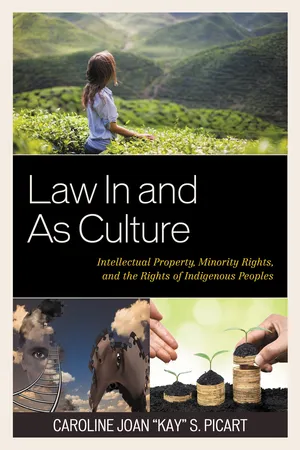
eBook - ePub
Law In and As Culture
Intellectual Property, Minority Rights, and the Rights of Indigenous Peoples
- English
- ePUB (mobile friendly)
- Available on iOS & Android
eBook - ePub
Law In and As Culture
Intellectual Property, Minority Rights, and the Rights of Indigenous Peoples
About this book
Information
Table of contents
- Contents
- Acknowledgments
- Chapter 1: Between Mirroring Master Narratives of Fear and Optimism
- Chapter 2: Law In and As Culture1
- Chapter 3: Cultural Meanings of Intellectual Property1
- Chapter 4: Colonial Appropriations of Marginalized Cultures and Possible Strategies of Resistance1
- Chapter 5: Attempting to Balance First Generation Human Rights and Third Generation Human Rights1
- Bibliography
- About the Author
Trusted by 375,005 students
Access to over 1.5 million titles for a fair monthly price.
Study more efficiently using our study tools.
Frequently asked questions
Yes, you can cancel anytime from the Subscription tab in your account settings on the Perlego website. Your subscription will stay active until the end of your current billing period. Learn how to cancel your subscription
No, books cannot be downloaded as external files, such as PDFs, for use outside of Perlego. However, you can download books within the Perlego app for offline reading on mobile or tablet. Learn how to download books offline
Perlego offers two plans: Essential and Complete
- Essential is ideal for learners and professionals who enjoy exploring a wide range of subjects. Access the Essential Library with 800,000+ trusted titles and best-sellers across business, personal growth, and the humanities. Includes unlimited reading time and Standard Read Aloud voice.
- Complete: Perfect for advanced learners and researchers needing full, unrestricted access. Unlock 1.5M+ books across hundreds of subjects, including academic and specialized titles. The Complete Plan also includes advanced features like Premium Read Aloud and Research Assistant.
We are an online textbook subscription service, where you can get access to an entire online library for less than the price of a single book per month. With over 1.5 million books across 990+ topics, we’ve got you covered! Learn about our mission
Look out for the read-aloud symbol on your next book to see if you can listen to it. The read-aloud tool reads text aloud for you, highlighting the text as it is being read. You can pause it, speed it up and slow it down. Learn more about Read Aloud
Yes! You can use the Perlego app on both iOS and Android devices to read anytime, anywhere — even offline. Perfect for commutes or when you’re on the go.
Please note we cannot support devices running on iOS 13 and Android 7 or earlier. Learn more about using the app
Please note we cannot support devices running on iOS 13 and Android 7 or earlier. Learn more about using the app
Yes, you can access Law In and As Culture by Caroline Joan "Kay" S. Picart in PDF and/or ePUB format, as well as other popular books in Law & Public Law. We have over 1.5 million books available in our catalogue for you to explore.