- English
- ePUB (mobile friendly)
- Available on iOS & Android
eBook - ePub
About this book
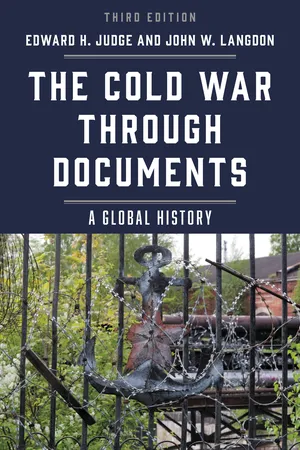
This comprehensive collection of carefully edited documents—speeches, treaties, statements, and articles—traces the rise and fall of the Cold War. The sources follow the Cold War from its roots in East–West tensions at the end of World War II to the collapse of the Soviet Union in 1991. Set in historical context by the editors' concise introductions and followed by thoughtful discussion questions, the documents are arranged in chronological order, starting with the Yalta Conference and ending with Gorbachev's resignation speech. Drawing on selections from a variety of countries and leaders involved in this prolonged global struggle, the editors treat the entire Cold War as an era in world history, not just U.S. history. Their judicious selection makes the great events of the time come alive through the words and phrases of those who were actively involved.
Information
Table of contents
- Contents
- Part I: The Origins of the Cold War, 1945–1950
- 1: The Yalta Conference, February 1945
- 2: The Potsdam Conference, July–August 1945
- 3: The Atomic Bombing of Hiroshima, August 1945
- 4: Ho Chi Minh’s Declaration of Independence for Vietnam, 2 September 1945
- 5: Stalin’s Election Speech, February 1946
- 6: Churchill’s Iron Curtain Speech, March 1946
- 7: The Baruch and Gromyko Plans for Control of Atomic Weapons, 1946
- 8: The Truman Doctrine, 1947
- 9: The Marshall Plan, 1947
- 10: George F. Kennan, “The Sources of Soviet Conduct,” 1947
- 11: The Rio Treaty, September 1947
- 12: Zhdanov and the Cominform on the Imperialist and Anti-Imperialist Camps, 1947
- 13: The Communist Coup in Czechoslovakia, February 1948
- 14: The Treaty of Brussels, 1948
- 15: The Expulsion of Tito from the Communist Bloc, 1948
- 16: The Berlin Blockade, 1948–1949
- 17: The NATO Alliance, 1949
- 18: Acheson on the Communist Triumph in China, 1949
- 19: Mao Proclaims the People’s Republic of China, 1 October 1949
- 20: The Soviet-Chinese Friendship Treaty, February 1950
- Part II: The Global Confrontation, 1950–1960
- 21: McCarthy on “Communists” in the US Government, 1950
- 22: Acheson on the American Defense Perimeter in Asia, 1950
- 23: NSC-68: American Cold War Strategy, 1950
- 24: The Korean War, 1950–1953
- 25: Dulles on “Massive Retaliation,” 1954
- 26: The Geneva Accords Regarding Indochina, 1954
- 27: The SEATO Alliance, 1954
- 28: The Bandung Asian-African Conference, 1955
- 29: The Warsaw Pact, 1955
- 30: Khrushchev on Peaceful Coexistence, 1956
- 31: Khrushchev’s Secret Speech on Stalin and His Crimes, 1956
- 32: The Hungarian Rebellion, 1956
- 33: The Suez Crisis, 1956
- 34: The Eisenhower Doctrine, 1957
- 35: Europe’s Common Market: The Treaty of Rome, 1957
- 36: China’s “Great Leap Forward,” 1958–1960
- 37: Harold Macmillan’s “Wind of Change” Speech, 1960
- 38: The U-2 Affair and Collapse of the Paris Summit, May 1960
- 39; The Congo Crisis, 1960
- 40: Castro on the Cuban Revolution, 1960
- Part III: Crisis and Conflict, 1961–1969
- 41: Khrushchev on “Wars of National Liberation,” January 1961
- 42: Kwame Nkrumah on the Need for African Unity, 1961
- 43: Eisenhower’s Farewell Address on the Military-Industrial Complex, 17 January 1961
- 44: Kennedy’s Inaugural Address, 1961
- 45: The Berlin Crisis, 1961
- 46: The Cuban Missile Crisis, October 1962
- 47: Kennedy’s “Peace Speech” at American University, June 1963
- 48: Kennedy’s Berlin Speech, June 1963: “Ich Bin Ein Berliner”
- 49: The Nuclear Test Ban Treaty, August 1963
- 50: The Sino-Soviet Split, 1960–1964
- 51: The Gulf of Tonkin Resolution, 1964
- 52: Lin Biao, “Long Live the Victory of People’s War,” 1965
- 53: Lyndon Johnson and the Vietnam War, 1965–1968
- 54: China’s Great Proletarian Cultural Revolution, 1966–1969
- 55: The Nuclear Non-Proliferation Treaty, July 1968
- 56: The Soviet Invasion of Czechoslovakia, August 1968
- 57: The Brezhnev Doctrine, 1968
- 58: The Soviet-Chinese Border Conflict, 1969
- 59: The Nixon Doctrine, 1969
- Part IV: The Era of Détente: 1969–1979
- 60: Salvador Allende’s Freely Elected Marxist Government in Chile, 1970–1973
- 61: The Berlin Accords, September 1971
- 62: Nixon’s China Visit: The Shanghai Communiqué, February 1972
- 63: The ABM Treaty and SALT I, 1972
- 64: The US Withdrawal from Vietnam, January 1973
- 65: The October War in the Middle East, 1973
- 66: Deng Xiaoping’s “Three Worlds” Speech, April 1974
- 67: The Vladivostok Summit, 1974
- 68: The Helsinki Final Act, 1975
- 69: The Cambodian Genocide, 1975–1979
- 70: Carter on Human Rights, 1977
- 71: Peace between Egypt and Israel, 1977–1979
- 72: The Normalization of US-Chinese Relations, 1978–1979
- 73: The SALT II Agreement, 1979
- Part V: The Renewal of the Cold War, 1979–1985
- 74: The Creation of an Islamic Republic in Iran, 1979
- 75: The Euromissile Controversy, 1979
- 76: The Soviet Invasion of Afghanistan, December 1979
- 77: The Carter Doctrine, January 1980
- 78: Reagan’s Anti-Soviet Rhetoric, 1981–1983
- 79: Reagan’s Arms Control Proposals, November 1981
- 80: The Polish Imposition of Martial Law, December 1981
- 81: Andropov’s Peace Offensive, 1982
- 82: Reagan’s “Star Wars” Speech, 1983
- 83: The Nuclear Freeze Resolution, 1983
- 84: The KAL 007 Incident, 1983
- Part VI: The End of the Cold War, 1985–1991
- 85: The Geneva Summit, 1985
- 86: The Reykjavik Summit, 1986
- 87: Reagan’s 1987 Berlin Speech: “Tear Down This Wall”
- 88: The INF Treaty, December 1987
- 89: The Soviet Withdrawal from Afghanistan, 1988–1989
- 90: Gorbachev’s UN Address, December 1988
- 91: The Tiananmen Square Massacre, June 1989
- 92: The Opening of the Berlin Wall, November 1989
- 93: NATO’s London Declaration on the End of the Cold War, July 1990
- 94: The Kohl-Gorbachev Agreement on German Unification, July 1990
- 95: The Strategic Arms Reduction Treaty (START), July 1991
- 96: The Attempted Coup in the USSR, August 1991
- 97: Gorbachev’s Resignation Speech, December 1991
Trusted by 375,005 students
Access to over 1.5 million titles for a fair monthly price.
Study more efficiently using our study tools.
Frequently asked questions
Yes, you can cancel anytime from the Subscription tab in your account settings on the Perlego website. Your subscription will stay active until the end of your current billing period. Learn how to cancel your subscription
No, books cannot be downloaded as external files, such as PDFs, for use outside of Perlego. However, you can download books within the Perlego app for offline reading on mobile or tablet. Learn how to download books offline
We are an online textbook subscription service, where you can get access to an entire online library for less than the price of a single book per month. With over 1.5 million books across 990+ topics, we’ve got you covered! Learn about our mission
Look out for the read-aloud symbol on your next book to see if you can listen to it. The read-aloud tool reads text aloud for you, highlighting the text as it is being read. You can pause it, speed it up and slow it down. Learn more about Read Aloud
Yes! You can use the Perlego app on both iOS and Android devices to read anytime, anywhere — even offline. Perfect for commutes or when you’re on the go.
Please note we cannot support devices running on iOS 13 and Android 7 or earlier. Learn more about using the app
Please note we cannot support devices running on iOS 13 and Android 7 or earlier. Learn more about using the app
Yes, you can access The Cold War through Documents by Edward H. Judge,John W. Langdon in PDF and/or ePUB format, as well as other popular books in History & 20th Century History. We have over 1.5 million books available in our catalogue for you to explore.