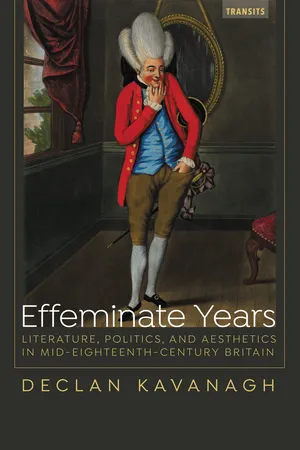
Effeminate Years: Literature, Politics, and Aesthetics in Mid-Eighteenth-Century Britain investigates the gendered, eroticized, and xenophobic ways in which the controversies in the 1760s surrounding the political figure John Wilkes (1725-97) legitimated some men as political subjects, while forcefully excluding others on the basis of their perceived effeminacy or foreignness. However, this book is not a literary analysis of the Wilkes affair in the 1760s, nor is it a linear account of Wilkes's political career. Instead, Effeminate Years examines the cultural crisis of effeminacy that made Wilkes's politicking so appealing. The central theoretical problem that this study addresses is the argument about what is and is not political: where does individual autonomy begin and end? Addressing this question, Kavanagh traces the shaping influence of the discourse of effeminacy in the literature that was generated by Wilkes's legal and sexual scandals, while, at the same time, he also reads Wilkes's spectacular drumming up of support as a timely exploitation of the broader cultural crisis of effeminacy during the mid century in Britain.
The book begins with the scandals and agitations surrounding Wilkes, and ends with readings of Edmund Burke's (1729-1797) earliest political writings, which envisage political community—a vision, that Kavanagh argues, is influenced by Wilkes and the effeminate years of the 1760s. Throughout, Kavanagh shows how interlocutors in the political and cultural debates of the mid-eighteenth-century period in Britain, such as Tobias Smollett (1721-1771) and Arthur Murphy (1727-1805), attempt to resolve the problem of effeminate excess. In part, the resolution for Wilkes and Charles Churchill (1731-1764) was to shunt effeminacy onto the sexually non-normative. On the other hand, Burke, in his aesthetic theorization of the beautiful privileges the socially constitutive affects of feeling effeminate. Through an analysis of poetry, fiction, social and economic pamphlets, aesthetic treatises, journalism and correspondences, placed within the latest queer historiography, Kavanagh demonstrates that the mid-century effeminacy crisis served to re-conceive male heterosexuality as the very mark of political legitimacy. Overall, Effeminate Years explores the development of modern ideas of masculinity and the political subject, which are still the basis of debate and argument in our own time.
eBook - ePub
Effeminate Years
Literature, Politics, and Aesthetics in Mid-Eighteenth-Century Britain
- English
- ePUB (mobile friendly)
- Available on iOS & Android
eBook - ePub
Effeminate Years
Literature, Politics, and Aesthetics in Mid-Eighteenth-Century Britain
About this book
Information
Table of contents
- Contents
- Acknowledgments
- Introduction
- Chapter 1: “Hercules, Turn’d Beau”: Charles Churchill’s Satire
- Chapter 2: Enlightenment Closets: Publishing Privacy
- Chapter 3: Mobocracy: Public Opinion and the Free Press
- Chapter 4: Bog Men: Celtic Landscapes during the Seven Years’ War
- Chapter 5: Effeminate Aesthetics and Backstairs Politics
- Coda
- Bibliography
- About the Author
Trusted by 375,005 students
Access to over 1.5 million titles for a fair monthly price.
Study more efficiently using our study tools.
Frequently asked questions
Yes, you can cancel anytime from the Subscription tab in your account settings on the Perlego website. Your subscription will stay active until the end of your current billing period. Learn how to cancel your subscription
No, books cannot be downloaded as external files, such as PDFs, for use outside of Perlego. However, you can download books within the Perlego app for offline reading on mobile or tablet. Learn how to download books offline
We are an online textbook subscription service, where you can get access to an entire online library for less than the price of a single book per month. With over 1.5 million books across 990+ topics, we’ve got you covered! Learn about our mission
Look out for the read-aloud symbol on your next book to see if you can listen to it. The read-aloud tool reads text aloud for you, highlighting the text as it is being read. You can pause it, speed it up and slow it down. Learn more about Read Aloud
Yes! You can use the Perlego app on both iOS and Android devices to read anytime, anywhere — even offline. Perfect for commutes or when you’re on the go.
Please note we cannot support devices running on iOS 13 and Android 7 or earlier. Learn more about using the app
Please note we cannot support devices running on iOS 13 and Android 7 or earlier. Learn more about using the app
Yes, you can access Effeminate Years by Declan Kavanagh in PDF and/or ePUB format, as well as other popular books in Literature & English Literary Criticism. We have over 1.5 million books available in our catalogue for you to explore.