In a period when the monarch was the key figure in the Portuguese government, the struggle for the throne among members of the royal family was of crucial significance. Against a backdrop of new liberal ideas, economic conservatism, and modernization, Dom Pedro challenged his brother, Dom Miguel (the Usurper), on behalf of his young daughter (Maria II) for the throne. But this struggle for the throne, and for a workable constitution, did little to change the fundamentally agrarian economy, so that in the end neither the monarch, nor the liberal ideals of the urban elite, nor foreign pressures had any fundamental effect on society as a whole.
The Concession of Évora Monte describes the economic and political problems unleashed by the Peninsular War and the evacuation of the court to Brazil; the 1820 revolution, the first Portuguese constitution, and the counter revolution; the attempt by Dom Pedro when he became king (while also emperor of Brazil) to introduce the new Constitutional Charter and pass the throne on to his young daughter; the usurpation of the throne by his brother Dom Miguel; the War of the Two Brothers in which Dom Pedro defeated Dom Miguel and forced him into exile. The signing of the Concession in 1834 marked the end of the civil war, but it did not bring peace and stability. The changes introduced by the victorious Dom Pedro did not solve the basic issues of Portuguese society, nor did the efforts of his daughter, Maria II, during the 1830s and the 1840s. Several attempts were made to impose a new liberal constitution on the country, but in the end it was the formation after 1850 of new political parties sharing the governing which brought stability. The country remained conservative despite the modernization which came to the cities but which penetrated the countryside only to a degree.
This book argues that liberalism in Portugal was an urban phenomenon involving a very small minority of the people, and points to a variety of reasons for this. Portugal remained a rural, conservative society into the twentieth century and throughout the Salazar regimes until, perhaps, the Carnation Revolution in 1974.
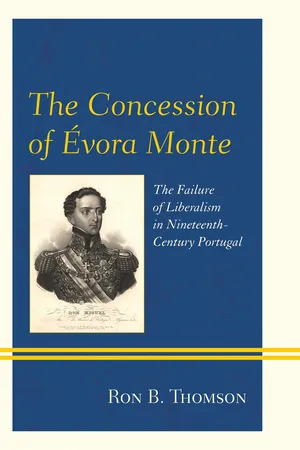
eBook - ePub
The Concession of Évora Monte
The Failure of Liberalism in Nineteenth-Century Portugal
- English
- ePUB (mobile friendly)
- Available on iOS & Android
eBook - ePub
The Concession of Évora Monte
The Failure of Liberalism in Nineteenth-Century Portugal
About this book
Information
Table of contents
- Illustrations and Maps
- Introduction: The Concession of Évora Monte
- The Houses of Bragança and Bragança-Saxe-Coburg
- Part One: The War of the Two Brothers
- Part Two: The Concession of Évora Monte
- Part Three: An Unstable Peace
- Appendix 1. The Constitutions of Portugal
- Appendix 2. The Descendants of Dom Miguel
- Appendix 3. Ranald MacDonell
- Bibliography
Trusted by 375,005 students
Access to over 1.5 million titles for a fair monthly price.
Study more efficiently using our study tools.
Frequently asked questions
Yes, you can cancel anytime from the Subscription tab in your account settings on the Perlego website. Your subscription will stay active until the end of your current billing period. Learn how to cancel your subscription
No, books cannot be downloaded as external files, such as PDFs, for use outside of Perlego. However, you can download books within the Perlego app for offline reading on mobile or tablet. Learn how to download books offline
Perlego offers two plans: Essential and Complete
- Essential is ideal for learners and professionals who enjoy exploring a wide range of subjects. Access the Essential Library with 800,000+ trusted titles and best-sellers across business, personal growth, and the humanities. Includes unlimited reading time and Standard Read Aloud voice.
- Complete: Perfect for advanced learners and researchers needing full, unrestricted access. Unlock 1.5M+ books across hundreds of subjects, including academic and specialized titles. The Complete Plan also includes advanced features like Premium Read Aloud and Research Assistant.
We are an online textbook subscription service, where you can get access to an entire online library for less than the price of a single book per month. With over 1.5 million books across 990+ topics, we’ve got you covered! Learn about our mission
Look out for the read-aloud symbol on your next book to see if you can listen to it. The read-aloud tool reads text aloud for you, highlighting the text as it is being read. You can pause it, speed it up and slow it down. Learn more about Read Aloud
Yes! You can use the Perlego app on both iOS and Android devices to read anytime, anywhere — even offline. Perfect for commutes or when you’re on the go.
Please note we cannot support devices running on iOS 13 and Android 7 or earlier. Learn more about using the app
Please note we cannot support devices running on iOS 13 and Android 7 or earlier. Learn more about using the app
Yes, you can access The Concession of Évora Monte by Ron B. Thomson in PDF and/or ePUB format, as well as other popular books in History & 19th Century History. We have over 1.5 million books available in our catalogue for you to explore.