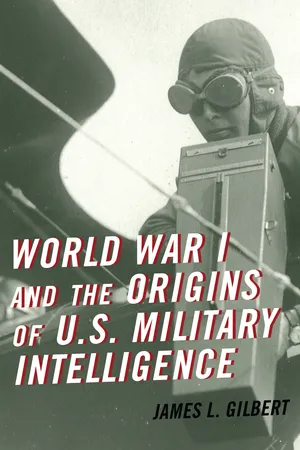
In World War I and the Origins of U.S. Military Intelligence, military historian James L. Gilbert provides an authoritative overview of the birth of modern Army intelligence. Following the natural division of the intelligence war, which was fought on both the home front and overseas, Gilbert traces the development and use of intelligence and counterintelligence through the eyes of their principal architects: General Dennis E. Nolan and Colonel Ralph Van Deman.
Gilbert explores how on the home front, US Army counterintelligence faced both internal and external threats that began with the Army's growing concerns over the loyalty of resident aliens who were being drafted into the ranks and soon evolved into the rooting out of enemy saboteurs and spies intent on doing great harm to America's war effort. To achieve their goals, counterintelligence personnel relied upon major strides in the areas of code breaking and detection of secret inks. Overseas, the intelligence effort proved far more extensive in terms of resources and missions, even reaching into nearby neutral countries. Intelligence within the American Expeditionary Forces was heavily indebted to its Allied counterparts who not only provided an organizational blueprint but also veteran instructors and equipment needed to train newly arriving intelligence specialists. Rapid advances by American intelligence were also made possible by the appointment of competent leaders and the recruitment of highly motivated and skilled personnel; likewise, the Army's decision to assign the bulk of its linguists to support intelligence proved critical. World War I would witness the linkage between intelligence and emerging technologies—from the use of cameras in aircraft to the intercept of enemy radio transmissions. Equally significant was the introduction of new intelligence disciplines—from exploitation of captured equipment to the translation of enemy documents. These and other functions that emerged from World War I would continue to the present to provide military intelligence with the essential tools necessary to support the Army and the nation.
World War I and the Origins of U.S. Military Intelligence is ideal not only for students and scholars of military history and World War I, but will also appeal to any reader interested in how modern intelligence operations first evolved.
- English
- ePUB (mobile friendly)
- Available on iOS & Android
eBook - ePub
World War I and the Origins of U.S. Military Intelligence
About this book
Information
Table of contents
- Contents
- Foreword
- Preface
- Chapter 1: Steps to War
- Chapter 2: America Enters the War
- Chapter 3: Intelligence and the AEF
- Chapter 4: Securing the Home Front
- Chapter 5: Tested under Fire
- Chapter 6: Coming to a Close
- Chapter 7: The Aftermath
- Appendix A: Military Intelligence Division in the War Department
- Appendix B: Radio-Tractor Units
- Appendix C: G2 Organization at GHQ
- Appendix D: First Army Observation/Photo Air Service, November 1918
- Appendix E: First Army Signals Intelligence Stations, November 1918
- Appendix F: First Army Security Service Monitoring Stations, November 1918
- Bibliography
- About the Author
Trusted by 375,005 students
Access to over 1.5 million titles for a fair monthly price.
Study more efficiently using our study tools.
Frequently asked questions
Yes, you can cancel anytime from the Subscription tab in your account settings on the Perlego website. Your subscription will stay active until the end of your current billing period. Learn how to cancel your subscription
No, books cannot be downloaded as external files, such as PDFs, for use outside of Perlego. However, you can download books within the Perlego app for offline reading on mobile or tablet. Learn how to download books offline
Perlego offers two plans: Essential and Complete
- Essential is ideal for learners and professionals who enjoy exploring a wide range of subjects. Access the Essential Library with 800,000+ trusted titles and best-sellers across business, personal growth, and the humanities. Includes unlimited reading time and Standard Read Aloud voice.
- Complete: Perfect for advanced learners and researchers needing full, unrestricted access. Unlock 1.5M+ books across hundreds of subjects, including academic and specialized titles. The Complete Plan also includes advanced features like Premium Read Aloud and Research Assistant.
We are an online textbook subscription service, where you can get access to an entire online library for less than the price of a single book per month. With over 1.5 million books across 990+ topics, we’ve got you covered! Learn about our mission
Look out for the read-aloud symbol on your next book to see if you can listen to it. The read-aloud tool reads text aloud for you, highlighting the text as it is being read. You can pause it, speed it up and slow it down. Learn more about Read Aloud
Yes! You can use the Perlego app on both iOS and Android devices to read anytime, anywhere — even offline. Perfect for commutes or when you’re on the go.
Please note we cannot support devices running on iOS 13 and Android 7 or earlier. Learn more about using the app
Please note we cannot support devices running on iOS 13 and Android 7 or earlier. Learn more about using the app
Yes, you can access World War I and the Origins of U.S. Military Intelligence by James L. Gilbert in PDF and/or ePUB format, as well as other popular books in History & Military & Maritime History. We have over 1.5 million books available in our catalogue for you to explore.