The book develops a new approach to, and a distinct reading of, the contemporary memorial-building boom which began in the 1980s.
Locating the origins of this boom in the crises associated with postmodernity and the rise of neoliberalism, it analyses the complex interplay between neoliberalism, postmodernism and nationalism in some of the most well-known memorials and memorial-museums to have emerged in the USA and Germany over the last four decades.
Rather than offering a survey of contemporary memorials, it traces a specific trajectory (and certainly not the only one ripe for analysis): from the postmodern memorials of the 1980s to the increasingly monumental and authoritative memorials and memorial-museums being constructed today.
Developing a distinct interdisciplinary approach, the book offers a critical analysis of the relationship between the memorials' form, the "visitor experience" they're intended to offer. and the understanding of history and our relation to it which underpins their philosophical, ethical and political stance. Questioning the notion that contemporary memorials are ambiguous, non-ideological and non-nationalistic, the book argues that they are engaged in rearticulating nationalism in line with the contradictory demands of the current conjuncture.
As well as critically analysing the political function of national memorials, the book is equally concerned with interrogating the aesthetic means they employ, with a specific focus on the way in which they mobilise the power of the sublime to generate particular affective responses. The book argues that contemporary national memorials reflect one of the most significant convergences between postmodern thought and neoliberal ideology – both project a permanent present, urging us to recreate ourselves in the light of existing conditions, for "there is no alternative".
- English
- ePUB (mobile friendly)
- Available on iOS & Android
eBook - ePub
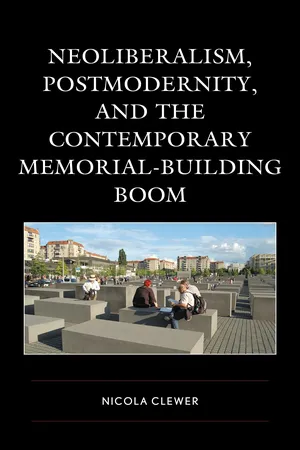
Neoliberalism, Postmodernity, and the Contemporary Memorial-Building Boom
About this book
Information
Table of contents
- List of Illustrations
- Acknowledgements
- Introduction
- 1 The Postmodern-Neoliberal Conjuncture
- 2 Memorialising in Postmodernity: The Vietnam Veterans Memorial
- 3 Representing the Holocaust: From the ‘After-Auschwitz’ Aporia through the ‘Holocaust Sublime’ to New Forms of ‘Knowing’
- 4 Memorialising in Postmodernity: The German Counter-Monuments
- 5 The Memorial-Museum, Trauma Architecture and the Sublime Authority of Affect
- 6 The Memorial to the Murdered Jews of Europe, the ‘End of History’ and the Holocaust Sublime
- 7 The National September 11 Memorial & Museum: Trauma, Commerce and Patriotism at the New World Trade Center
- Final Reflections
- Bibliography
- About the Author
Trusted by 375,005 students
Access to over 1.5 million titles for a fair monthly price.
Study more efficiently using our study tools.
Frequently asked questions
Yes, you can cancel anytime from the Subscription tab in your account settings on the Perlego website. Your subscription will stay active until the end of your current billing period. Learn how to cancel your subscription
No, books cannot be downloaded as external files, such as PDFs, for use outside of Perlego. However, you can download books within the Perlego app for offline reading on mobile or tablet. Learn how to download books offline
Perlego offers two plans: Essential and Complete
- Essential is ideal for learners and professionals who enjoy exploring a wide range of subjects. Access the Essential Library with 800,000+ trusted titles and best-sellers across business, personal growth, and the humanities. Includes unlimited reading time and Standard Read Aloud voice.
- Complete: Perfect for advanced learners and researchers needing full, unrestricted access. Unlock 1.5M+ books across hundreds of subjects, including academic and specialized titles. The Complete Plan also includes advanced features like Premium Read Aloud and Research Assistant.
We are an online textbook subscription service, where you can get access to an entire online library for less than the price of a single book per month. With over 1.5 million books across 990+ topics, we’ve got you covered! Learn about our mission
Look out for the read-aloud symbol on your next book to see if you can listen to it. The read-aloud tool reads text aloud for you, highlighting the text as it is being read. You can pause it, speed it up and slow it down. Learn more about Read Aloud
Yes! You can use the Perlego app on both iOS and Android devices to read anytime, anywhere — even offline. Perfect for commutes or when you’re on the go.
Please note we cannot support devices running on iOS 13 and Android 7 or earlier. Learn more about using the app
Please note we cannot support devices running on iOS 13 and Android 7 or earlier. Learn more about using the app
Yes, you can access Neoliberalism, Postmodernity, and the Contemporary Memorial-Building Boom by Nicola Clewer in PDF and/or ePUB format, as well as other popular books in Social Sciences & Urban Sociology. We have over 1.5 million books available in our catalogue for you to explore.