- English
- ePUB (mobile friendly)
- Available on iOS & Android
About this book
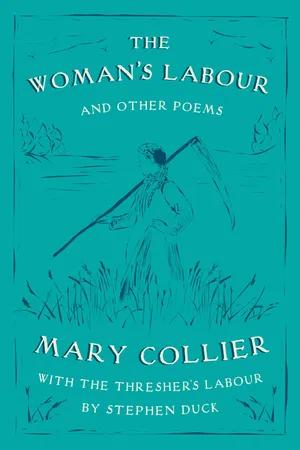
Eighteenth-century poetry was dominated by men of education and wealth, and bookcases sagged under the weight of volumes by Swift, Johnson and Pope. When Stephen Duck's The Thresher's Labour was published in 1730, however, it was a sensation â highlighting the plight of the working class in verse was hereto simply unthought of.Â
Duck's poem came to the attention of Mary Collier, a washerwoman working in Hampshire, who was astounded to read Duck's dismissal of women as work-shy layabouts who indulged in 'noisy prattle', and she penned a stinging riposte, The Woman's Labour, which reframed Duck's relation of harvest-time toil from a woman's perspective.
This edition of The Woman's Labour seeks to give a wider view of the conversation, and includes The Thresher's Labour, 'The Three Wise Sentences' (which Collier included in the first publication of her reply), 'An Epistolary Answer to an Exciseman Who Doubted Her Being the Author' and the elegy she wrote for Stephen Duck after he died.
Frequently asked questions
- Essential is ideal for learners and professionals who enjoy exploring a wide range of subjects. Access the Essential Library with 800,000+ trusted titles and best-sellers across business, personal growth, and the humanities. Includes unlimited reading time and Standard Read Aloud voice.
- Complete: Perfect for advanced learners and researchers needing full, unrestricted access. Unlock 1.4M+ books across hundreds of subjects, including academic and specialized titles. The Complete Plan also includes advanced features like Premium Read Aloud and Research Assistant.
Please note we cannot support devices running on iOS 13 and Android 7 or earlier. Learn more about using the app.
Information
Table of contents
- the womanâs labour
- advertisement
- the womanâs labour
- the three wise sentences
- the thresherâs labour
- an elegy upon stephen duck
- an epistolary answer
- note on the texts
- notes