A comparative analysis of Islamist groups' ideological positioning toward nation-state, secularism, and democracy across different countries in the MENA region.
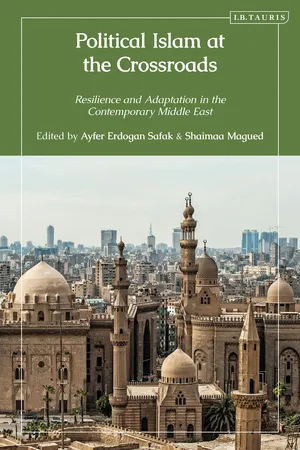
Authoritarian reassertion following the Arab uprisings in the Middle East has restrained Islamists' political participation and challenged their survival as both opposition groups and rulers. In light of national sociopolitical variations across the region, this book explores Islamists' means of adaptation and resilience in the face of this political exclusion, unpacking Islamists' sociopolitical persistence and ideological sustainability.
In doing so this book sheds light on the following questions: How did Islamists adapt to contextual restrictions in terms of repression and stigmatization? How did the Arab uprisings impact their internal debates, ideological revisions, and reconsideration of tools of action? Individual chapters explore similarities and divergences among Islamist groups and parties in terms of ideological affiliations, means of survival and political participation strategies, drawing on comparative cases from across the MENA region. Examples include the Muslim Brotherhood in Egypt, Al-Nahda in Tunisia, the AKP (Justice and Development Party) in Turkey, Hezbollah in Lebanon, Hamas in Palestine, and the Islamic State in Syria and Iraq. These studies engage critically with conceptual debates related to Islamism, post-Islamism, Jihadist Islam, and the Islamic nation/community (ummah) to determine the trajectory of political Islam in the MENA.
eBook - ePub
Political Islam at the Crossroads
Resilience and Adaptation in the Contemporary Middle East
- English
- ePUB (mobile friendly)
- Available on iOS & Android
eBook - ePub
Political Islam at the Crossroads
Resilience and Adaptation in the Contemporary Middle East
About this book
Information
Table of contents
- Cover
- Halftitle Page
- Dedication Page
- Title Page
- Contents
- List of Contributors
- Preface
- Introduction
- 1 Bending to the Wind: The Coping Strategies Adopted by the Islamist Political Movements in the Post-2013 Arab World
- 2 The Prospects of Political Islam in the Arab and Islamicate World(s) in the Post–Arab Spring Era
- 3 Beyond Islamism: A Comparative Analysis of Post-Islamist Trajectories in Turkey and Tunisia
- 4 Transformation of Political Islam in the Hashemite Kingdom of Jordan following the Arab Uprisings: Old Islamism vs. Post-Islamism
- 5 A Stalled Change Process: The Case of Ennahda Party in Tunisia a Decade after the Arab Uprisings (2011–2021)
- 6 Ennahda Conceptualizing “Tunisianité” during 2014 Constitution Drafting
- 7 Hamas: Doing Islamism under Blockade
- 8 A Multi-Level Analysis of the Persistence of Transnational Radical Islamism: ISIS in the Aftermath of the Arab Uprisings
- 9 Between Factionalism and Reconfigurations: Egypt’s Muslim Brotherhood in the Aftermath of 2013
- 10 Grievances and Fears in Democratization: The Catalysts for Change in Hamas and Hezbollah Post–Arab Spring
- Conclusion
- Index
- Imprint
Trusted by 375,005 students
Access to over 1.5 million titles for a fair monthly price.
Study more efficiently using our study tools.
Frequently asked questions
Yes, you can cancel anytime from the Subscription tab in your account settings on the Perlego website. Your subscription will stay active until the end of your current billing period. Learn how to cancel your subscription
No, books cannot be downloaded as external files, such as PDFs, for use outside of Perlego. However, you can download books within the Perlego app for offline reading on mobile or tablet. Learn how to download books offline
Perlego offers two plans: Essential and Complete
- Essential is ideal for learners and professionals who enjoy exploring a wide range of subjects. Access the Essential Library with 800,000+ trusted titles and best-sellers across business, personal growth, and the humanities. Includes unlimited reading time and Standard Read Aloud voice.
- Complete: Perfect for advanced learners and researchers needing full, unrestricted access. Unlock 1.5M+ books across hundreds of subjects, including academic and specialized titles. The Complete Plan also includes advanced features like Premium Read Aloud and Research Assistant.
We are an online textbook subscription service, where you can get access to an entire online library for less than the price of a single book per month. With over 1.5 million books across 990+ topics, we’ve got you covered! Learn about our mission
Look out for the read-aloud symbol on your next book to see if you can listen to it. The read-aloud tool reads text aloud for you, highlighting the text as it is being read. You can pause it, speed it up and slow it down. Learn more about Read Aloud
Yes! You can use the Perlego app on both iOS and Android devices to read anytime, anywhere — even offline. Perfect for commutes or when you’re on the go.
Please note we cannot support devices running on iOS 13 and Android 7 or earlier. Learn more about using the app
Please note we cannot support devices running on iOS 13 and Android 7 or earlier. Learn more about using the app
Yes, you can access Political Islam at the Crossroads by Ayfer Erdogan,Shaimaa Magued in PDF and/or ePUB format, as well as other popular books in Politics & International Relations & Middle Eastern Politics. We have over 1.5 million books available in our catalogue for you to explore.