The literature on the Belt and Road Initiative (BRI) points out either its negative or positive impacts on global and domestic governance. However, such a dichotomy is too simplistic, not least because it tells us little about the complexity of change in the nature of the BRI as it is implemented. This book argues that the BRI manifests an intricate dynamic comprising two contradictory tendencies: Xi Jinping's top-down and centralised approach to policymaking, with its focus on producing robust Chinese actors who can succeed in a competitive global economy; and a fragmented and decentralised reality made up of an expanding range of actors engaged in realising myriad BRI projects on the ground. The co-existence of these two contradictory tendencies implies that the BRI has a multidimensional impact on global and domestic governance in general, and on the role of Japan in countries where BRI projects take place. Japan matters because of its 'in-between' position between non-Western donors and the Development Assistance Committee of the Organisation for Economic Co-operation and Development, a position that offers a unique dimension to a frequently dichotomous discussion of the BRI. Globally, China's promotion of the BRI has strengthened an aspect of global governance, the 'open economy', while at the same time fostering the Chinese nuance of a 'planned economy'. Domestically, a Chinese-style approach to state management and investment without political conditions may set back democratisation efforts in emerging countries, but the BRI has also given rise to a renewed sense of democracy in those countries. These multidimensional impacts enable China and Japan to find an on-the-ground complementarity in their approaches to development aid in relation to future cooperation.
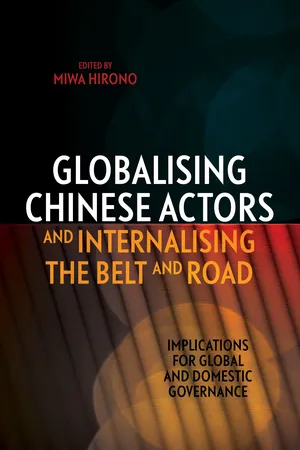
eBook - PDF
Globalising Chinese Actors and Internalising the Belt and Road
Implications for Global and Domestic Governance
- 258 pages
- English
- PDF
- Available on iOS & Android
eBook - PDF
Globalising Chinese Actors and Internalising the Belt and Road
Implications for Global and Domestic Governance
About this book
Information
Table of contents
- List of illustrations
- List of contributors
- Acknowledgements
- Abbreviations
- 1. Introduction: The Belt and Road Initiative from bottom-up perspectives
- Part I: The challenges of the BRI—Implications for global and domestic governance and Japan
- Part II: Internalising the BRI projects in emerging countries
- Part III: Conclusion
- Index
Trusted by 375,005 students
Access to over 1.5 million titles for a fair monthly price.
Study more efficiently using our study tools.
Frequently asked questions
Yes, you can cancel anytime from the Subscription tab in your account settings on the Perlego website. Your subscription will stay active until the end of your current billing period. Learn how to cancel your subscription
No, books cannot be downloaded as external files, such as PDFs, for use outside of Perlego. However, you can download books within the Perlego app for offline reading on mobile or tablet. Learn how to download books offline
Perlego offers two plans: Essential and Complete
- Essential is ideal for learners and professionals who enjoy exploring a wide range of subjects. Access the Essential Library with 800,000+ trusted titles and best-sellers across business, personal growth, and the humanities. Includes unlimited reading time and Standard Read Aloud voice.
- Complete: Perfect for advanced learners and researchers needing full, unrestricted access. Unlock 1.5M+ books across hundreds of subjects, including academic and specialized titles. The Complete Plan also includes advanced features like Premium Read Aloud and Research Assistant.
We are an online textbook subscription service, where you can get access to an entire online library for less than the price of a single book per month. With over 1.5 million books across 990+ topics, we’ve got you covered! Learn about our mission
Look out for the read-aloud symbol on your next book to see if you can listen to it. The read-aloud tool reads text aloud for you, highlighting the text as it is being read. You can pause it, speed it up and slow it down. Learn more about Read Aloud
Yes! You can use the Perlego app on both iOS and Android devices to read anytime, anywhere — even offline. Perfect for commutes or when you’re on the go.
Please note we cannot support devices running on iOS 13 and Android 7 or earlier. Learn more about using the app
Please note we cannot support devices running on iOS 13 and Android 7 or earlier. Learn more about using the app
Yes, you can access Globalising Chinese Actors and Internalising the Belt and Road by Miwa Hirono in PDF and/or ePUB format, as well as other popular books in Politics & International Relations & International Relations. We have over 1.5 million books available in our catalogue for you to explore.