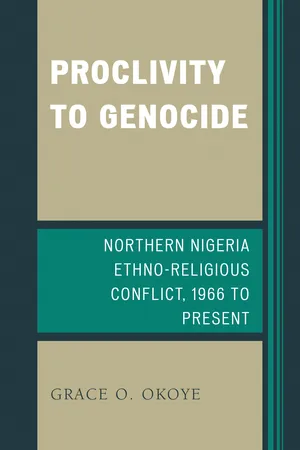
This book examines proclivity to genocide in the protracted killings that have continued for decades in the northern Nigeria ethno-religious conflict, spanning from the 1966 northern Nigeria massacres of thousands of Ibos up to the present, ongoing killings between extremist Muslims and Christians or non-Muslims in the region. It explores the ethnic and religious dimensions of the conflict over five phases to investigate genocidal proclivity to the killings and the extent to which religion foments and escalates the conflict.
This book adopts a conceptual analytic approach of establishing similarity of genocidal patterns to the northern Nigeria ethno-religious conflict by examining genocidal occurrences and massacres in history, particularly the twentieth-century contemporary genocides, for an understanding of genocide. With this reference frame, the study structures a Genocide Proclivity Model for identifying inclinations to genocide and derives a substantive theory using the Strauss and Corbin (1990) approach.
By identifying genocidal intent as underlying the various manifestations and causes of genocide in specific genocide cases, the book establishes that genocidal proclivity or the intent to exterminate the "other" on the basis of religion and/or ethnicity underlies most of the northern Nigerian episodic, but protracted, killings. The book's analytic framework and approach are grounded in identifiable and provable evidences of specific intent to annihilate the "other," mostly involving extremist Muslimsintent to'cleanse' northern Nigeria of Christians and other non-Muslims through the 'exclusionary ideology' of imposition of the Sharia Law, and to 'force assimilation' or 'extermination' through massacres and genocidal killings of those who refuse to assimilate or adopt the Muslim ideology. The study establishes that the genocidal inclinations to the conflict have remained latent because of the intermittent but protracted nature of the killings and lends credence to the conception of genocidal intent and its covertness in situations of genocidal intermittency. The book unearths the latency of episodic genocide in the northern Nigeria ethno-religious conflict, prescribes recommendations, and launches a clarion call for international intervention to stop the genocide.
eBook - ePub
Proclivity to Genocide
Northern Nigeria Ethno-Religious Conflict, 1966 to Present
- English
- ePUB (mobile friendly)
- Available on iOS & Android
eBook - ePub
About this book
Information
Table of contents
- Title Page
- List of Tables
- List of Figures
- Acknowledgments
- Introduction
- Genocidal Underpinnings and Genesis of Northern Nigeria Ethno-Religious Conflict
- Identifying and Establishing Proclivity to Genocide
- Resolution Considerations
- Appendixes
- Maps of Nigeria
- Selected Cases of Religious Crises in Northern Nigeria from 1980 to 2009
- References
- Index
- About the Author
Trusted by 375,005 students
Access to over 1.5 million titles for a fair monthly price.
Study more efficiently using our study tools.
Frequently asked questions
Yes, you can cancel anytime from the Subscription tab in your account settings on the Perlego website. Your subscription will stay active until the end of your current billing period. Learn how to cancel your subscription
No, books cannot be downloaded as external files, such as PDFs, for use outside of Perlego. However, you can download books within the Perlego app for offline reading on mobile or tablet. Learn how to download books offline
Perlego offers two plans: Essential and Complete
- Essential is ideal for learners and professionals who enjoy exploring a wide range of subjects. Access the Essential Library with 800,000+ trusted titles and best-sellers across business, personal growth, and the humanities. Includes unlimited reading time and Standard Read Aloud voice.
- Complete: Perfect for advanced learners and researchers needing full, unrestricted access. Unlock 1.5M+ books across hundreds of subjects, including academic and specialized titles. The Complete Plan also includes advanced features like Premium Read Aloud and Research Assistant.
We are an online textbook subscription service, where you can get access to an entire online library for less than the price of a single book per month. With over 1.5 million books across 990+ topics, we’ve got you covered! Learn about our mission
Look out for the read-aloud symbol on your next book to see if you can listen to it. The read-aloud tool reads text aloud for you, highlighting the text as it is being read. You can pause it, speed it up and slow it down. Learn more about Read Aloud
Yes! You can use the Perlego app on both iOS and Android devices to read anytime, anywhere — even offline. Perfect for commutes or when you’re on the go.
Please note we cannot support devices running on iOS 13 and Android 7 or earlier. Learn more about using the app
Please note we cannot support devices running on iOS 13 and Android 7 or earlier. Learn more about using the app
Yes, you can access Proclivity to Genocide by Grace O. Okoye in PDF and/or ePUB format, as well as other popular books in Politics & International Relations & African History. We have over 1.5 million books available in our catalogue for you to explore.