There is no question that the death penalty is disproportionately imposed in cases involving defendants with mental disabilities. There is clear, systemic bias at all stages of the prosecution and the sentencing process – in determining who is competent to be executed, in the assessment of mitigation evidence, in the ways that counsel is assigned, in the ways that jury determinations are often contaminated by stereotyped preconceptions of persons with mental disabilities, in the ways that cynical expert testimony reflects a propensity on the part of some experts to purposely distort their testimony in order to achieve desired ends. These questions are shockingly ignored at all levels of the criminal justice system, and by society in general.
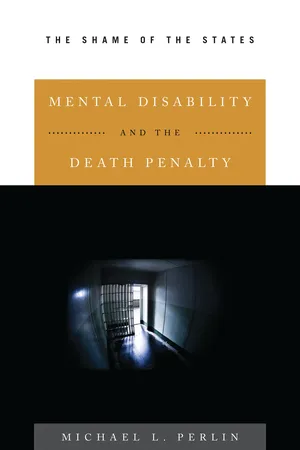
Here, Michael Perlin explores the relationship between mental disabilities and the death penalty and explains why and how this state of affairs has come to be, to explore why it is necessary to identify the factors that have contributed to this scandalous and shameful policy morass, to highlight the series of policy choices that need immediate remediation, and to offer some suggestions that might meaningfully ameliorate the situation. Using real cases to illustrate the ways in which the persons with mental disabilities are unable to receive fair treatment during death penalty trials, he demonstrates the depth of the problem and the way it's been institutionalized so as to be an accepted part of our system. He calls for a new approach, and greater attention to the issues that have gone overlooked for so long.
- English
- ePUB (mobile friendly)
- Available on iOS & Android
eBook - ePub
About this book
Information
Topic
JuraSubtopic
StrafverfahrenTable of contents
- Contents
- Preface
- Chapter 1: An Introduction and the Dilemma of Factual Innocence
- Chapter 2: Sanism, Pretextuality, the Role of Dignity, and Therapeutic Jurisprudence
- Chapter 3: Future Dangerousness and the Death Penalty
- Chapter 4: Mental Disability Evidence and Mitigation
- Chapter 5: Competency to Be Executed: The Case of Mental Retardation
- Chapter 6: Competency to Be Executed: The Case of Mental Illness
- Chapter 7: Competency to Be Executed: The Question of Medication
- Chapter 8: Neuroimaging and the Death Penalty
- Chapter 9: The Role of Jurors, Prosecutors, and Judges
- Chapter 10: The Death Penalty, Mental Disability, and Adequacy of Counsel
- Chapter 11: The Death Penalty and International Human Rights Law
- Chapter 12: Conclusion
- Notes
- Bibliography
- About the Author
Trusted by 375,005 students
Access to over 1.5 million titles for a fair monthly price.
Study more efficiently using our study tools.
Frequently asked questions
Yes, you can cancel anytime from the Subscription tab in your account settings on the Perlego website. Your subscription will stay active until the end of your current billing period. Learn how to cancel your subscription
No, books cannot be downloaded as external files, such as PDFs, for use outside of Perlego. However, you can download books within the Perlego app for offline reading on mobile or tablet. Learn how to download books offline
Perlego offers two plans: Essential and Complete
- Essential is ideal for learners and professionals who enjoy exploring a wide range of subjects. Access the Essential Library with 800,000+ trusted titles and best-sellers across business, personal growth, and the humanities. Includes unlimited reading time and Standard Read Aloud voice.
- Complete: Perfect for advanced learners and researchers needing full, unrestricted access. Unlock 1.5M+ books across hundreds of subjects, including academic and specialized titles. The Complete Plan also includes advanced features like Premium Read Aloud and Research Assistant.
We are an online textbook subscription service, where you can get access to an entire online library for less than the price of a single book per month. With over 1.5 million books across 990+ topics, we’ve got you covered! Learn about our mission
Look out for the read-aloud symbol on your next book to see if you can listen to it. The read-aloud tool reads text aloud for you, highlighting the text as it is being read. You can pause it, speed it up and slow it down. Learn more about Read Aloud
Yes! You can use the Perlego app on both iOS and Android devices to read anytime, anywhere — even offline. Perfect for commutes or when you’re on the go.
Please note we cannot support devices running on iOS 13 and Android 7 or earlier. Learn more about using the app
Please note we cannot support devices running on iOS 13 and Android 7 or earlier. Learn more about using the app
Yes, you can access Mental Disability and the Death Penalty by Michael L. Perlin in PDF and/or ePUB format, as well as other popular books in Jura & Strafverfahren. We have over 1.5 million books available in our catalogue for you to explore.