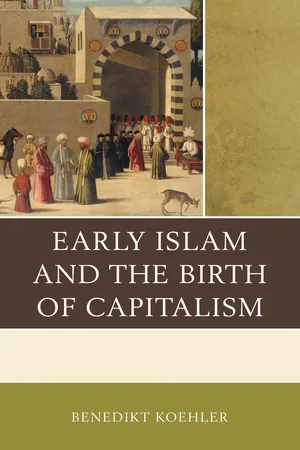
Early Islam and the Birth of Capitalism proposes a strikingly original thesis—that capitalism first emerged in Arabia, not in late medieval Italian city states as is commonly assumed.
Early Islam made a seminal but largely unrecognized contribution to the history of economic thought; it is the only religion founded by an entrepreneur. Descending from an elite dynasty of religious, civil, and commercial leaders, Muhammad was a successful businessman before founding Islam. As such, the new religion had much to say on trade, consumer protection, business ethics, and property. As Islam rapidly spread across the region so did the economic teachings of early Islam, which eventually made their way to Europe.
Early Islam and the Birth of Capitalism demonstrates how Islamic institutions and business practices were adopted and adapted in Venice and Genoa. These financial innovations include the invention of the corporation, business management techniques, commercial arithmetic, and monetary reform. There were other Islamic institutions assimilated in Europe: charities, the waqf, inspired trusts, and institutions of higher learning; the madrasas were models for the oldest colleges of Oxford and Cambridge. As such, it can be rightfully said that these essential aspects of capitalist thought all have Islamic roots.
- English
- ePUB (mobile friendly)
- Available on iOS & Android
eBook - ePub
Early Islam and the Birth of Capitalism
About this book
Information
Table of contents
- Title Page
- The Richest Man in Arabia
- Markets without Government
- Family Matters
- A Mosque, a Market, and a War
- Muhammad’s Household Finances
- Muhammad’s Executive Office
- Muhammadan Taxation
- Succession
- Rise of the Rashidun Caliphs
- Decline of the Rashidun Caliphs
- Journey to Jerusalem
- Islamic Gold Currency
- Bankers of Baghdad
- Islamic Philanthropy: Waqfs
- Islamic Venture Capital: Qirâds
- Islamic Trade Centers: Funduqs
- Law in Early Islam
- From Law to Economics
- Market Economics in Early Islam
- Muslim Merchants Abroad
- Shifting Alliances
- Tax Havens in the Holy Land
- The Economic Consequences of Saladin
- Lives of the Merchants
- Early Law and Economics in Christendom
- Conclusion
- Bibliography
- Index
- About the Author
Trusted by 375,005 students
Access to over 1.5 million titles for a fair monthly price.
Study more efficiently using our study tools.
Frequently asked questions
Yes, you can cancel anytime from the Subscription tab in your account settings on the Perlego website. Your subscription will stay active until the end of your current billing period. Learn how to cancel your subscription
No, books cannot be downloaded as external files, such as PDFs, for use outside of Perlego. However, you can download books within the Perlego app for offline reading on mobile or tablet. Learn how to download books offline
Perlego offers two plans: Essential and Complete
- Essential is ideal for learners and professionals who enjoy exploring a wide range of subjects. Access the Essential Library with 800,000+ trusted titles and best-sellers across business, personal growth, and the humanities. Includes unlimited reading time and Standard Read Aloud voice.
- Complete: Perfect for advanced learners and researchers needing full, unrestricted access. Unlock 1.5M+ books across hundreds of subjects, including academic and specialized titles. The Complete Plan also includes advanced features like Premium Read Aloud and Research Assistant.
We are an online textbook subscription service, where you can get access to an entire online library for less than the price of a single book per month. With over 1.5 million books across 990+ topics, we’ve got you covered! Learn about our mission
Look out for the read-aloud symbol on your next book to see if you can listen to it. The read-aloud tool reads text aloud for you, highlighting the text as it is being read. You can pause it, speed it up and slow it down. Learn more about Read Aloud
Yes! You can use the Perlego app on both iOS and Android devices to read anytime, anywhere — even offline. Perfect for commutes or when you’re on the go.
Please note we cannot support devices running on iOS 13 and Android 7 or earlier. Learn more about using the app
Please note we cannot support devices running on iOS 13 and Android 7 or earlier. Learn more about using the app
Yes, you can access Early Islam and the Birth of Capitalism by Benedikt Koehler in PDF and/or ePUB format, as well as other popular books in Economics & Business General. We have over 1.5 million books available in our catalogue for you to explore.