- English
- ePUB (mobile friendly)
- Available on iOS & Android
eBook - ePub
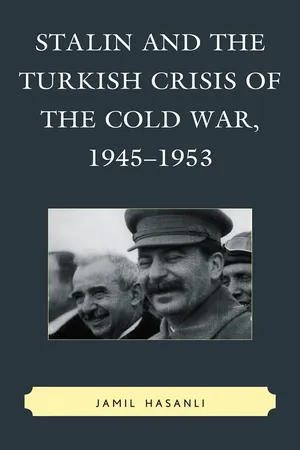
Stalin and the Turkish Crisis of the Cold War, 1945–1953
About this book
This book presents the ups and downs of the Soviet-Turkish relations during World War II and immediately after it. Hasanli draws on declassified archive documents from the United States, Russia, Armenia, Georgia, Turkey, and Azerbaijan to recreate a true picture of the time when the 'Turkish crisis' of the Cold War broke out. It explains why and how the friendly relations between the USSR and Turkey escalated into enmity, led to the increased confrontation between these two countries, and ended up with Turkey's entry into NATO. Hasanli uses recently-released Soviet archive documents to shed light on some dark points of the Cold War era and the relations between the Soviets and the West. Apart from bringing in an original point of view regarding starting of the Cold War, the book reveals some secret sides of the Soviet domestic and foreign policies. The book convincingly demonstrates how Soviet political technologists led by Josef Stalin distorted the picture of a friendly and peaceful country_Turkey_into the image of an enemy in the minds of millions of Soviet citizens.
Information
Table of contents
- Introduction
- Chapter 1: Soviet-Turkish Relations during the Second World War: From Neutrality to Escalating Tensions
- Chapter 2: Increasing Soviet Pressure on Turkey and the Beginning of the War of Nerves
- Chapter 3: Inclusion of the South Caucasus Republics in the Soviet Policy against Turkey
- Chapter 4: Growth of Pro-American Sentiments in Turkey in Response to Increasing Soviet Pressures
- Chapter 5: Soviet Plans on the Straits and Their Failure
- Chapter 6: The War of Nerves between the Republics of the South Caucasus
- Chapter 7: Turkey and the Truman Doctrine
- Chapter 8: Escalation of the Cold War and Turkey’s Entry into NATO
- Conclusion
- Bibliography
Trusted by 375,005 students
Access to over 1.5 million titles for a fair monthly price.
Study more efficiently using our study tools.
Frequently asked questions
Yes, you can cancel anytime from the Subscription tab in your account settings on the Perlego website. Your subscription will stay active until the end of your current billing period. Learn how to cancel your subscription
No, books cannot be downloaded as external files, such as PDFs, for use outside of Perlego. However, you can download books within the Perlego app for offline reading on mobile or tablet. Learn how to download books offline
Perlego offers two plans: Essential and Complete
- Essential is ideal for learners and professionals who enjoy exploring a wide range of subjects. Access the Essential Library with 800,000+ trusted titles and best-sellers across business, personal growth, and the humanities. Includes unlimited reading time and Standard Read Aloud voice.
- Complete: Perfect for advanced learners and researchers needing full, unrestricted access. Unlock 1.5M+ books across hundreds of subjects, including academic and specialized titles. The Complete Plan also includes advanced features like Premium Read Aloud and Research Assistant.
We are an online textbook subscription service, where you can get access to an entire online library for less than the price of a single book per month. With over 1.5 million books across 990+ topics, we’ve got you covered! Learn about our mission
Look out for the read-aloud symbol on your next book to see if you can listen to it. The read-aloud tool reads text aloud for you, highlighting the text as it is being read. You can pause it, speed it up and slow it down. Learn more about Read Aloud
Yes! You can use the Perlego app on both iOS and Android devices to read anytime, anywhere — even offline. Perfect for commutes or when you’re on the go.
Please note we cannot support devices running on iOS 13 and Android 7 or earlier. Learn more about using the app
Please note we cannot support devices running on iOS 13 and Android 7 or earlier. Learn more about using the app
Yes, you can access Stalin and the Turkish Crisis of the Cold War, 1945–1953 by Jamil Hasanli in PDF and/or ePUB format, as well as other popular books in History & Russian History. We have over 1.5 million books available in our catalogue for you to explore.