The Department of Housing and Urban Development (HUD) emphasizes the word "community" for building economic development, citizen participations, and revitalization of facilities and services in urban and rural areas. Resident Councils are one way to develop and build community among residents of public housing. Despite HUD stressing community building in public housing and investing money and policies around it, there are some resident councils that are not fulfilling the expectations of HUD.
This book is my attempt to describe and explain HUD's expectations for the resident council as an active agent for community building and the actual practices of the resident council. I argue that policies and regulations of resident councils which exist to support the effectiveness of the resident council in creating and implementing community-building, self-sufficiency, and empowerment activities and goals in a public housing community may do more harm than good.
The Department of Housing and Urban Development invests and spends billions on Public Housing Programs (6.6 billion in 2013). The majority of the 1.2 million people who live in public housing do not live in large urban areas with thousands of people confined to a certain space. The majority of public housing units (90%) have fewer than 500 units. These smaller units and the people that live in them tend to go unnoticed.
This ethnographic case study focuses on explaining and understanding the factors and constraints that exist between HUD's expectations for the resident council as an active agent for community building and the actual practices of the resident council. To explain the disjunction—in fact, to determine if such disjunctions identified by Rivertown council members are real. Using the tenets of Critical Race Theory allows us to understand what forces—either real or imagined, structural or cultural—prevent the resident council from being an effective agent for change in the public housing community.
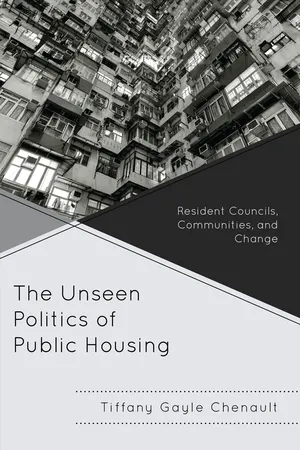
eBook - ePub
The Unseen Politics of Public Housing
Resident Councils, Communities, and Change
- English
- ePUB (mobile friendly)
- Available on iOS & Android
eBook - ePub
The Unseen Politics of Public Housing
Resident Councils, Communities, and Change
About this book
Information
Table of contents
- Title Page
- Start of the Journey
- Welcome to Rivertown
- Code for Community Engagement
- Who’s Leading the Council?
- Rules for Organizing a Council
- Not Fitting the Public Housing Image: Location and Communication
- Meetings and Manager Dynamics
- Policy Recommendations
- Appendix A
- Appendix B
- Bibliography
- Index
- About the Author
Trusted by 375,005 students
Access to over 1.5 million titles for a fair monthly price.
Study more efficiently using our study tools.
Frequently asked questions
Yes, you can cancel anytime from the Subscription tab in your account settings on the Perlego website. Your subscription will stay active until the end of your current billing period. Learn how to cancel your subscription
No, books cannot be downloaded as external files, such as PDFs, for use outside of Perlego. However, you can download books within the Perlego app for offline reading on mobile or tablet. Learn how to download books offline
Perlego offers two plans: Essential and Complete
- Essential is ideal for learners and professionals who enjoy exploring a wide range of subjects. Access the Essential Library with 800,000+ trusted titles and best-sellers across business, personal growth, and the humanities. Includes unlimited reading time and Standard Read Aloud voice.
- Complete: Perfect for advanced learners and researchers needing full, unrestricted access. Unlock 1.5M+ books across hundreds of subjects, including academic and specialized titles. The Complete Plan also includes advanced features like Premium Read Aloud and Research Assistant.
We are an online textbook subscription service, where you can get access to an entire online library for less than the price of a single book per month. With over 1.5 million books across 990+ topics, we’ve got you covered! Learn about our mission
Look out for the read-aloud symbol on your next book to see if you can listen to it. The read-aloud tool reads text aloud for you, highlighting the text as it is being read. You can pause it, speed it up and slow it down. Learn more about Read Aloud
Yes! You can use the Perlego app on both iOS and Android devices to read anytime, anywhere — even offline. Perfect for commutes or when you’re on the go.
Please note we cannot support devices running on iOS 13 and Android 7 or earlier. Learn more about using the app
Please note we cannot support devices running on iOS 13 and Android 7 or earlier. Learn more about using the app
Yes, you can access The Unseen Politics of Public Housing by Tiffany Gayle Chenault in PDF and/or ePUB format, as well as other popular books in Social Sciences & Social Work. We have over 1.5 million books available in our catalogue for you to explore.