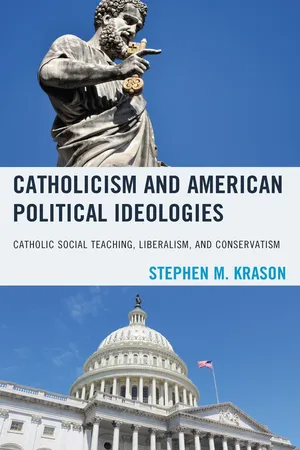
This book examines the perspectives of American liberalism and conservatism in the new millennium—their general political and social philosophy and their positions in leading public issue areas—and evaluates them in light of Catholic social teaching. Before making that evaluation, it sets out the Church's teaching as it has been authoritatively set forth in documents from her Magisterium—especially the social encyclicals. It looks to recognized thinkers, writers, and spokesmen for each of the two ideologies to determine what their general philosophy is in six major, central areas: the role of the state; God, religion, and the natural law as the basis of the political order; the family; the thinking on freedom; the thinking about equality; and international life and ethics.
Since American conservatism has been known for having different groupings or schools of thought within it—in the new millennium these are traditionalist conservatism, paleoconservatism, cultural or religious-based conservatism, neoconservatism, libertarian conservatism, and TEA party conservatism—the book examines leading representatives from each grouping and then determines what the consensus conservatism thinking is in each area. Then it looks to a recent platform of the Democratic party that was acknowledged to be especially "liberal" and one of the Republican party that was acknowledged to be especially "conservative" (they were the 2012 platforms of each party) to determine the thinking of each ideology on eight major public issue/policy areas: economics and social welfare policy; energy and the environment; civil rights and civil liberties; education and health care; family policy; immigration policy; human life issues; and foreign policy, defense, and disarmament. It compares each ideology's thinking in these different areas of their general political and social philosophy and their public issue/policy positions and compares them to the basic principles of Catholic social teaching, assessing how well each conforms to that teaching in each area or if each clearly deviates and then coming to an conclusion overall about which is closer to Catholic social teaching.
eBook - ePub
Catholicism and American Political Ideologies
Catholic Social Teaching, Liberalism, and Conservatism
- English
- ePUB (mobile friendly)
- Available on iOS & Android
eBook - ePub
Catholicism and American Political Ideologies
Catholic Social Teaching, Liberalism, and Conservatism
About this book
Information
Topic
Theology & ReligionSubtopic
American GovernmentTable of contents
- Acknowledgements
- Chapter 1: The Nature of Liberalism and Conservatism, and Their Relationship to American Catholics
- Chapter 2: A Summary of Catholic Social Teaching from the Social Encyclicals and Other Church Documents
- Chapter 3: Comparing American Liberalism and Church Teaching
- Chapter 4: Comparing American Conservatism and Church Teaching
- Chapter 5: Conclusion
- About the Author
Trusted by 375,005 students
Access to over 1.5 million titles for a fair monthly price.
Study more efficiently using our study tools.
Frequently asked questions
Yes, you can cancel anytime from the Subscription tab in your account settings on the Perlego website. Your subscription will stay active until the end of your current billing period. Learn how to cancel your subscription
No, books cannot be downloaded as external files, such as PDFs, for use outside of Perlego. However, you can download books within the Perlego app for offline reading on mobile or tablet. Learn how to download books offline
Perlego offers two plans: Essential and Complete
- Essential is ideal for learners and professionals who enjoy exploring a wide range of subjects. Access the Essential Library with 800,000+ trusted titles and best-sellers across business, personal growth, and the humanities. Includes unlimited reading time and Standard Read Aloud voice.
- Complete: Perfect for advanced learners and researchers needing full, unrestricted access. Unlock 1.5M+ books across hundreds of subjects, including academic and specialized titles. The Complete Plan also includes advanced features like Premium Read Aloud and Research Assistant.
We are an online textbook subscription service, where you can get access to an entire online library for less than the price of a single book per month. With over 1.5 million books across 990+ topics, we’ve got you covered! Learn about our mission
Look out for the read-aloud symbol on your next book to see if you can listen to it. The read-aloud tool reads text aloud for you, highlighting the text as it is being read. You can pause it, speed it up and slow it down. Learn more about Read Aloud
Yes! You can use the Perlego app on both iOS and Android devices to read anytime, anywhere — even offline. Perfect for commutes or when you’re on the go.
Please note we cannot support devices running on iOS 13 and Android 7 or earlier. Learn more about using the app
Please note we cannot support devices running on iOS 13 and Android 7 or earlier. Learn more about using the app
Yes, you can access Catholicism and American Political Ideologies by Stephen M. Krason in PDF and/or ePUB format, as well as other popular books in Theology & Religion & American Government. We have over 1.5 million books available in our catalogue for you to explore.