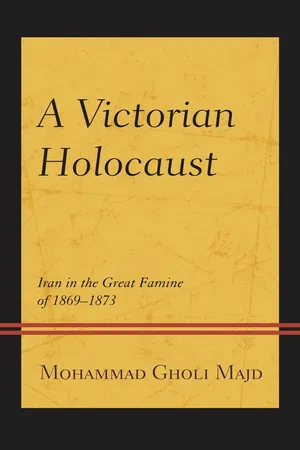
The death by famine of tens of millions of human beings in Asia and Africa during the Victorian era (1837–1901) is "the secret history of the nineteenth century" about which Western history books contain nothing. The Great Famine of 1869–1873 in Iran took 10–12 million lives, or two-thirds of the population, and is part of this secret history. While the famines that ravaged China and India during 1876 to 1902 have received some recent scrutiny, the precursor of these cataclysmic famines, the Great Famine of 1869–1873 in Iran, has remained practically unknown. This study is the first monograph on the subject in the English language. This famine in Iran killed on a scale similar to the 1876–79 famine in China, which has been called the worst to afflict the human species.
This study is based on British diplomatic reports and semi-official sources, European travel accounts, Persian documents and writings, British and American newspapers, and the reports by American missionaries who witnessed the famine. These sources enable one to provide a chronological and numerical account of the death and suffering as the famine spread from the southern and central regions to the rest of the country. The population statistics and rich micro-level data on famine losses in rural and urban areas indicate that during the nearly five years of famine, two-thirds of the population had perished. Not until 1910 did Iran come close to recovering its 1869 population. Soon after, Iran was plunged into the Great Famine of 1917–19, which claimed another 8–10 million, and again the 1942–43 famine and typhus epidemic that carried off an additional 4 million persons. In the seventy-five year span of 1869–1944, Iran had suffered three famines that had taken 25 million lives. Iran's 1944 population of 10–12 million was unchanged from 11 million recorded in 1841, a perfect case of a Malthusian catastrophe. It is difficult to find another country in which a century of population growth had been wiped out by famine. Having previously described and quantified the 1917–19 and 1942–43 famines, Majd does the same for the 1869–73 famine. This book is the third of a trilogy on famines in Iran during the last 150 years.
- English
- ePUB (mobile friendly)
- Available on iOS & Android
eBook - ePub
About this book
Information
Table of contents
- Title Page
- Introduction
- Reports of Famine and Iranian Government Denial
- Famine in South Iran
- Famine in Central Iran
- Famine in Khorassan and North-East Iran
- Famine in Tehran
- Famine in Hamadan and Kermanshah
- Famine in Zanjan and Qazvin
- Famine in Azerbaijan
- The Persian Famine Relief Committee
- The Toll from Famine and Disease
- References
- About the Author
Trusted by 375,005 students
Access to over 1.5 million titles for a fair monthly price.
Study more efficiently using our study tools.
Frequently asked questions
Yes, you can cancel anytime from the Subscription tab in your account settings on the Perlego website. Your subscription will stay active until the end of your current billing period. Learn how to cancel your subscription
No, books cannot be downloaded as external files, such as PDFs, for use outside of Perlego. However, you can download books within the Perlego app for offline reading on mobile or tablet. Learn how to download books offline
Perlego offers two plans: Essential and Complete
- Essential is ideal for learners and professionals who enjoy exploring a wide range of subjects. Access the Essential Library with 800,000+ trusted titles and best-sellers across business, personal growth, and the humanities. Includes unlimited reading time and Standard Read Aloud voice.
- Complete: Perfect for advanced learners and researchers needing full, unrestricted access. Unlock 1.5M+ books across hundreds of subjects, including academic and specialized titles. The Complete Plan also includes advanced features like Premium Read Aloud and Research Assistant.
We are an online textbook subscription service, where you can get access to an entire online library for less than the price of a single book per month. With over 1.5 million books across 990+ topics, we’ve got you covered! Learn about our mission
Look out for the read-aloud symbol on your next book to see if you can listen to it. The read-aloud tool reads text aloud for you, highlighting the text as it is being read. You can pause it, speed it up and slow it down. Learn more about Read Aloud
Yes! You can use the Perlego app on both iOS and Android devices to read anytime, anywhere — even offline. Perfect for commutes or when you’re on the go.
Please note we cannot support devices running on iOS 13 and Android 7 or earlier. Learn more about using the app
Please note we cannot support devices running on iOS 13 and Android 7 or earlier. Learn more about using the app
Yes, you can access A Victorian Holocaust by Mohammad Gholi Majd in PDF and/or ePUB format, as well as other popular books in History & 19th Century History. We have over 1.5 million books available in our catalogue for you to explore.