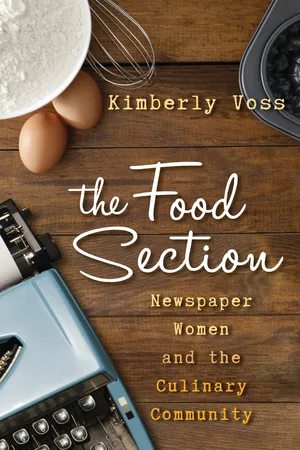
Food blogs are everywhere today but for generations, information and opinions about food were found in the food sections of newspapers in communities large and small. Until the early 1970s, these sections were housed in the women's pages of newspapers—where women could hold an authoritative voice. The food editors—often a mix of trained journalist and home economist—reported on everything from nutrition news to features on the new chef in town. They wrote recipes and solicited ideas from readers. The sections reflected the trends of the time and the cooks of the community. The editors were local celebrities, judging cooking contests and getting calls at home about how to prepare a Thanksgiving turkey. They were consumer advocates and reporters for food safety and nutrition. They helped make James Beard and Julia Child household names as the editors wrote about their television appearances and reviewed their cookbooks.
These food editors laid the foundation for the food community that Nora Ephron described in her classic 1968 essay, "The Food Establishment," and eventually led to the food communities of today. Included in the chapters are profiles of such food editors as Jane Nickerson, Jeanne Voltz, and Ruth Ellen Church, who were unheralded pioneers in the field, as well as Cecily Brownstone, Poppy Cannon, and Clementine Paddleford, who are well known today; an analysis of their work demonstrates changes in the country's culinary history. The book concludes with a look at how the women's pages folded at the same time that home economics saw its field transformed and with thoughts about the foundation that these women laid for the food journalism of today.
- English
- ePUB (mobile friendly)
- Available on iOS & Android
eBook - ePub
About this book
Information
Topic
ArtSubtopic
JournalismTable of contents
- Title Page
- Acknowledgments
- Preface
- The Origins of Food Journalismin US Newspapers
- Food and Food Journalism during and after World War II
- Food Journalism and the Rise of Consumer Activism
- Cookbooks, Exchanging Recipes, and Competitive Cooking
- Home Economics
- The Restaurant Reviewer as Journalist
- The Death of the Women’s Pages
- Appendix
- Notes
- Selected Bibliography
- Index
Trusted by 375,005 students
Access to over 1.5 million titles for a fair monthly price.
Study more efficiently using our study tools.
Frequently asked questions
Yes, you can cancel anytime from the Subscription tab in your account settings on the Perlego website. Your subscription will stay active until the end of your current billing period. Learn how to cancel your subscription
No, books cannot be downloaded as external files, such as PDFs, for use outside of Perlego. However, you can download books within the Perlego app for offline reading on mobile or tablet. Learn how to download books offline
Perlego offers two plans: Essential and Complete
- Essential is ideal for learners and professionals who enjoy exploring a wide range of subjects. Access the Essential Library with 800,000+ trusted titles and best-sellers across business, personal growth, and the humanities. Includes unlimited reading time and Standard Read Aloud voice.
- Complete: Perfect for advanced learners and researchers needing full, unrestricted access. Unlock 1.5M+ books across hundreds of subjects, including academic and specialized titles. The Complete Plan also includes advanced features like Premium Read Aloud and Research Assistant.
We are an online textbook subscription service, where you can get access to an entire online library for less than the price of a single book per month. With over 1.5 million books across 990+ topics, we’ve got you covered! Learn about our mission
Look out for the read-aloud symbol on your next book to see if you can listen to it. The read-aloud tool reads text aloud for you, highlighting the text as it is being read. You can pause it, speed it up and slow it down. Learn more about Read Aloud
Yes! You can use the Perlego app on both iOS and Android devices to read anytime, anywhere — even offline. Perfect for commutes or when you’re on the go.
Please note we cannot support devices running on iOS 13 and Android 7 or earlier. Learn more about using the app
Please note we cannot support devices running on iOS 13 and Android 7 or earlier. Learn more about using the app
Yes, you can access The Food Section by Kimberly Wilmot Voss in PDF and/or ePUB format, as well as other popular books in Art & Journalism. We have over 1.5 million books available in our catalogue for you to explore.