Women in Uzbekistan have been labeled as victims of patriarchy and submissive, voiceless bodies who lack agency and decision-making power. They are also often symbolized as preservers of rituals and culture and also the victims of socio-economic transformations. During the years of land tenure changes from collectivization to de-collectivization, World War II and the five-year plan economy, women played a vital role in pursuing a diverse range of livelihood opportunities to sustain their families and communities. But what kind of livelihood activities do women pursue in rural areas in Uzbekistan? What do they think about themselves? Do they exercise agency? What are their values, desires, dreams, and inspirations in the post-Soviet period in Uzbekistan?
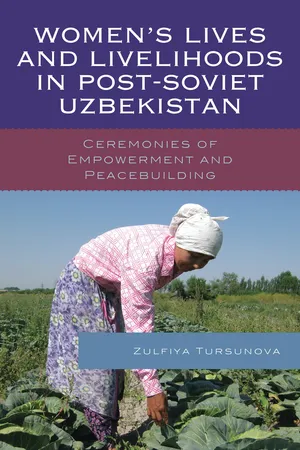
Women's Lives and Livelihoods in Post-Soviet Uzbekistan presentswomen's voices and their experiences of carrying out livelihood activities such asfarming, trading, baking, sewing, building greenhouses, and establishing furniture workshops. In a major contribution to the study of post-Soviet transformations, Zulfiya Tursunova demonstrates how women exercise multi-dimensional empowerment by joining social and economic saving networks such as gap and chernaya kassa. These networks represent a collective movement and action against economic dependency of women on men and the state micro-loan bank system. The networks that do not require external donor interventions have been able to empower women for social justice, knowledge, redistribution of resources, and conflict resolution in ways that are vital to community development.
Tursunova provides accounts of such ceremonies as mavlud, ihson, Bibi Seshanba, and Mushkul Kushod. These ceremonies show the ways the conflict resolution practices of women are woven into their everyday life, and function autonomously from the hierarchical elite-driven Women's Committees and state court systems established in the Soviet times. Many local healers and otins (religious teachers) use their discursive knowledge, based on Islam, Sufism, shamanism, and animism to challenge and transform women's subordination, abuse, and other practices that impinge on women's needs and rights. These female religious leaders, through different ceremonial practices, create space for raising the critical consciousness of women and transform the social order for maintaining peace in the communities.
eBook - ePub
Women’s Lives and Livelihoods in Post-Soviet Uzbekistan
Ceremonies of Empowerment and Peacebuilding
- English
- ePUB (mobile friendly)
- Available on iOS & Android
eBook - ePub
Women’s Lives and Livelihoods in Post-Soviet Uzbekistan
Ceremonies of Empowerment and Peacebuilding
About this book
Trusted by 375,005 students
Access to over 1.5 million titles for a fair monthly price.
Study more efficiently using our study tools.
Information
Table of contents
- Figures
- Acknowledgments
- Preface
- Chapter 1 Introduction
- Chapter 2 Women’s Rituals: Sacred Spaces of Knowledge and Empowerment
- Chapter 3 “The Imperial Pleasure”: Construction and the Representation of Women
- Chapter 4 Women’s Constraints and Empowerment in Livelihood Strategies
- Chapter 5 Women, Islam, and Livelihood Strategies
- Chapter 6 Gap as a Space of Agency, Power, and Knowledge
- Chapter 7 “Cutting the Knots”: Ceremonies of Healing and Peacebuilding
- Chapter 8 Conclusion: Grassroots Structures of Empowerment and Peacebuilding
- Glossary
- Appendix
- Bibliography
- About the Author
Frequently asked questions
Yes, you can cancel anytime from the Subscription tab in your account settings on the Perlego website. Your subscription will stay active until the end of your current billing period. Learn how to cancel your subscription
No, books cannot be downloaded as external files, such as PDFs, for use outside of Perlego. However, you can download books within the Perlego app for offline reading on mobile or tablet. Learn how to download books offline
We are an online textbook subscription service, where you can get access to an entire online library for less than the price of a single book per month. With over 1.5 million books across 990+ topics, we’ve got you covered! Learn about our mission
Look out for the read-aloud symbol on your next book to see if you can listen to it. The read-aloud tool reads text aloud for you, highlighting the text as it is being read. You can pause it, speed it up and slow it down. Learn more about Read Aloud
Yes! You can use the Perlego app on both iOS and Android devices to read anytime, anywhere — even offline. Perfect for commutes or when you’re on the go.
Please note we cannot support devices running on iOS 13 and Android 7 or earlier. Learn more about using the app
Please note we cannot support devices running on iOS 13 and Android 7 or earlier. Learn more about using the app
Yes, you can access Women’s Lives and Livelihoods in Post-Soviet Uzbekistan by Zulfiya Tursunova in PDF and/or ePUB format, as well as other popular books in History & Eastern European History. We have over 1.5 million books available in our catalogue for you to explore.