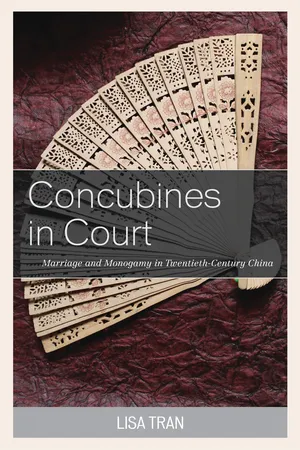
This groundbreaking book analyzes marriage and family reform in twentieth-century China. Lisa Tran's examination of changes in the perception of concubinage explores the subtle, yet very meaningful, shifts in the construction of monogamy in contemporary China. Equally important is her use of court cases to assess how these shifts affected legal and social practice. Tran argues that this dramatic story has often been overlooked, leading to the mistaken conclusion that concubinage remained largely unchanged or quietly disappeared in "modern" China. Customarily viewed as a minor wife because her "husband" was already married, a concubine found her legal status in question under a political order that came to be based on the principles of monogamy and equality. Yet although the custom of concubinage came under attack in the early twentieth century, the image of the concubine stirred public sympathy. How did lawmakers attack the practice without jeopardizing the interests of concubines? Conversely, how did jurists protect the interests of women without appearing to sanction concubinage? How law and society negotiated these conflicting interests dramatically altered existing views of monogamy and marriage and restructured gender and family relations.
As the first in-depth study of the meaning and practice of monogamy and concubinage in modern China, this book makes an important contribution to our understanding of Chinese society and legal norms. In addition, by crossing the "1949 divide," it compares the Guomindang's designation of concubinage as adultery with the Chinese Communist Party's treatment of it as bigamy, and draws out the legal implications for the practice of concubinage as well as for women who were concubines. Poised at the intersection of Chinese history, women's history, and legal history, this book makes a unique and significant contribution to the scholarship in all three fields.
- English
- ePUB (mobile friendly)
- Available on iOS & Android
eBook - ePub
About this book
Information
Table of contents
- Title Page
- Acknowledgments
- Concubinage as Legal and Social History
- Concubinage under Early Republican Law
- Concubinage under GMD Law
- The Benefits of Household Membership under Early Republican and GMD Law
- Severance and Support under Early Republican and GMD Law
- The Line between Marriage and Concubinage in Early Republican and GMD Law
- The Unintended Recognition of Concubinage as Bigamy under GMD Law
- Concubinage under CCP Law
- The Handling of Concubinage Cases under CCP Law
- Conclusion
- Character List
- References
- Index
Trusted by 375,005 students
Access to over 1.5 million titles for a fair monthly price.
Study more efficiently using our study tools.
Frequently asked questions
Yes, you can cancel anytime from the Subscription tab in your account settings on the Perlego website. Your subscription will stay active until the end of your current billing period. Learn how to cancel your subscription
No, books cannot be downloaded as external files, such as PDFs, for use outside of Perlego. However, you can download books within the Perlego app for offline reading on mobile or tablet. Learn how to download books offline
Perlego offers two plans: Essential and Complete
- Essential is ideal for learners and professionals who enjoy exploring a wide range of subjects. Access the Essential Library with 800,000+ trusted titles and best-sellers across business, personal growth, and the humanities. Includes unlimited reading time and Standard Read Aloud voice.
- Complete: Perfect for advanced learners and researchers needing full, unrestricted access. Unlock 1.5M+ books across hundreds of subjects, including academic and specialized titles. The Complete Plan also includes advanced features like Premium Read Aloud and Research Assistant.
We are an online textbook subscription service, where you can get access to an entire online library for less than the price of a single book per month. With over 1.5 million books across 990+ topics, we’ve got you covered! Learn about our mission
Look out for the read-aloud symbol on your next book to see if you can listen to it. The read-aloud tool reads text aloud for you, highlighting the text as it is being read. You can pause it, speed it up and slow it down. Learn more about Read Aloud
Yes! You can use the Perlego app on both iOS and Android devices to read anytime, anywhere — even offline. Perfect for commutes or when you’re on the go.
Please note we cannot support devices running on iOS 13 and Android 7 or earlier. Learn more about using the app
Please note we cannot support devices running on iOS 13 and Android 7 or earlier. Learn more about using the app
Yes, you can access Concubines in Court by Lisa Tran in PDF and/or ePUB format, as well as other popular books in History & Chinese History. We have over 1.5 million books available in our catalogue for you to explore.