- English
- ePUB (mobile friendly)
- Available on iOS & Android
eBook - ePub
About this book
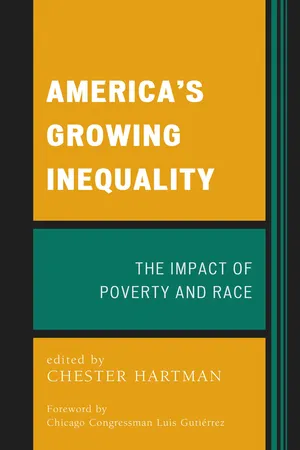
The book is a compilation of the best and still-most-relevant articles published in Poverty & Race, the bimonthly of The Poverty & Race Research Action Council from 2006 to the present. Authors are some of the leading figures in a range of activities around these themes. It is the fourth such book PRRAC has published over the years, each with a high-visibility foreword writer: Rep. John Lewis, Rep. Jesse Jackson, Jr. Bill Bradley, Julian Bond in previous books, Rep. Luis Gutierrez of Chicago for this book. The chapters are organized into four sections: Race & Poverty: The Structural Underpinnings; Deconstructing Poverty and Racial Inequities; Re(emerging) Issues; Civil Rights History.
Information
Table of contents
- Contents
- Foreword
- Introduction
- Part I: Racism and Poverty: The Structural Underpinnings
- Toward a Structural Racism Framework
- Structural Racism: Focusing on the Cause
- American Indian Tribes and Structural Racism
- Structural Racism and Rebuilding New Orleans
- Race vis-à-vis Class in the U.S.?
- More Than Just Race: Being Black and Poor in the Inner City
- Tensions Among Minority Groups
- Indigenous Peoples: Response to the Periodic Report of the United States to the United Nations Committee on the Elimination of Racial Discrimination
- Tribal Self-Government in the United States
- When Affirmative Action Was White
- The Importance of Targeted Universalism
- Implicit Bias: A Forum
- Tax Aversion: The Legacy of Slavery
- Tax Aversion: The Sequel
- Scapegoating Blacks for the Economic Crisis
- Speculators, Not CRA, Behind Foreclosures in Black Neighborhoods
- The Missing Class: The Near Poor
- Criminalization of Poverty: UN Report
- Can We Think about Poverty without Thinking about Criminality?
- The Criminalization of Homelessness
- Can We Organize for Economic Justice Beyond Capitalism?
- Beyond Public/Private: Understanding Corporate Power
- The Help
- Reshaping the Social Contract: Demographic Distance and Our Fiscal Future
- Social Justice Movements in a Liminal Age
- Part II: Deconstructing Poverty and Racial Inequality
- The Spirit Level: Why Greater Equality Makes Societies Stronger
- Why Racial Integration Remains an Imperative
- Building a National Museum
- How White Activists Embrace Racial Justice
- Ending/Reducing Poverty: A Forum
- Unions Make Us Strong
- A Freedom Budget for All Americans
- The Kerner Commission: Remembering, Forgetting and Truth-Telling
- How Seattle and King County Are Tackling Institutional Inequities
- One Nation Indivisible: Just Cause—Causa Justa: Multiracial Movement-Building for Housing Rights
- The Opportunity Impact Statement
- The International Year for People of African Descent
- Count Them One by One: Black Mississippians Fighting for the Right to Vote
- Why Are African Americans and Latinos Underrepresented Among Recipients of Unemployment Insurance and What Should We Do About It?
- The Cobell Trust Land Lawsuit
- Truth and Reconciliation in Greensboro, North Carolina: A Paradigm for Social Transformation
- Greensboro Truth & Reconciliation Commission
- Apologies/Reparations, 2003–2011
- Apology for Slavery (H.Res. 194)
- Joint Resolution of Apology to Native People
- Part III: (Re)Emerging Issues
- The Seattle/Louisville Decision and the Future of Race-Conscious Programs
- Separate ≠ Equal: Mexican Americans Before Brown v. Board
- Segregation and Exposure to High-Poverty Schools in Large Metropolitan Areas, 2008–2009
- The Social Science Evidence on the Effects of Diversity in K-12 Schools
- How Colleges and Universities Can Promote K-12 Diversity: A Modest Proposal
- When the Feds Won’t Act: School Desegregation, State Courts, and Minnesota’s The Choice is Yours Program
- Reaffirming the Role of School Integration in K-12 Education Policy
- Middle-Income Peers As Educational Resources and the Constitutional Right to Equal Access
- Community-Based Accountability: Best Practices for School Officials
- The Role of Teacher Union Locals in Advancing Racial Justice and Improving the Quality of Schooling in the United States
- American Indian Boarding Schools
- Affirmative Furthering of Fair Housing: The 21st Century Challenge
- Race and Public Housing: Revisiting the Federal Role
- Integration and Housing Choice: A Dialogue
- What Are We Holding Our Public Schools Accountable For? The Gap Between What is Measured and What is Needed to Prepare Children for an Increasingly Diverse Society
- The Goal of Inclusive, Diverse Communities: Introduction to the Final Report of the National Commission on Fair Housing and Equal Opportunity
- Lessons from Mount Laurel: The Benefits of Affordable Housing for All Concerned
- Housing America’s Native People
- No Home in Indian Country
- Mossville, Louisiana: A Community’s Fight for the Human Right to a Healthy Environment
- Understanding Health Impact Assessment: A Tool for Addressing Health Disparities
- Health Equity for Asian American, Native Hawaiian, and Pacific Islander Children and Youth: What’s Racism Got to Do With It?
- Neighborhood—The Smallest Unit of Health: A Health Center Model for Pacific Islander and Asian Health
- Healthcare and Indigenous Peoples in the United States
- Race, Poverty and Incarceration
- A Strategy for Dismantling Structural Racism in the Juvenile Justice System
- Native Americans and Juvenile Justice: A Hidden Tragedy
- National Statement to Support Human and Civil Rights for All Immigrants and to Oppose Compromise Immigration Reform Proposal
- 21st Century Gateways: Immigrants in Suburban America
- Natural Allies or Irreconcilable Foes? Reflections on African-American/Immigrant Relations
- Transportation and Civil Rights
- Right to the City: Social Movement and Theory
- Part IV: Civil Rights History
- Bayard Rustin and the Civil Rights Movement
- A Civil Right to Organize
- Local People as Law Shapers: Lessons from Atlanta’s Civil Rights Movement
- Freedom Riders
- The Chicago Freedom Movement 40 Years Later: A Symposium
- The Student Nonviolent Coordinating Committee Gathers 50 Years After It Started: A Report on the Reunion
- The Other Side of Immigration: Humane, Sensible and Replicable Responses in a Changing Nation
- PRRAC Board of Directors and Social Science Advisory Board—Current and Former Members
- The Contributors
Trusted by 375,005 students
Access to over 1.5 million titles for a fair monthly price.
Study more efficiently using our study tools.
Frequently asked questions
Yes, you can cancel anytime from the Subscription tab in your account settings on the Perlego website. Your subscription will stay active until the end of your current billing period. Learn how to cancel your subscription
No, books cannot be downloaded as external files, such as PDFs, for use outside of Perlego. However, you can download books within the Perlego app for offline reading on mobile or tablet. Learn how to download books offline
We are an online textbook subscription service, where you can get access to an entire online library for less than the price of a single book per month. With over 1.5 million books across 990+ topics, we’ve got you covered! Learn about our mission
Look out for the read-aloud symbol on your next book to see if you can listen to it. The read-aloud tool reads text aloud for you, highlighting the text as it is being read. You can pause it, speed it up and slow it down. Learn more about Read Aloud
Yes! You can use the Perlego app on both iOS and Android devices to read anytime, anywhere — even offline. Perfect for commutes or when you’re on the go.
Please note we cannot support devices running on iOS 13 and Android 7 or earlier. Learn more about using the app
Please note we cannot support devices running on iOS 13 and Android 7 or earlier. Learn more about using the app
Yes, you can access America's Growing Inequality by Chester Hartman in PDF and/or ePUB format, as well as other popular books in Politics & International Relations & American Government. We have over 1.5 million books available in our catalogue for you to explore.