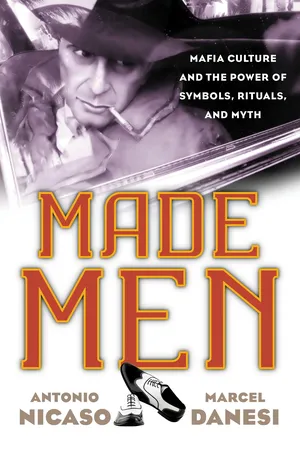
The novel The Godfather (1969) and the movie of the same name (1972) entrenched the myth of the Mafiosi as valiant knights, men of honor, and defenders of the traditional concept of family. As a result of this movie and other popular portrayals, the image of mobsters as "men of honor and tradition" has become iconic throughout America. Yet the truth of the matter belies this more noble image. The Mafia is a ruthless organization. Their concept of family is a twisted one. But viewed through the lens of popular culture, it is often difficult to separate the fiction from the reality. Made Men demystifies this image by dismantling the code of honor that Mafiosi live by, including its attendant symbols, rituals, and the lifestyle that it demands.
Since the end of World War II, the Mafia in Italy and America has undergone major changes, which are charted by the authors through the present day. Nicaso and Danesi also consider all kinds of related organizations, not only the Italian ones, including the Yakuza, the Triads, and the Russian Mafia. The authors look at organized criminal culture in general, attempting to explain why its symbols, rituals, and practices continue to draw people in, both as literal members, or as consumers of the pop culture that glorifies them. This story traces and decodes the origins, history and success of the mafia in the U.S., bringing a better, and more accurate understanding of this ultimately brutal, violent, and corrupting "family business." It is a story that has rarely been told in this way, but which is believed, nonetheless, important to tell.
eBook - ePub
Made Men
Mafia Culture and the Power of Symbols, Rituals, and Myth
- English
- ePUB (mobile friendly)
- Available on iOS & Android
eBook - ePub
About this book
Information
Table of contents
- Title Page
- Acknowledgments
- Introduction
- Origins and Organization
- Honor
- Rituals and Symbols
- Appearance
- Names
- Myth
- Conclusion
- Notes
- Bibliography
- Index
- About the Authors
Trusted by 375,005 students
Access to over 1.5 million titles for a fair monthly price.
Study more efficiently using our study tools.
Frequently asked questions
Yes, you can cancel anytime from the Subscription tab in your account settings on the Perlego website. Your subscription will stay active until the end of your current billing period. Learn how to cancel your subscription
No, books cannot be downloaded as external files, such as PDFs, for use outside of Perlego. However, you can download books within the Perlego app for offline reading on mobile or tablet. Learn how to download books offline
Perlego offers two plans: Essential and Complete
- Essential is ideal for learners and professionals who enjoy exploring a wide range of subjects. Access the Essential Library with 800,000+ trusted titles and best-sellers across business, personal growth, and the humanities. Includes unlimited reading time and Standard Read Aloud voice.
- Complete: Perfect for advanced learners and researchers needing full, unrestricted access. Unlock 1.5M+ books across hundreds of subjects, including academic and specialized titles. The Complete Plan also includes advanced features like Premium Read Aloud and Research Assistant.
We are an online textbook subscription service, where you can get access to an entire online library for less than the price of a single book per month. With over 1.5 million books across 990+ topics, we’ve got you covered! Learn about our mission
Look out for the read-aloud symbol on your next book to see if you can listen to it. The read-aloud tool reads text aloud for you, highlighting the text as it is being read. You can pause it, speed it up and slow it down. Learn more about Read Aloud
Yes! You can use the Perlego app on both iOS and Android devices to read anytime, anywhere — even offline. Perfect for commutes or when you’re on the go.
Please note we cannot support devices running on iOS 13 and Android 7 or earlier. Learn more about using the app
Please note we cannot support devices running on iOS 13 and Android 7 or earlier. Learn more about using the app
Yes, you can access Made Men by Antonio Nicaso,Marcel Danesi in PDF and/or ePUB format, as well as other popular books in Social Sciences & 20th Century History. We have over 1.5 million books available in our catalogue for you to explore.