The economic theories of Karl Marx and his disciples continue to be anthologized in books of literary theory and criticism and taught in humanities classrooms to the exclusion of other, competing economic paradigms. Marxism is collectivist, predictable, monolithic, impersonal, linear, reductive — in short, wholly inadequate as an instrument for good in an era when we know better than to reduce the variety of human experience to simplistic formulae. A person's creative and intellectual energies are never completely the products of culture or class. People are rational agents who choose between different courses of action based on their reason, knowledge, and experience. A person's choices affect lives, circumstances, and communities. Even literary scholars who reject pure Marxism are still motivated by it, because nearly all economic literary theory derives from Marxism or advocates for vast economic interventionism as a solution to social problems.
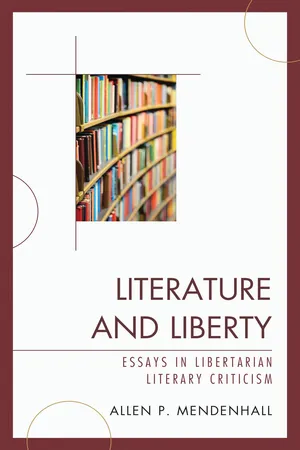
Such interventionism, however, has a track-record of mass murder, war, taxation, colonization, pollution, imprisonment, espionage, and enslavement — things most scholars of imaginative literature deplore. Yet most scholars of imaginative literature remain interventionists. Literature and Liberty offers these scholars an alternative economic paradigm, one that over the course of human history has eliminated more generic bads than any other system. It argues that free market or libertarian literary theory is more humane than any variety of Marxism or interventionism. Just as Marxist historiography can be identified in the use of structuralism and materialist literary theory, so should free-market libertarianism be identifiable in all sorts of literary theory. Literature and Liberty disrupts the near monopolistic control of economic ideas in literary studies and offers a new mode of thinking for those who believe that arts and literature should play a role in discussions about law, politics, government, and economics. Drawing from authors as wide-ranging as Emerson, Shakespeare, E.M. Forster, Geoffrey of Monmouth, Henry Hazlitt, and Mark Twain, Literature and Liberty is a significant contribution to libertarianism and literary studies.
- English
- ePUB (mobile friendly)
- Available on iOS & Android
eBook - ePub
About this book
Information
Table of contents
- Title Page
- Acknowledgments
- Introduction
- Emersonian Individualism
- Liberty and Shakespeare
- Law and Liberty in E.M. Forster’s A Passage to India
- A Tale of the Rise of Law
- Henry Hazlitt, Literary Critic
- Bowdlerizing Huck
- Literature, Transnational Law, and the Decline of the Nation-State
- Conclusion
- Bibliography
- Index
- About the Author
Trusted by 375,005 students
Access to over 1.5 million titles for a fair monthly price.
Study more efficiently using our study tools.
Frequently asked questions
Yes, you can cancel anytime from the Subscription tab in your account settings on the Perlego website. Your subscription will stay active until the end of your current billing period. Learn how to cancel your subscription
No, books cannot be downloaded as external files, such as PDFs, for use outside of Perlego. However, you can download books within the Perlego app for offline reading on mobile or tablet. Learn how to download books offline
Perlego offers two plans: Essential and Complete
- Essential is ideal for learners and professionals who enjoy exploring a wide range of subjects. Access the Essential Library with 800,000+ trusted titles and best-sellers across business, personal growth, and the humanities. Includes unlimited reading time and Standard Read Aloud voice.
- Complete: Perfect for advanced learners and researchers needing full, unrestricted access. Unlock 1.5M+ books across hundreds of subjects, including academic and specialized titles. The Complete Plan also includes advanced features like Premium Read Aloud and Research Assistant.
We are an online textbook subscription service, where you can get access to an entire online library for less than the price of a single book per month. With over 1.5 million books across 990+ topics, we’ve got you covered! Learn about our mission
Look out for the read-aloud symbol on your next book to see if you can listen to it. The read-aloud tool reads text aloud for you, highlighting the text as it is being read. You can pause it, speed it up and slow it down. Learn more about Read Aloud
Yes! You can use the Perlego app on both iOS and Android devices to read anytime, anywhere — even offline. Perfect for commutes or when you’re on the go.
Please note we cannot support devices running on iOS 13 and Android 7 or earlier. Learn more about using the app
Please note we cannot support devices running on iOS 13 and Android 7 or earlier. Learn more about using the app
Yes, you can access Literature and Liberty by Allen Mendenhall in PDF and/or ePUB format, as well as other popular books in Business & Business General. We have over 1.5 million books available in our catalogue for you to explore.