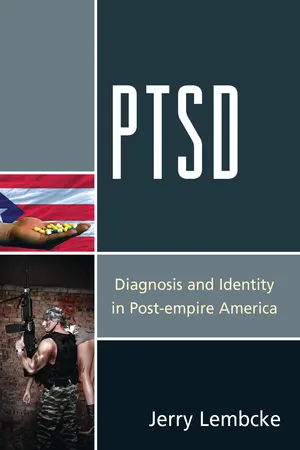
Stories of soldiers suffering from Post-Traumatic Stress Disorder dominate news coverage of the return from wars in the Middle East. On the surface, the stories call our attention to psychic trauma and the need for mental health services for veterans; scratch that surface and we see that PTSD has morphed from a diagnostic category into a cultural trope with broad societal implications. In PTSD: Diagnosis and Identity in Post-empire America, Jerry Lembcke exposes those implications.
Lembcke reprises PTSD's formulation following the war in Vietnam, examining how its medical discourse provided a psychological alternative to the political interpretations of veterans' opposition to the war— psychiatrists said veteran dissent was cathartic, a form of acting-out.
Lembcke drills deeply into the modern history of war-trauma treatment, picking up the threads left by nineteenth-century work on men and hysteria, and following them into the treatment of "shell shock" in World War I. With great originality, Lembcke also shows how art and the media led the "science" of war trauma, and then how the followers of Sigmund Freud showed that shell-shock symptoms were as likely to be expressions of fears and conflicts internal to the patients as the effects of exploding shells. The line drawn by the Freudian critique of the medical/neurological model would resurface in debates leading to PTSD's inclusion in the DSM in 1980 and on-going deliberations over the definition and meaning of Traumatic Brain Injury.
In core chapters, Lembcke shows the influence of film, theater, television, and news coverage on public and professional thinking about war trauma.
The inglorious nature of recent wars, from Vietnam through Iraq and Afghanistan, leaves Americans searching for meaning in those conflicts and finding it in loss and sacrifice. Lembcke warns that the image of damaged war veterans is working metaphorically in these dangerous times to construct a national self-image of defeat and damage that needs to be avenged. It is a dangerous end-of-empire narrative that needs to be engaged, he says, lest its dangers reach fruition in more war. The insights found in this book make it an invaluable resource for scholars of sociology, medical sociology, psychology, military studies, gender studies, and history of psychiatry, and a riveting read for anyone interested in the subjects it treats.
- English
- ePUB (mobile friendly)
- Available on iOS & Android
eBook - ePub
About this book
Information
Table of contents
- Title Page
- Acknowledgements
- Preface
- Wound on the War Front, Alibi on the Home Front: Post Traumatic Stress Disorder in Medical and Legal Guise
- Post Traumatic Stress Disorder: The Coming-home Story for a New Generation of Veterans
- Combat in the American Imagination: What Did You Do in the War?
- The Legacy of Salpêtrière: Art in the Science of War Trauma
- Flashbacks: War Trauma Refashioned for PTSD
- Traumatic Brain Injury: Making a “Signature Wound”
- Mt. Rushmore: Ready for War’s New Face?
- Embrace The Horror
- Bibliography
- Filmography
- Index
- About the Author
Trusted by 375,005 students
Access to over 1.5 million titles for a fair monthly price.
Study more efficiently using our study tools.
Frequently asked questions
Yes, you can cancel anytime from the Subscription tab in your account settings on the Perlego website. Your subscription will stay active until the end of your current billing period. Learn how to cancel your subscription
No, books cannot be downloaded as external files, such as PDFs, for use outside of Perlego. However, you can download books within the Perlego app for offline reading on mobile or tablet. Learn how to download books offline
Perlego offers two plans: Essential and Complete
- Essential is ideal for learners and professionals who enjoy exploring a wide range of subjects. Access the Essential Library with 800,000+ trusted titles and best-sellers across business, personal growth, and the humanities. Includes unlimited reading time and Standard Read Aloud voice.
- Complete: Perfect for advanced learners and researchers needing full, unrestricted access. Unlock 1.5M+ books across hundreds of subjects, including academic and specialized titles. The Complete Plan also includes advanced features like Premium Read Aloud and Research Assistant.
We are an online textbook subscription service, where you can get access to an entire online library for less than the price of a single book per month. With over 1.5 million books across 990+ topics, we’ve got you covered! Learn about our mission
Look out for the read-aloud symbol on your next book to see if you can listen to it. The read-aloud tool reads text aloud for you, highlighting the text as it is being read. You can pause it, speed it up and slow it down. Learn more about Read Aloud
Yes! You can use the Perlego app on both iOS and Android devices to read anytime, anywhere — even offline. Perfect for commutes or when you’re on the go.
Please note we cannot support devices running on iOS 13 and Android 7 or earlier. Learn more about using the app
Please note we cannot support devices running on iOS 13 and Android 7 or earlier. Learn more about using the app
Yes, you can access PTSD by Jerry Lembcke in PDF and/or ePUB format, as well as other popular books in Social Sciences & Global Development Studies. We have over 1.5 million books available in our catalogue for you to explore.