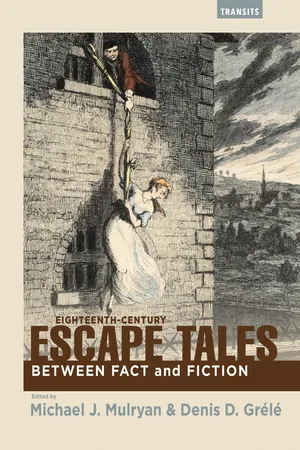
eBook - ePub
Eighteenth-Century Escape Tales
Between Fact and Fiction
- English
- ePUB (mobile friendly)
- Available on iOS & Android
eBook - ePub
About this book
This volume is a study of the interdisciplinary nature of prison escape tales and their impact on European cultural identity in the eighteenth century. Prison escape narratives are reflections of the tension between the individual's potential happiness via freedom and the confines of the social order. Contemporary readers identified with the prisoner, who, like them suffered the injustices of an absolutist regime. The state imprisons such renegades not just out of a desire to protect the public but more importantly to protect the state itself. Hence, prison escape tales can be linked with a revolutionary tendency: when free, such former detainees equipped with a pen openly and justly challenge the status quo, hoping to inspire their readers to do the same. Escape tales have had a considerable impact on cultural identity, because they embody the interdependent relationship between literature and myth on the one hand and literature and history on the other.
Information
Table of contents
- Contents
- A Note on Translations
- Acknowledgments
- Introduction
- Chapter 1: A Model for Eighteenth-Century Récits d’évasion
- Chapter 2: The “Slippery Eel”
- Chapter 3: Having a Cage in Her Hand
- Chapter 4: Du plaisir dans ma solitude
- Chapter 5: Utopia as a Prison
- Chapter 6: Conclusion
- Notes
- Bibliography
- About the Contributors
Trusted by 375,005 students
Access to over 1.5 million titles for a fair monthly price.
Study more efficiently using our study tools.
Frequently asked questions
Yes, you can cancel anytime from the Subscription tab in your account settings on the Perlego website. Your subscription will stay active until the end of your current billing period. Learn how to cancel your subscription
No, books cannot be downloaded as external files, such as PDFs, for use outside of Perlego. However, you can download books within the Perlego app for offline reading on mobile or tablet. Learn how to download books offline
Perlego offers two plans: Essential and Complete
- Essential is ideal for learners and professionals who enjoy exploring a wide range of subjects. Access the Essential Library with 800,000+ trusted titles and best-sellers across business, personal growth, and the humanities. Includes unlimited reading time and Standard Read Aloud voice.
- Complete: Perfect for advanced learners and researchers needing full, unrestricted access. Unlock 1.5M+ books across hundreds of subjects, including academic and specialized titles. The Complete Plan also includes advanced features like Premium Read Aloud and Research Assistant.
We are an online textbook subscription service, where you can get access to an entire online library for less than the price of a single book per month. With over 1.5 million books across 990+ topics, we’ve got you covered! Learn about our mission
Look out for the read-aloud symbol on your next book to see if you can listen to it. The read-aloud tool reads text aloud for you, highlighting the text as it is being read. You can pause it, speed it up and slow it down. Learn more about Read Aloud
Yes! You can use the Perlego app on both iOS and Android devices to read anytime, anywhere — even offline. Perfect for commutes or when you’re on the go.
Please note we cannot support devices running on iOS 13 and Android 7 or earlier. Learn more about using the app
Please note we cannot support devices running on iOS 13 and Android 7 or earlier. Learn more about using the app
Yes, you can access Eighteenth-Century Escape Tales by Michael J. Mulryan,Denis D. Grélé in PDF and/or ePUB format, as well as other popular books in Literature & French Literary Criticism. We have over 1.5 million books available in our catalogue for you to explore.