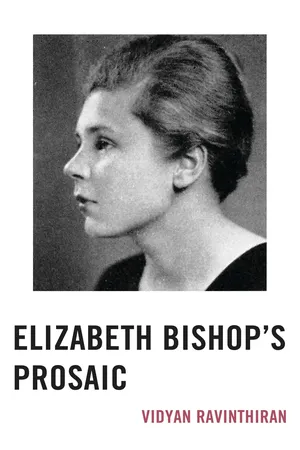
Elizabeth Bishop is now recognized as one of the greatest poets of the twentieth century—a uniquely cosmopolitan writer with connections to the US, Canada, Brazil, and also the UK, given her neglected borrowings from many English authors, and her strong influence on modern British verse. Yet the dominant biographical/psychoanalytical approach leaves her style relatively untouched—and it is vital that an increasing focus on archival material does not replace our attention to the writing itself. Bishop's verse is often compared with prose (sometimes insultingly); writing fiction, she worried she was really writing poems. But what truly is the difference between poetry and prose—structurally, conceptually, historically speaking? Is prose simply formalized speech, or does it have rhythms of its own? Ravinthiran seeks an answer to this question through close analysis of Bishop's prose-like verse, her literary prose, her prose poems, and her letter prose. This title is a provocation. It demands that we reconsider the pejorative quality of the word prosaic; playing on mosaic, Ravinthiran uses Bishop's thinking about prose to approach—for the first time—her work in multiple genres as a stylistic whole.
Elizabeth Bishop's Prosaic is concerned not only with her inimitable style, but also larger questions to do with the Anglo-American shift from closed to open forms in the twentieth century. This study identifies not just borrowings from, but rich intertextual relationships with, writers as diverse as—among others—Gerard Manley Hopkins, W.H. Auden, Virginia Woolf, Flannery O'Connor, and Dorothy Richardson. (Though Bishop criticized Woolf, she in particular is treated as a central and thus far neglected precursor, crucial to our understanding of Bishop as a feminist poet.) Finally, the sustained discussion of how the history of prose frames effects of rhythm, syntax, and acoustic texture—in both Bishop's prose proper and her prosaic verse—extends a body of research which seeks now to treat literature as a form of cognition. Technique and thought are finely wedded in Bishop's work—her literary forms evince a historical intelligence attuned to questions of power, nationality, tradition (both literary and otherwise), race, and gender.
- English
- ePUB (mobile friendly)
- Available on iOS & Android
eBook - ePub
Elizabeth Bishop's Prosaic
About this book
Information
Table of contents
- Title Page
- Acknowledgments
- Credits
- Introduction
- Poetry and Prose-Rhythm
- Bishop’s Description
- Bishop’s Letters
- Bishop’s Literary Prose
- “Rainy Season; Sub-Tropics”
- “Santarém” and the Aesthetic Claim
- Postscript
- Bibliography
- Index
- About the Author
Trusted by 375,005 students
Access to over 1.5 million titles for a fair monthly price.
Study more efficiently using our study tools.
Frequently asked questions
Yes, you can cancel anytime from the Subscription tab in your account settings on the Perlego website. Your subscription will stay active until the end of your current billing period. Learn how to cancel your subscription
No, books cannot be downloaded as external files, such as PDFs, for use outside of Perlego. However, you can download books within the Perlego app for offline reading on mobile or tablet. Learn how to download books offline
We are an online textbook subscription service, where you can get access to an entire online library for less than the price of a single book per month. With over 1.5 million books across 990+ topics, we’ve got you covered! Learn about our mission
Look out for the read-aloud symbol on your next book to see if you can listen to it. The read-aloud tool reads text aloud for you, highlighting the text as it is being read. You can pause it, speed it up and slow it down. Learn more about Read Aloud
Yes! You can use the Perlego app on both iOS and Android devices to read anytime, anywhere — even offline. Perfect for commutes or when you’re on the go.
Please note we cannot support devices running on iOS 13 and Android 7 or earlier. Learn more about using the app
Please note we cannot support devices running on iOS 13 and Android 7 or earlier. Learn more about using the app
Yes, you can access Elizabeth Bishop's Prosaic by Vidyan Ravinthiran in PDF and/or ePUB format, as well as other popular books in Literature & Literary Criticism for Women Authors. We have over 1.5 million books available in our catalogue for you to explore.