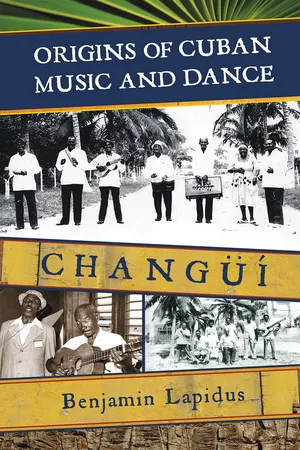
Origins of Cuban Music and Dance: Changüí is the first in-depth study of changüí, a style of music and dance in Guantánamo, Cuba. Changüí is analogous to blues in the United States and is a crucible of Cuban Creole culture. Benjamin Lapidus describes changüí and its relationship to the roots of son, Cuba's national genre and the style of music that contributed to the development of salsa, in Eastern Cuba. He also highlights the connections between Afro-Haitian music and Cuban popular music through changüí, connections with the Caribbean that have been largely overlooked in the past.
After an initial historical discussion about the region of Guantánamo and the inter-connectedness of its various musical styles with a focus on changüí, Lapidus discusses the technical aspects of the genre as practiced within the region and beyond. He considers the socio-historical importance of its lyrics, presenting numerous musical transcriptions that explain how the music is structured, as well as providing background stories to songs. In a chapter unique to this book and a first in Cuban musicology and ethnography, Lapidus describes years of festivals and musical competitions to show how local musical identity takes shape, particularly when encountering national narratives of music history. The volume concludes with a comparison between changüí and son, as well as a bibliography, discography, and videography.
- English
- ePUB (mobile friendly)
- Available on iOS & Android
eBook - ePub
About this book
Information
Subtopic
EthnomusicologyTable of contents
- Cover
- Title
- Copyright
- Dedication
- Contents
- Foreword
- Preface
- Acknowledgments
- Introduction
- 1 Guantánamo and the Greater Oriente Region
- 2 Como se toca se baila, como se baila se toca: The Instruments and Their Roles in the Changüí Ensemble
- 3 Styles of Tres Improvisation
- 4 Historicity and Self-Referencing in Changüí Songs
- 5 The Changüí Complex in Guantánamo
- 6 Variations of Changüí outside of Guantánamo
- 7 The Afro-Haitian Presence in Eastern Cuba and Its Significance in the Development of the Cuban Son
- 8 Cultural Festivals and Musical Competitions in Guantánamo and Oriente
- Conclusion: Changüí, Son, and the Pan-Caribbean Perspective
- Bibliography
- Index
- About the Author
Trusted by 375,005 students
Access to over 1.5 million titles for a fair monthly price.
Study more efficiently using our study tools.
Frequently asked questions
Yes, you can cancel anytime from the Subscription tab in your account settings on the Perlego website. Your subscription will stay active until the end of your current billing period. Learn how to cancel your subscription
No, books cannot be downloaded as external files, such as PDFs, for use outside of Perlego. However, you can download books within the Perlego app for offline reading on mobile or tablet. Learn how to download books offline
We are an online textbook subscription service, where you can get access to an entire online library for less than the price of a single book per month. With over 1.5 million books across 990+ topics, we’ve got you covered! Learn about our mission
Look out for the read-aloud symbol on your next book to see if you can listen to it. The read-aloud tool reads text aloud for you, highlighting the text as it is being read. You can pause it, speed it up and slow it down. Learn more about Read Aloud
Yes! You can use the Perlego app on both iOS and Android devices to read anytime, anywhere — even offline. Perfect for commutes or when you’re on the go.
Please note we cannot support devices running on iOS 13 and Android 7 or earlier. Learn more about using the app
Please note we cannot support devices running on iOS 13 and Android 7 or earlier. Learn more about using the app
Yes, you can access Origins of Cuban Music and Dance by Benjamin Lapidus in PDF and/or ePUB format, as well as other popular books in Media & Performing Arts & Ethnomusicology. We have over 1.5 million books available in our catalogue for you to explore.