- English
- ePUB (mobile friendly)
- Available on iOS & Android
eBook - ePub
About this book
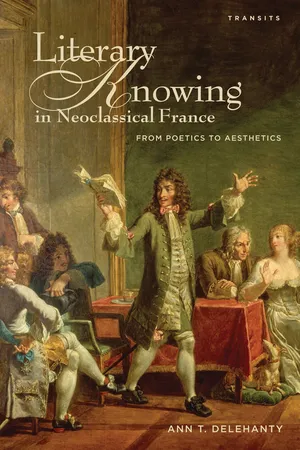
Literary Knowing in Neoclassical France analyzes the work of several literary critics in France and England, at the end of the seventeenth and beginning of the eighteenth centuries, who were inspired by the idea that literature – especially the literary sublime – might offer us the deepest kind of knowledge. Dominique Bouhours, Nicolas Boileau, René Rapin, John Dennis, and the abbé Dubos believed that literature could deliver truths that transcend our world and were analogous or even equal to the truths of divine revelation. Ann Delehanty argues that this shift towards the transcendental realm pushed the definition of the literary work away from describing its objective properties and towards its effects on the mind of the reader. After placing these ideas about literature in the context of the religious and philosophical thinking of Blaise Pascal, Delehanty traces the evolution of a debate about literature in the writings of the critics in question. They embraced theories of sentiment and the passions as the epistemological means of identifying and knowing the transcendental aspects of a literary work that eventually came to be known as aesthetics. By tracing the historical evolution of the relationship between transcendentalism and aesthetics in French and English neoclassical thought, Literary Knowing in Neoclassical France provides new and engaging insights into an important moment in our literary history.
Information
Table of contents
- Contents
- Acknowledgements
- A Note on Translations
- Introduction
- Chapter 1: The Heart’s Knowledge in Pascal
- Chapter 2: Divine and Human Creation in Bouhours
- Chapter 3: Boileau and the Sublime
- Chapter 4: From Transcendence to Virtue in Rapin
- Chapter 5: Dennis’s Theory of Mind
- Chapter 6: Dubos and the Faculty of Sentiment
- Conclusion
- Notes
- Bibliography
- About the Author
Trusted by 375,005 students
Access to over 1.5 million titles for a fair monthly price.
Study more efficiently using our study tools.
Frequently asked questions
Yes, you can cancel anytime from the Subscription tab in your account settings on the Perlego website. Your subscription will stay active until the end of your current billing period. Learn how to cancel your subscription
No, books cannot be downloaded as external files, such as PDFs, for use outside of Perlego. However, you can download books within the Perlego app for offline reading on mobile or tablet. Learn how to download books offline
Perlego offers two plans: Essential and Complete
- Essential is ideal for learners and professionals who enjoy exploring a wide range of subjects. Access the Essential Library with 800,000+ trusted titles and best-sellers across business, personal growth, and the humanities. Includes unlimited reading time and Standard Read Aloud voice.
- Complete: Perfect for advanced learners and researchers needing full, unrestricted access. Unlock 1.5M+ books across hundreds of subjects, including academic and specialized titles. The Complete Plan also includes advanced features like Premium Read Aloud and Research Assistant.
We are an online textbook subscription service, where you can get access to an entire online library for less than the price of a single book per month. With over 1.5 million books across 990+ topics, we’ve got you covered! Learn about our mission
Look out for the read-aloud symbol on your next book to see if you can listen to it. The read-aloud tool reads text aloud for you, highlighting the text as it is being read. You can pause it, speed it up and slow it down. Learn more about Read Aloud
Yes! You can use the Perlego app on both iOS and Android devices to read anytime, anywhere — even offline. Perfect for commutes or when you’re on the go.
Please note we cannot support devices running on iOS 13 and Android 7 or earlier. Learn more about using the app
Please note we cannot support devices running on iOS 13 and Android 7 or earlier. Learn more about using the app
Yes, you can access Literary Knowing in Neoclassical France by Ann T. Delehanty in PDF and/or ePUB format, as well as other popular books in Literature & English Literary Criticism. We have over 1.5 million books available in our catalogue for you to explore.