Through the study of more than twenty novels produced in Spain from the 1840s to the 1920s, this book explores the literary means by which the social options available to modern Spanish bourgeois citizens were discursively constructed, occasionally before and often concomitantly to their production in reality. As a result, this study is concerned with the interplay of realism and reality in modern Spain. From the earliest folletines of the 1840s to the Modernist novels of the 1920s, the majority of novels written in this eighty-year period are what one might term novelas de costumbres contemporáneas, or novels of contemporary customs, and therefore primarily concerned with faithfully copying and moreover influencing real social norms in the public sphere.
In these pages, I argue that the spatial and behavioral discourses in the novels of contemporary customs offer a telling history of the evolving formulation of the Spanish bourgeoisie. The linking of novels and urbanism is hardly arbitrary in the context of nineteenth-century Spain. Urbanism, particularly in the nineteenth century, was as much a verbal construction as the novel, as proven by the lengthy treatises of such prominent Spanish bureaucrats, engineers, architects, and urban planners as Ramón de Mesonero Romanos, Ildefons Cerdà and Carlos María de Castro. For Spanish intellectuals of this era, city planning and the novel functioned as parallel, enmeshed discourses in which to work out what it meant to be middle class and the roles this class ought to play in contemporary society. In this way, they can be considered associated fields of discourse, in the sense described by Michel Foucault in The Archaeology of Knowledge. Foucault's treatise was a call for scholars to reexamine historical fields and question the historical grouping of knowledge(s) into certain discursive unities, and consider whether these might be broken up and new ones conceived.In this vein, this book undertakes a broader and more integrative view of the Spanish nineteenth century, calling into question the boundaries of fields such as etiquette and urban planning, or literature and touristic discourse.
eBook - ePub
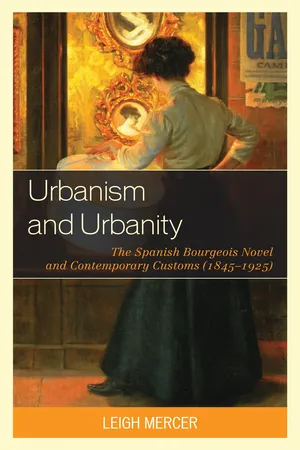
Urbanism and Urbanity
The Spanish Bourgeois Novel and Contemporary Customs (1845–1925)
- English
- ePUB (mobile friendly)
- Available on iOS & Android
eBook - ePub
About this book
Information
Table of contents
- Title Page
- Note on Translations
- Acknowledgments
- Introduction
- All the World’s Her Stage: The Museum and the Theater
- Consuming Desires: The Boutique and the Promenade
- The Games Men Play: The Stock Market and the Casino
- Fields of Honor: Political Clubs, Congress, and Dueling Grounds
- Afterword
- Bibliography
- Index
- About the Author
Trusted by 375,005 students
Access to over 1.5 million titles for a fair monthly price.
Study more efficiently using our study tools.
Frequently asked questions
Yes, you can cancel anytime from the Subscription tab in your account settings on the Perlego website. Your subscription will stay active until the end of your current billing period. Learn how to cancel your subscription
No, books cannot be downloaded as external files, such as PDFs, for use outside of Perlego. However, you can download books within the Perlego app for offline reading on mobile or tablet. Learn how to download books offline
Perlego offers two plans: Essential and Complete
- Essential is ideal for learners and professionals who enjoy exploring a wide range of subjects. Access the Essential Library with 800,000+ trusted titles and best-sellers across business, personal growth, and the humanities. Includes unlimited reading time and Standard Read Aloud voice.
- Complete: Perfect for advanced learners and researchers needing full, unrestricted access. Unlock 1.5M+ books across hundreds of subjects, including academic and specialized titles. The Complete Plan also includes advanced features like Premium Read Aloud and Research Assistant.
We are an online textbook subscription service, where you can get access to an entire online library for less than the price of a single book per month. With over 1.5 million books across 990+ topics, we’ve got you covered! Learn about our mission
Look out for the read-aloud symbol on your next book to see if you can listen to it. The read-aloud tool reads text aloud for you, highlighting the text as it is being read. You can pause it, speed it up and slow it down. Learn more about Read Aloud
Yes! You can use the Perlego app on both iOS and Android devices to read anytime, anywhere — even offline. Perfect for commutes or when you’re on the go.
Please note we cannot support devices running on iOS 13 and Android 7 or earlier. Learn more about using the app
Please note we cannot support devices running on iOS 13 and Android 7 or earlier. Learn more about using the app
Yes, you can access Urbanism and Urbanity by Leigh Mercer in PDF and/or ePUB format, as well as other popular books in Literature & European Literary Criticism. We have over 1.5 million books available in our catalogue for you to explore.