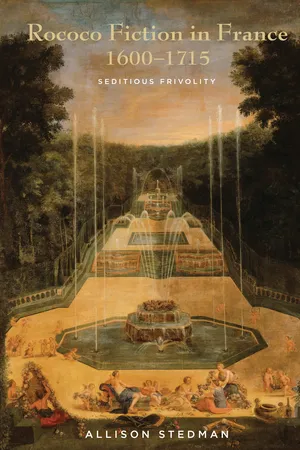
Rococo Fiction in France reconfigures the history of the "long eighteenth century" by revealing the rococo as a literary phenomenon that characterized a range of experimental texts from the end of the French Renaissance to the eve of the French Revolution. Tracing the literary rococo's evolution from the late 1500s to the early 1700s, and exploring its radicalization during the 1670s, '80s, and '90s, Allison Stedman unearths the seventeenth century rococo's counter-vision for the trajectory of the French monarchy and the dawn of the French Enlightenment.
The first part of the study investigates the relationship between Montaigne's philosophy of literary production and those of early seventeenth-century "table-talk" novelists, libertine writers, and playwrights involved in the quarrel over Corneille's play Le Cid. She thus establishes the existence of a rococo philosophy of literary production whose goal was to innovate, to bring pleasure, and to create communities. The second part of the study explores the impact that the Duchess de Montpensier's literary portrait galleries, Jean Donneau de Visé's periodical the Mercure Galant, and other forms of rococo literary production—by such authors as Charles Sorel, Alcide de Saint-Maurice, J.N. de Parvial and Jean de Préchac—had in the creation of a textually mediated social sphere that served as the foundation of the publicly critical culture of the French Enlightenment. The study concludes with an investigation of the influx of salon sociability into the textually mediated social sphere during the 1690s. Stedman examines the role of interpolated literary fairy tales, proverb plays and other rococo publication strategies—in such late seventeenth-century women writers as d'Aulnoy, Lhéritier, Murat, and Durand—in transfiguring the salon from an exclusive social circle mediated by physical presence to an inclusive social diaspora mediated by texts. Rococo Fiction in France challenges established views of early modern French literary history and discusses a range of little known works in a generous and engaging manner.
- English
- ePUB (mobile friendly)
- Available on iOS & Android
eBook - ePub
About this book
Information
Table of contents
- Contents
- Acknowledgments
- A Note on Translations
- Introduction
- Chapter 1: Innovation in Early Seventeenth-Century France
- Chapter 2: The Origins of the Rococo
- Chapter 3: The Rococo and the Transfiguration of the Old-Regime Social Sphere
- Chapter 4: The Rococo and the Transfiguration of the Salon
- Conclusion
- Notes
- Bibliography
- About the Author
Trusted by 375,005 students
Access to over 1.5 million titles for a fair monthly price.
Study more efficiently using our study tools.
Frequently asked questions
Yes, you can cancel anytime from the Subscription tab in your account settings on the Perlego website. Your subscription will stay active until the end of your current billing period. Learn how to cancel your subscription
No, books cannot be downloaded as external files, such as PDFs, for use outside of Perlego. However, you can download books within the Perlego app for offline reading on mobile or tablet. Learn how to download books offline
Perlego offers two plans: Essential and Complete
- Essential is ideal for learners and professionals who enjoy exploring a wide range of subjects. Access the Essential Library with 800,000+ trusted titles and best-sellers across business, personal growth, and the humanities. Includes unlimited reading time and Standard Read Aloud voice.
- Complete: Perfect for advanced learners and researchers needing full, unrestricted access. Unlock 1.5M+ books across hundreds of subjects, including academic and specialized titles. The Complete Plan also includes advanced features like Premium Read Aloud and Research Assistant.
We are an online textbook subscription service, where you can get access to an entire online library for less than the price of a single book per month. With over 1.5 million books across 990+ topics, we’ve got you covered! Learn about our mission
Look out for the read-aloud symbol on your next book to see if you can listen to it. The read-aloud tool reads text aloud for you, highlighting the text as it is being read. You can pause it, speed it up and slow it down. Learn more about Read Aloud
Yes! You can use the Perlego app on both iOS and Android devices to read anytime, anywhere — even offline. Perfect for commutes or when you’re on the go.
Please note we cannot support devices running on iOS 13 and Android 7 or earlier. Learn more about using the app
Please note we cannot support devices running on iOS 13 and Android 7 or earlier. Learn more about using the app
Yes, you can access Rococo Fiction in France, 1600–1715 by Allison Stedman in PDF and/or ePUB format, as well as other popular books in Literature & Early Modern History. We have over 1.5 million books available in our catalogue for you to explore.