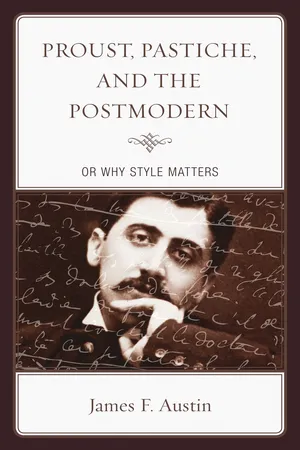
Proust, Pastiche, and the Postmodern, or Why Style Matters argues against the traditional view that Marcel Proust wrote pastiches, that is, texts that imitate the style of another author, to master his literary predecessors while sharpening his writerly quill. On the contrary, James F. Austin demonstrates that Proust's oeuvre, and In Search of Lost Time in particular, deploy pastiche to other ends: Proust's pastiches, in fact, "do things with words" to create powerful real-world effects. His works are indeed performative acts that forge social relationships, redefine our ideas of literature, and even work against oppressive political and economic discourses.
Building on the "speech-act" theory of J.L. Austin, Jacques Derrida, and J. Hillis Miller, and on the postmodern theory of Fredric Jameson, this book not only elucidates the performative nature of pastiche, but also shows that the famous "Goncourt" pastiche from In Search of Lost Time has attracted so much attention because it already attained the postmodern; that is, it eliminated temporal depth and experience, transforming time itself into a nostalgic style of an era, and into the sort of aestheticized surface that came to define postmodernism decades later.
To reflect this transformation of pastiche, this work rearticulates its history in France around Proust. Reconfiguring a scholastic, classically-inspired pedagogical tradition based on imitation, and breaking with the dominant satirical practice, Proust's work opened up possibilities in the twentieth century for a new kind of pastiche: playful and performative in the literary field, and postmodern in a French cinema that, as with the Goncourt pastiche, represents time as the visual style of an era, whether unreflexively in "heritage" films such as Régis Wargnier's Indochine, or discerningly in Eric Rohmer's Lady and the Duke, which uses period pictorial and painterly conventions to illustrate how the representation of history onscreen typically flattens time into style.
- English
- ePUB (mobile friendly)
- Available on iOS & Android
eBook - ePub
Proust, Pastiche, and the Postmodern or Why Style Matters
About this book
Information
Table of contents
- Title Page
- Acknowledgments
- Abbreviations
- List of Figures
- Introduction
- Proust in School
- Parody and Pastiche in Nineteenth-Century French Literature
- Why Proust’s Pastiches Are Neither Parodic, Nor a Proof of Mastery Over the Predecessor
- What Can Pastiche Do?
- Pastiche as Politically and Economically Performative in A la recherche du temps perdu
- Proust’s Goncourt Pastiche and the Postmodern
- Literary Pastiche Since Proust
- Pastiche Proustian, Postmodern, and Purloined in the Cinema, or, Where’s the Pastiche in French Film?
- Postmodern Pastiche in the Films of Rohmer and Gans
- Conclusion
- Bibliography
- Index
- About the Author
Trusted by 375,005 students
Access to over 1.5 million titles for a fair monthly price.
Study more efficiently using our study tools.
Frequently asked questions
Yes, you can cancel anytime from the Subscription tab in your account settings on the Perlego website. Your subscription will stay active until the end of your current billing period. Learn how to cancel your subscription
No, books cannot be downloaded as external files, such as PDFs, for use outside of Perlego. However, you can download books within the Perlego app for offline reading on mobile or tablet. Learn how to download books offline
Perlego offers two plans: Essential and Complete
- Essential is ideal for learners and professionals who enjoy exploring a wide range of subjects. Access the Essential Library with 800,000+ trusted titles and best-sellers across business, personal growth, and the humanities. Includes unlimited reading time and Standard Read Aloud voice.
- Complete: Perfect for advanced learners and researchers needing full, unrestricted access. Unlock 1.5M+ books across hundreds of subjects, including academic and specialized titles. The Complete Plan also includes advanced features like Premium Read Aloud and Research Assistant.
We are an online textbook subscription service, where you can get access to an entire online library for less than the price of a single book per month. With over 1.5 million books across 990+ topics, we’ve got you covered! Learn about our mission
Look out for the read-aloud symbol on your next book to see if you can listen to it. The read-aloud tool reads text aloud for you, highlighting the text as it is being read. You can pause it, speed it up and slow it down. Learn more about Read Aloud
Yes! You can use the Perlego app on both iOS and Android devices to read anytime, anywhere — even offline. Perfect for commutes or when you’re on the go.
Please note we cannot support devices running on iOS 13 and Android 7 or earlier. Learn more about using the app
Please note we cannot support devices running on iOS 13 and Android 7 or earlier. Learn more about using the app
Yes, you can access Proust, Pastiche, and the Postmodern or Why Style Matters by James F. Austin in PDF and/or ePUB format, as well as other popular books in Literature & French Literary Criticism. We have over 1.5 million books available in our catalogue for you to explore.