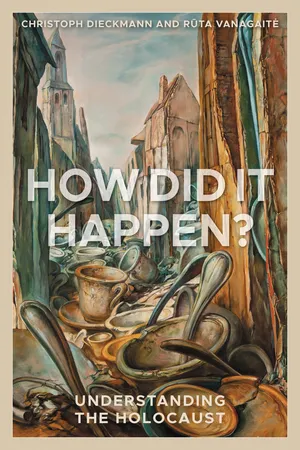
In this compelling book, Lithuanian author Ruta Vanagaite holds an extended conversation with noted historian Christoph Dieckmann. His exploration of the causes and consequences of the
Holocaust in Lithuania provides the first overview for general readers that considers the perspectives of all the central groups involved—Jews, Lithuanians, and Germans. Drawing on a rich array of sources in all the key languages—Yiddish, Ivrit, Lithuanian, and German—Dieckmann considers not only the Berlin-based orientation of the German perpetrators but also the space where the Shoah took place—Lithuanian society with its Jewish minority under German occupation. He contends that this "space" of mass crimes is always linked with warfare and occupation. The Holocaust was unprecedented, but he makes a powerful case it cannot be isolated from the other mass crimes that took place at the same time in the same space against thousands of Soviet prisoners of war and forced refugees from the Soviet territories.
Dieckmann shows that the Holocaust could not have unfolded throughout German-dominated Europe without the conditional cooperation of non-Germans in each occupied country. Existing antisemitism was radicalized from the 1930s onward, turning Jews, under the enormous stress of unrelenting warfare and often instable conditions of occupation, into what were perceived as deadly enemies. The Holocaust, its history and memory, can only be understood through this broader context. The authors' searching exchanges illuminate the most profound questions we have as we struggle to understand the Holocaust.
- English
- ePUB (mobile friendly)
- Available on iOS & Android
eBook - ePub
About this book
Information
Table of contents
- Title Page
- Prologue
- Acknowledgments
- Why This Book?
- People Had a Choice
- Germany’s Trauma
- Lithuania’s Trauma
- The Jew Is the Devil
- Small and Radical
- Plans for Mass Murder
- “Blitzkrieg”: Local Helpers Needed!
- Lithuania’s Dream of Independence
- An Easy Occupation
- Controversies of the Uprising
- Enter the SS
- Jews in Panic
- Lithuanian Border Strip: The First Shootings
- Pogroms
- The First Mass Shooting of Jews in Kaunas
- The Road to Ponar
- Vigilante Lithuanian Courts
- Ghettoization in the Provinces
- Robbing the Living
- Lithuanian Fascists Take Over
- “Kill Them All!”
- The “Final Solution” in the Provinces
- The Oral Orders
- The Lithuanian Road Killers
- 100,000 Trapped City Jews
- Life in the Ghettos: Hunger, Poetry, Death
- Choiceless Choices
- The Accidental Death of European Jews
- Forgotten Victims: Soviet POWs
- Forgotten Victims: The Soviet Evacuees
- Slavery
- No to the SS Legion
- To Die as Free Fighters
- Survival and Terror
- The End: Vilnius
- The End: Šiauliai
- The End: Kaunas
- The Murdered “Others”
- Burning the Bodies
- To Save a Jew
- The Silence of the Church
- The Brief Story of Lithuanian Resistance
- Epilogue
- Selected Bibliography
- Index
- About the Authors
Trusted by 375,005 students
Access to over 1.5 million titles for a fair monthly price.
Study more efficiently using our study tools.
Frequently asked questions
Yes, you can cancel anytime from the Subscription tab in your account settings on the Perlego website. Your subscription will stay active until the end of your current billing period. Learn how to cancel your subscription
No, books cannot be downloaded as external files, such as PDFs, for use outside of Perlego. However, you can download books within the Perlego app for offline reading on mobile or tablet. Learn how to download books offline
Perlego offers two plans: Essential and Complete
- Essential is ideal for learners and professionals who enjoy exploring a wide range of subjects. Access the Essential Library with 800,000+ trusted titles and best-sellers across business, personal growth, and the humanities. Includes unlimited reading time and Standard Read Aloud voice.
- Complete: Perfect for advanced learners and researchers needing full, unrestricted access. Unlock 1.5M+ books across hundreds of subjects, including academic and specialized titles. The Complete Plan also includes advanced features like Premium Read Aloud and Research Assistant.
We are an online textbook subscription service, where you can get access to an entire online library for less than the price of a single book per month. With over 1.5 million books across 990+ topics, we’ve got you covered! Learn about our mission
Look out for the read-aloud symbol on your next book to see if you can listen to it. The read-aloud tool reads text aloud for you, highlighting the text as it is being read. You can pause it, speed it up and slow it down. Learn more about Read Aloud
Yes! You can use the Perlego app on both iOS and Android devices to read anytime, anywhere — even offline. Perfect for commutes or when you’re on the go.
Please note we cannot support devices running on iOS 13 and Android 7 or earlier. Learn more about using the app
Please note we cannot support devices running on iOS 13 and Android 7 or earlier. Learn more about using the app
Yes, you can access How Did It Happen? by Christoph Dieckmann,Ruta Vanagaite in PDF and/or ePUB format, as well as other popular books in History & Holocaust History. We have over 1.5 million books available in our catalogue for you to explore.