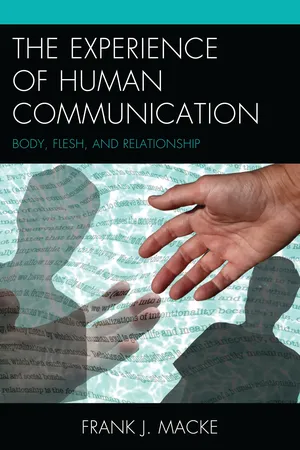
This book deals with matters of embodiment and meaning—in other words, the essential components of what Continental thought, since Heidegger, has come to consider as "communication." A critical theme of this book concerns the basic tenet that consciousness of one's Self and one's body is only possible through human relationship. This is, of course, the phenomenological concept of intersubjectivity. But rather than let this concept remain an abstraction by discussing it as merely a function of language and signs, this work attempts to explicate it empirically. That is, it discusses the manner in which—from infancy to childhood and adolescence (and the dawning of our sexual identities) through physical maturity and old age—we come to experience the ecstasy of what Merleau-Ponty has so poetically termed "flesh."
It is rarely clear what someone means when she or he uses the word "communication." An important objective of this book is, thus, to advance understanding of what communication is. In academic discourse, "communication" has come to be understood in a number of contexts—some conflicting and overlapping—as a process, a strategy, an event, an ethic, a mode or instance of information, or even a technology. In virtually all of these discussions, the concept of communication is discussed as though the term's meaning is well known to the reader. When communication is described as a process, the meaning of the term is held at an operational level—that is, in the exchange of information between one person and another, what must unambiguously be inferred is that "communication" is taking place. In this context, information exchange and communication become functionally synonymous. But as a matter of embodied human psychological experience, there is a world of difference between them. As such, this book attempts to fully consider the question of how we experience the event of human communication. The author offers a pioneering study that advances the raison d'être of the emergent field of "communicology," while at the same time offering scholars of the human sciences a new way of thinking about embodiment and relational experience.
- English
- ePUB (mobile friendly)
- Available on iOS & Android
eBook - ePub
About this book
Information
Table of contents
- Title Page
- Acknowledgments
- Introduction
- Therapy, Vulnerability, and Feeling in the Interstices of Embodied Expression
- The Mirrored Body
- On Contact
- Body, Liquidity, and Flesh
- The Diabolical Parable and the Devil in Speech
- Identity, Intimacy, and Eroticism
- An Archaeology of Gender Symbols and a Theory of Communication
- The Flesh of Human Communicative Embodiment and the Game of Intimacy
- The Dream and the Self
- Conclusion
- References
- Index
Trusted by 375,005 students
Access to over 1.5 million titles for a fair monthly price.
Study more efficiently using our study tools.
Frequently asked questions
Yes, you can cancel anytime from the Subscription tab in your account settings on the Perlego website. Your subscription will stay active until the end of your current billing period. Learn how to cancel your subscription
No, books cannot be downloaded as external files, such as PDFs, for use outside of Perlego. However, you can download books within the Perlego app for offline reading on mobile or tablet. Learn how to download books offline
Perlego offers two plans: Essential and Complete
- Essential is ideal for learners and professionals who enjoy exploring a wide range of subjects. Access the Essential Library with 800,000+ trusted titles and best-sellers across business, personal growth, and the humanities. Includes unlimited reading time and Standard Read Aloud voice.
- Complete: Perfect for advanced learners and researchers needing full, unrestricted access. Unlock 1.5M+ books across hundreds of subjects, including academic and specialized titles. The Complete Plan also includes advanced features like Premium Read Aloud and Research Assistant.
We are an online textbook subscription service, where you can get access to an entire online library for less than the price of a single book per month. With over 1.5 million books across 990+ topics, we’ve got you covered! Learn about our mission
Look out for the read-aloud symbol on your next book to see if you can listen to it. The read-aloud tool reads text aloud for you, highlighting the text as it is being read. You can pause it, speed it up and slow it down. Learn more about Read Aloud
Yes! You can use the Perlego app on both iOS and Android devices to read anytime, anywhere — even offline. Perfect for commutes or when you’re on the go.
Please note we cannot support devices running on iOS 13 and Android 7 or earlier. Learn more about using the app
Please note we cannot support devices running on iOS 13 and Android 7 or earlier. Learn more about using the app
Yes, you can access The Experience of Human Communication by Frank J. Macke in PDF and/or ePUB format, as well as other popular books in Languages & Linguistics & Communication Studies. We have over 1.5 million books available in our catalogue for you to explore.