eBook - ePub
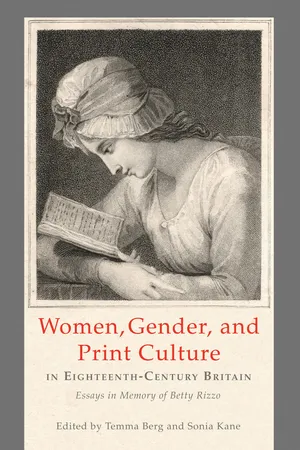
Women, Gender, and Print Culture in Eighteenth-Century Britain
Essays in Memory of Betty Rizzo
- English
- ePUB (mobile friendly)
- Available on iOS & Android
eBook - ePub
Women, Gender, and Print Culture in Eighteenth-Century Britain
Essays in Memory of Betty Rizzo
About this book
This edited collection, a tribute to the late noted eighteenth-century scholar Betty Rizzo, testifies to her influence as a researcher, writer, teacher, and mentor. The essays, written by a range of established and younger eighteenth-century specialists, expand on the themes important to Rizzo: the importance of the archive, the contributions of women writers to the canon of eighteenth-century literature and to an emerging print culture, the sometimes fraught relations within the eighteenth-century family, the relationship between life and literature, and, finally, the role of female companionship in women's lives. Divided into three sections, "Living in the Eighteenth-Century Novel," "Living in the Eighteenth-Century World," and "Afterlives," the fourteen essays that form the body of the collection treat such topics as epistolarity, fraternal relations in novels and in families, women and travel in Jane Austen's novels, the pleasures and challenges of searching through archives to understand the complex entanglements of eighteenth-century families, the changing reception of Alexander Pope's poetry, and intersections among race, class, gender, and sexuality in a famous early-nineteenth-century Scottish libel case. The final essay of the fourteen connects the archetypal eighteenth-century figure of the seduced and abandoned woman to Sophie Calle's 2007 Venice Biennale exhibition entitled Take Care of Yourself, which the author reads as a direct descendant of the eighteenth-century letter novel.The book is framed by an introduction that situates the book as part of the ongoing redefinition of the archive of eighteenth-century literature and an afterword that gives a personal account of Rizzo's career and her indelible legacy as friend, mentor, and professional model. The contributors use a variety of methods in their scholarship, but a common strand is archival research and close reading inflected by feminist analysis. The book will appeal to students and scholars of eighteenth-century British literature and culture and to those interested in women's writing and women's relationships in the eighteenth century—and today—and in feminist literary history. The contributors to the volume practice the kind of scholarship Rizzo was known for—painstaking archival research and attention to the nuances of relationships among eighteenth-century women (and men)—and in so doing shed new light on a number of familiar and not-so-familiar eighteenth-century texts.
Information
Table of contents
- Contents
- Acknowledgments
- Introduction
- Part I: Living in the Eighteenth-Century Novel
- Chapter 1: Clarissa’s Darkness
- Chapter 2: Brotherly Love in Eighteenth-Century Literature
- Chapter 3: “Queernesses” Remembered: Male-Female Friendship in Emma
- Chapter 4: Sarah Fielding’s The Governess: A Gloss on Her “Books upon Education”
- Part II: Living in the Eighteenth-Century World
- Chapter 5: “I have travelled so little”: Jane Austen’s Women on the Road
- Chapter 6: Lady Minto and Her Lord
- Chapter 7: Sarah Scott, Elizabeth Montagu, and the Familiar Letter in Dialogue
- Chapter 8: Hidden Talents: Women Writers in the Burney Family
- Chapter 9: “Moving upon Glass”: The Madness of Lady Frances Coningsby
- Part III: Afterlives
- Chapter 10: “Admiring Pope no more than is proper”: Romanticizing Alexander Pope in Late-Eighteenth-Century Booksellers’ Beauties
- Chapter 11: Hester Lynch Piozzi’s British Synonymy and the “notion of a sex in words”
- Chapter 12: Taking the Baltic Merchant: At Sea through the Archives
- Chapter 13: The Girl Who Raged and Her Virago of a Grandmother: A Co-Biography of Jane Cumming and Dame Helen Cumming Gordon
- Chapter 14: Remediating Interpretation: Sophie Calle Rewrites Epistolarity
- Afterword
- Chapter 15: “A New and Braver Point to Make”: Parting Thoughts on the Brilliant Career of a Master Teacher-Scholar
- About the Contributors
Trusted by 375,005 students
Access to over 1.5 million titles for a fair monthly price.
Study more efficiently using our study tools.
Frequently asked questions
Yes, you can cancel anytime from the Subscription tab in your account settings on the Perlego website. Your subscription will stay active until the end of your current billing period. Learn how to cancel your subscription
No, books cannot be downloaded as external files, such as PDFs, for use outside of Perlego. However, you can download books within the Perlego app for offline reading on mobile or tablet. Learn how to download books offline
Perlego offers two plans: Essential and Complete
- Essential is ideal for learners and professionals who enjoy exploring a wide range of subjects. Access the Essential Library with 800,000+ trusted titles and best-sellers across business, personal growth, and the humanities. Includes unlimited reading time and Standard Read Aloud voice.
- Complete: Perfect for advanced learners and researchers needing full, unrestricted access. Unlock 1.5M+ books across hundreds of subjects, including academic and specialized titles. The Complete Plan also includes advanced features like Premium Read Aloud and Research Assistant.
We are an online textbook subscription service, where you can get access to an entire online library for less than the price of a single book per month. With over 1.5 million books across 990+ topics, we’ve got you covered! Learn about our mission
Look out for the read-aloud symbol on your next book to see if you can listen to it. The read-aloud tool reads text aloud for you, highlighting the text as it is being read. You can pause it, speed it up and slow it down. Learn more about Read Aloud
Yes! You can use the Perlego app on both iOS and Android devices to read anytime, anywhere — even offline. Perfect for commutes or when you’re on the go.
Please note we cannot support devices running on iOS 13 and Android 7 or earlier. Learn more about using the app
Please note we cannot support devices running on iOS 13 and Android 7 or earlier. Learn more about using the app
Yes, you can access Women, Gender, and Print Culture in Eighteenth-Century Britain by Temma Berg,Sonia Kane in PDF and/or ePUB format, as well as other popular books in Literature & European Literary Collections. We have over 1.5 million books available in our catalogue for you to explore.