- English
- ePUB (mobile friendly)
- Available on iOS & Android
eBook - ePub
About this book
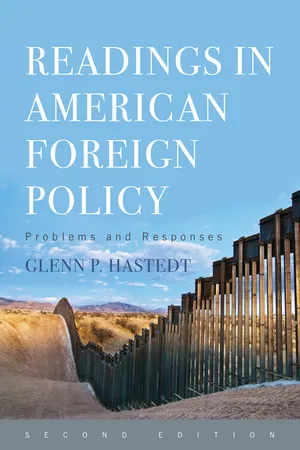
Readings in American Foreign Policy delivers a contemporary introduction to America's role in world affairs. Useful alone or as a supplementary reader for undergraduate American foreign policy courses, the second edition focuses on the most current problems and how to interpret them. Readings are divided into six parts and each part opens with an introductory essay providing students with a historical framework and "big picture" questions to guide comprehension. Each part incorporates a variety of sources, including not only articles from the most popular journals worldwide, but lesser known government documents and think tank pieces. By exposing students to a unique array of government policies and debates, Readings in American Foreign Policy prompts students to analyze policy making from multiple perspectives and to develop their own strategies toward evaluating policy positions.
Information
Table of contents
- Title
- Copyright
- Content
- Instructor Guide
- Preface
- PART I: Defining Foreign Policy
- 1 The White House, “America First Foreign Policy,” and Barack Obama, “Remarks by the President on Winning the Nobel Peace Prize”
- 2 Robert Kagan, “Allure of Normalcy: What America Still Owes the World”
- 3 David C. Unger, “A Better Internationalism”
- 4 Barry R. Posen, “Pull Back: The Case for a Less Activist Foreign Policy”
- Part II: Foreign-Policy Challenges
- 5 Excerpts from the U.S. Intelligence Community, “Worldwide Threat Assessment”
- 6 Excerpts from Christopher Wilson, “Growing Together: Economic Ties between the United States and Mexico”
- 7 Excerpts from Jeffrey A. Bader, “A Framework for U.S. Foreign Policy toward China”
- 8 Bastian Giegerich, “NATO’s Strategic Adaptation: The Warsaw Summit and Beyond”
- 9 Fawaz A. Gerges, “ISIS and the Third Wave of Jihadism”
- 10 Excerpts from David L. Goldwyn, “The Outlook for Energy Policy under a Trump Administration”
- Part III: Societal Influences on U.S. Foreign Policy
- 11 Robert W. Merry, “America’s History of Protectionism”
- 12 Excerpts from the Office of the Director of National Intelligence, Background to “Assessing Russian Activities and Intentions in Recent U.S. Elections”
- 13 Excerpts from A. Trevor Thrall and Erik Goepner, “Millennials and U.S. Foreign Policy”
- 14 David J. Danelo, “The Courage Crisis”
- Part IV: Institutions and U.S. Foreign Policy
- 15 Ken Gude, “Understanding Authorizations for the Use of Military Force”
- 16 Daniel L. Byman and Benjamin Wittes, “Reforming the NSA: How to Spy after Snowden”
- 17 Glenn Hastedt, “The Trump Foreign Policy Transition”
- 18 Excerpts from the National Commission on the Future of the Army, “The Future of the Army”
- Part V: Responses
- 19 Laura Kanji, “Moving Targets: The Evolution and Future of Smart Sanctions”
- 20 Gareth Evans, “R2P: Looking Back, Looking Forward”
- 21 Clyde Prestowitz, “A Tale of Two Trade Deals”
- 22 Franklin D. Kramer and Melanie J. Teplinsky, “Cybersecurity and Tailored Deterrence”
- 23 H.R. McMaster, “The Human Element: When Gadgetry Becomes Strategy”
- Part VI: Emerging Issues
- 24 Excerpt from the National Intelligence Council, “Global Trends 2030: Alternative Worlds”
- 25 Max Boot, “More Small Wars: Counterinsurgency Is Here to Stay”
- 26 Excerpts from Taryn Fransen with Casey Cronin, “A Critical Decade for Climate Policy: Tools and Initiatives to Track Our Progress”
- 27 Michael J. Boyle, “Is the U.S. Drone War Effective?”
- 28 Michael T. Klare, “From Scarcity to Abundance: The New Geopolitics of Energy”
Trusted by 375,005 students
Access to over 1.5 million titles for a fair monthly price.
Study more efficiently using our study tools.
Frequently asked questions
Yes, you can cancel anytime from the Subscription tab in your account settings on the Perlego website. Your subscription will stay active until the end of your current billing period. Learn how to cancel your subscription
No, books cannot be downloaded as external files, such as PDFs, for use outside of Perlego. However, you can download books within the Perlego app for offline reading on mobile or tablet. Learn how to download books offline
Perlego offers two plans: Essential and Complete
- Essential is ideal for learners and professionals who enjoy exploring a wide range of subjects. Access the Essential Library with 800,000+ trusted titles and best-sellers across business, personal growth, and the humanities. Includes unlimited reading time and Standard Read Aloud voice.
- Complete: Perfect for advanced learners and researchers needing full, unrestricted access. Unlock 1.5M+ books across hundreds of subjects, including academic and specialized titles. The Complete Plan also includes advanced features like Premium Read Aloud and Research Assistant.
We are an online textbook subscription service, where you can get access to an entire online library for less than the price of a single book per month. With over 1.5 million books across 990+ topics, we’ve got you covered! Learn about our mission
Look out for the read-aloud symbol on your next book to see if you can listen to it. The read-aloud tool reads text aloud for you, highlighting the text as it is being read. You can pause it, speed it up and slow it down. Learn more about Read Aloud
Yes! You can use the Perlego app on both iOS and Android devices to read anytime, anywhere — even offline. Perfect for commutes or when you’re on the go.
Please note we cannot support devices running on iOS 13 and Android 7 or earlier. Learn more about using the app
Please note we cannot support devices running on iOS 13 and Android 7 or earlier. Learn more about using the app
Yes, you can access Readings in American Foreign Policy by Glenn P. Hastedt in PDF and/or ePUB format, as well as other popular books in Politics & International Relations & International Relations. We have over 1.5 million books available in our catalogue for you to explore.