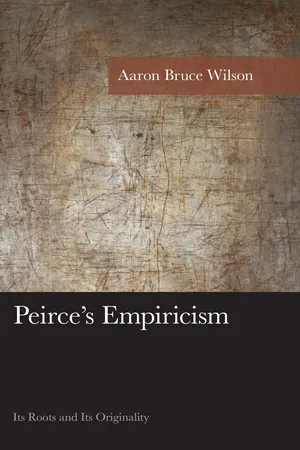
Widely praised as a founder of modern semiotics and of the pragmatist tradition in philosophy, Charles S. Peirce (1839-1914) spent over forty years developing a philosophical system that addresses the fundamental problems of Western metaphysics, epistemology, and value theory. Although never formally completed, what emerges from Peirce's writings is a distinctive system that, through an innovative semiotic or theory of signs and cognition, combines a thoroughgoing form of empiricism with a robustly realist metaphysics that emphasizes the mind-independence of laws and other universals. Peirce's Empiricism: Its Roots and Its Originality explains this marriage of empiricism with realism by tracing the roots of Peirce's thought in the history of Western philosophy, with particular attention paid to his predecessors in the empiricist and the common sense traditions. By purging modern empiricism of its nominalistic metaphysics and its Cartesian assumptions about mind and knowledge, and by combining it with insights from sources as diverse as Duns Scotus and Charles Darwin, Peirce reinvents the idea that all our knowledge depends on sense perception while reaffirming the place of philosophy as a foundational field of inquiry.
In Peirce's Empiricism, Aaron Bruce Wilson defends an interpretation of Peirce's philosophical work as forming a systematic whole, and develops the connections between Peirce, Reid, and the British empiricists. Wilson provides focused analyses of Peirce's accounts of experience, habit, perception, semeiosis, truth, and ultimate ends. This book will be of great value to students and scholars with interests in Peirce, American philosophy more broadly, modern philosophy, and semiotics.
- English
- ePUB (mobile friendly)
- Available on iOS & Android
eBook - ePub
About this book
Information
Topic
PhilosophySubtopic
Philosophical MetaphysicsTable of contents
- Title Page
- Acknowledgments
- List of Abbreviations
- Introduction
- Empiricism—History and Analysis
- Empiricism without Nominalism
- Cartesianism and the Rise of Modern Empiricism
- The Associationist Step Toward Pragmatism
- The Reidian Strand: Common Sense and Perception
- Peirce’s Account of Perception
- Semeiosis, Truth, and Inquiry
- Empiricism and Philosophical Inquiry
- Concluding Remarks
- Bibliography
- Index
- About the Author
Trusted by 375,005 students
Access to over 1.5 million titles for a fair monthly price.
Study more efficiently using our study tools.
Frequently asked questions
Yes, you can cancel anytime from the Subscription tab in your account settings on the Perlego website. Your subscription will stay active until the end of your current billing period. Learn how to cancel your subscription
No, books cannot be downloaded as external files, such as PDFs, for use outside of Perlego. However, you can download books within the Perlego app for offline reading on mobile or tablet. Learn how to download books offline
Perlego offers two plans: Essential and Complete
- Essential is ideal for learners and professionals who enjoy exploring a wide range of subjects. Access the Essential Library with 800,000+ trusted titles and best-sellers across business, personal growth, and the humanities. Includes unlimited reading time and Standard Read Aloud voice.
- Complete: Perfect for advanced learners and researchers needing full, unrestricted access. Unlock 1.5M+ books across hundreds of subjects, including academic and specialized titles. The Complete Plan also includes advanced features like Premium Read Aloud and Research Assistant.
We are an online textbook subscription service, where you can get access to an entire online library for less than the price of a single book per month. With over 1.5 million books across 990+ topics, we’ve got you covered! Learn about our mission
Look out for the read-aloud symbol on your next book to see if you can listen to it. The read-aloud tool reads text aloud for you, highlighting the text as it is being read. You can pause it, speed it up and slow it down. Learn more about Read Aloud
Yes! You can use the Perlego app on both iOS and Android devices to read anytime, anywhere — even offline. Perfect for commutes or when you’re on the go.
Please note we cannot support devices running on iOS 13 and Android 7 or earlier. Learn more about using the app
Please note we cannot support devices running on iOS 13 and Android 7 or earlier. Learn more about using the app
Yes, you can access Peirce's Empiricism by Aaron Bruce Wilson in PDF and/or ePUB format, as well as other popular books in Philosophy & Philosophical Metaphysics. We have over 1.5 million books available in our catalogue for you to explore.