eBook - ePub
Three American Hegels
Henry C. Brokmeyer, Horace Williams, and John William Miller
- English
- ePUB (mobile friendly)
- Available on iOS & Android
eBook - ePub
About this book
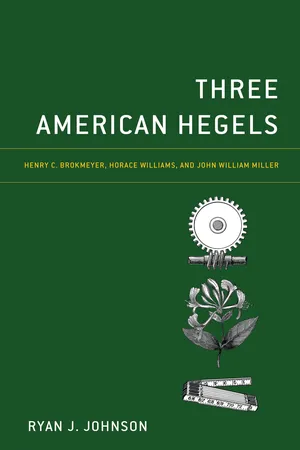
Three American Hegels explores Georg Wilhelm Friedrich Hegel's influence on three seminal, yet overlooked, philosophers: Henry C. Brokmeyer, Horace Williams, and John William Miller. Each of them was, in his own way, both an apprentice of Hegel and a true American original: Brokmeyer, the backwoods translator of Hegel; Williams, the mentor of Southern Hegelianism; Williams, the Hegelian teacher of democracy. Until now, their influence on the one school of philosophy that is distinctly grounded in the U.S. experience—pragmatism—has been overlooked, along with the intellectual history of how their contributions developed. Such neglect has resulted in an underestimation of the role that the theories of Hegel played in the development of American philosophy. To unearth these formative yet forgotten works and influences, Johnson explores their respective untapped archives and unearths a three-generation story of a Hegel that is thoroughly practical, concrete, and alive.
Information
Topic
PhilosophySubtopic
PhilosophersTable of contents
- Cover
- Half Title
- Dedication
- Contents
- Abbreviations
- Acknowledgments
- Introduction: A Plea for Patience
- Part I: Henry C. Brokmeyer
- Chapter 1: Brokmeyer and the St. Louis Hegelians
- Chapter 2: Brokmeyer’s Wissenschaft der Logik
- Chapter 3: Brokmeyer’s Frontier Hegelianism
- Part II: Horace Williams: “The Mentor of Southern Hegelianism”
- Chapter 4: Horace, An Introduction
- Chapter 5: Honeysuckle Hegel
- Chapter 6: Dialectic with a Drawl
- Part III: John William Miller
- Chapter 7: The Act and Actuality
- Chapter 8: History and Responsibility
- Chapter 9: Concrete Universality and the Midworld
- Conclusion
- Notes
- Bibliography
- About the Author
Trusted by 375,005 students
Access to over 1.5 million titles for a fair monthly price.
Study more efficiently using our study tools.
Frequently asked questions
Yes, you can cancel anytime from the Subscription tab in your account settings on the Perlego website. Your subscription will stay active until the end of your current billing period. Learn how to cancel your subscription
No, books cannot be downloaded as external files, such as PDFs, for use outside of Perlego. However, you can download books within the Perlego app for offline reading on mobile or tablet. Learn how to download books offline
Perlego offers two plans: Essential and Complete
- Essential is ideal for learners and professionals who enjoy exploring a wide range of subjects. Access the Essential Library with 800,000+ trusted titles and best-sellers across business, personal growth, and the humanities. Includes unlimited reading time and Standard Read Aloud voice.
- Complete: Perfect for advanced learners and researchers needing full, unrestricted access. Unlock 1.5M+ books across hundreds of subjects, including academic and specialized titles. The Complete Plan also includes advanced features like Premium Read Aloud and Research Assistant.
We are an online textbook subscription service, where you can get access to an entire online library for less than the price of a single book per month. With over 1.5 million books across 990+ topics, we’ve got you covered! Learn about our mission
Look out for the read-aloud symbol on your next book to see if you can listen to it. The read-aloud tool reads text aloud for you, highlighting the text as it is being read. You can pause it, speed it up and slow it down. Learn more about Read Aloud
Yes! You can use the Perlego app on both iOS and Android devices to read anytime, anywhere — even offline. Perfect for commutes or when you’re on the go.
Please note we cannot support devices running on iOS 13 and Android 7 or earlier. Learn more about using the app
Please note we cannot support devices running on iOS 13 and Android 7 or earlier. Learn more about using the app
Yes, you can access Three American Hegels by Ryan J. Johnson in PDF and/or ePUB format, as well as other popular books in Philosophy & Philosophers. We have over 1.5 million books available in our catalogue for you to explore.