There is growing consensus that life on the planet is in peril if climate change continues at its current pace. At stake is not only the future of many species but of humanity itself. As an increasing number of ecological economists have emphasized, these problems will only be adequately addressed by re-examining economic systems from an ecological perspective, fundamentally calling into question assumptions of unlimited growth and the maximization of shareholder profit foundational to neoliberal capitalism. Religion and ecology scholars have also increasingly emphasized the ways climate change challenges assumed divides between nature and culture, religion and labor, economy and ecology, and calls for critical and constructive engagement with the religion, economy, and ecology nexus.
Often, though, religious engagements with economy and ecology have placed emphasis on individual morality, action, and agency at the level of consumption patterns or have suggested mere modifications within existing economic paradigms. Contributors to this volume call into question the adequacy of this approach in light of the urgency of climate change which is always ever entwined with ongoing patterns of exploitation, oppression, and colonialism in current economic systems. Rather than tweaking a system of exploitation, for instance by emphasizing individual consumption or care for human and non-human victims, these authors articulate important opportunities for religious engagement, activism, resistance, and solidarity around issues of production and labor. Recalling that Marx linked agencies and labor of people as well as the other-than-human world, these authors aim to articulate a sense in which liberation of people and the planet are intertwined and can be accomplished only through collaboration for their common good.
The basic intuition driving this volume is that while Christianity has by and large become the handmaiden of exploitative capitalism and empire, it might also reclaim latent theologies and religious practices that call into question the fundamental valuation of labor without recognition or rest, of extractive exploitation, and a "winner take all" praxis. In the process, Christianity might reclaim and reinvest in tenuous historical materializations of transformed ecological and economic relationships while economics might be re-informed by a valuation of the shared oikos as well as a just accounting of and renumeration for labor. Together they might serve the aim of the flourishing of all people and the planet.
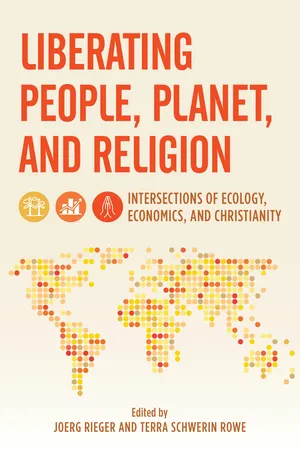
eBook - ePub
Liberating People, Planet, and Religion
Intersections of Ecology, Economics, and Christianity
- English
- ePUB (mobile friendly)
- Available on iOS & Android
eBook - ePub
Liberating People, Planet, and Religion
Intersections of Ecology, Economics, and Christianity
About this book
Information
Topic
Teología y religiónSubtopic
Teología cristianaTable of contents
- Cover
- Half Title
- Contents
- Acknowledgments
- Introduction
- Part I: Global Historical and Contextual Approaches
- Chapter 1: “Energizing Human Development”? Humanity, Divinity, and Climate Change
- Chapter 2: Liberation Theologies and Grassroots Education in Latin America and the Caribbean: The Complex Path to Restore Human and More-than-Human Worlds
- Chapter 3: Moana Eco-Theology: Toward an Eco-Theology of Commoning
- Part II: Alternative Frameworks
- Chapter 4: The Peculiar Agency of People and the Planet: On the Need to Rethink Everything, Including Religion
- Chapter 5: Capitalism’s Incompatibility with Christianity: The Churches’ Deep Solidarity with Labor
- Chapter 6: Christian Animist Economics: The Intimate Re-enchantment of Creation for a Regenerative Eco-Socialism
- Chapter 7: Planetary Economies
- Part III: Practical Engagements
- Chapter 8: Resistance as Healing: Disrupting the Spiritual Foundations of Capitalism
- Chapter 9: Corporate Confession: The Presbyterian Church (USA) and Fossil Fuels
- Chapter 10: Engaging the Climate Crisis through Spiritual Nonviolence
- Chapter 11: Distorted Imagination: Land, Food, and Economies
- Contributor Biographies
Trusted by 375,005 students
Access to over 1.5 million titles for a fair monthly price.
Study more efficiently using our study tools.
Frequently asked questions
Yes, you can cancel anytime from the Subscription tab in your account settings on the Perlego website. Your subscription will stay active until the end of your current billing period. Learn how to cancel your subscription
No, books cannot be downloaded as external files, such as PDFs, for use outside of Perlego. However, you can download books within the Perlego app for offline reading on mobile or tablet. Learn how to download books offline
Perlego offers two plans: Essential and Complete
- Essential is ideal for learners and professionals who enjoy exploring a wide range of subjects. Access the Essential Library with 800,000+ trusted titles and best-sellers across business, personal growth, and the humanities. Includes unlimited reading time and Standard Read Aloud voice.
- Complete: Perfect for advanced learners and researchers needing full, unrestricted access. Unlock 1.5M+ books across hundreds of subjects, including academic and specialized titles. The Complete Plan also includes advanced features like Premium Read Aloud and Research Assistant.
We are an online textbook subscription service, where you can get access to an entire online library for less than the price of a single book per month. With over 1.5 million books across 990+ topics, we’ve got you covered! Learn about our mission
Look out for the read-aloud symbol on your next book to see if you can listen to it. The read-aloud tool reads text aloud for you, highlighting the text as it is being read. You can pause it, speed it up and slow it down. Learn more about Read Aloud
Yes! You can use the Perlego app on both iOS and Android devices to read anytime, anywhere — even offline. Perfect for commutes or when you’re on the go.
Please note we cannot support devices running on iOS 13 and Android 7 or earlier. Learn more about using the app
Please note we cannot support devices running on iOS 13 and Android 7 or earlier. Learn more about using the app
Yes, you can access Liberating People, Planet, and Religion by Joerg Rieger,Terra Rowe in PDF and/or ePUB format, as well as other popular books in Teología y religión & Teología cristiana. We have over 1.5 million books available in our catalogue for you to explore.