This book describes the conduct of the US-led post-9/11 war in Afghanistan. Adopting a long-term perspective, it argues that even though Washington initially had an opportunity to achieve its security goals and give Afghanistan a chance to enter a new era, it compromised any possibility of success from the very moment it let bin Laden escape to Pakistan in December 2001, and found itself locked in a strategic overreach.
Given the bureaucratic and rhetorical momentum triggered by the war on terror in America, the Bush Administration was bound to deploy more resources in Afghanistan sooner or later (despite its focus on Iraq). The need to satisfy unfulfilled counter-terrorism objectives made the US dependent on Afghanistan's warlords, which compromised the country's stability and tarnished its new political system. The extension of the US military presence made Washington lose its leverage on the Pakistan army leaders, who, aware of America's logistical dependency on Islamabad, supported the Afghan insurgents – their historical proxies - more and more openly. The extension of the war also contributed to radicalize segments of the Afghan and Pakistani populations, destabilizing the area further.
In the meantime, the need to justify the extension of its military presence influenced the US-led coalition into proclaiming its determination to democratize and reconstruct Afghanistan. While highly opportunistic, the emergence of these policies proved both self-defeating and unsustainable due to an inescapable collision between the US-led coalition's inherent self-interest, hubris, limited knowledge, limited attention span and limited resources, and, on the other hand, Afghanistan's inherent complexity. As the critical contradictions at the very heart of the campaign increased with the extension of the latter's duration, scale, and cost, America's leaders, entrapped in path-dependence, lost their strategic flexibility. Despite debates on troops/resource allocation and more sophisticated doctrines, they repeated the same structural mistakes over and over again. The strategic overreach became self-sustaining, until its costs became intolerable, leading to a drawdown which has more to do with a pervasive sense of failure than with the accomplishment of any noble purpose or strategic breakthrough.
eBook - ePub
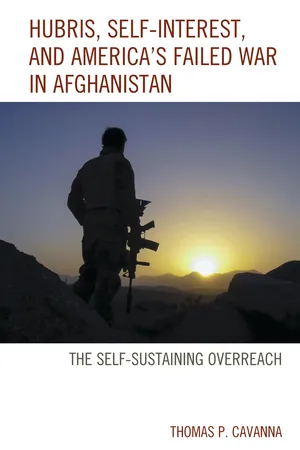
Hubris, Self-Interest, and America's Failed War in Afghanistan
the Self-Sustaining Overreach
- English
- ePUB (mobile friendly)
- Available on iOS & Android
eBook - ePub
Hubris, Self-Interest, and America's Failed War in Afghanistan
the Self-Sustaining Overreach
About this book
Information
Table of contents
- Title Page
- TABLE OF ACRONYMS
- Introduction
- THE STRUCTURAL WEIGHT OF REALISM: FOREIGN SECURITY INTERESTS AND THE US ENTANGLEMENT IN AFGHANISTAN
- TOWARD THE SELF-SUSTAINING OVERREACH:GRANDIOSE PROJECTS, STRUCTURAL AMBIGUITIES, AND QUESTIONABLE SUSTAINABILITY
- THE OBAMA ERA: A FINAL SHOWDOWN TO SECURE A “DECENT INTERVAL?"
- Conclusion
- Bibliography
- Index
Trusted by 375,005 students
Access to over 1.5 million titles for a fair monthly price.
Study more efficiently using our study tools.
Frequently asked questions
Yes, you can cancel anytime from the Subscription tab in your account settings on the Perlego website. Your subscription will stay active until the end of your current billing period. Learn how to cancel your subscription
No, books cannot be downloaded as external files, such as PDFs, for use outside of Perlego. However, you can download books within the Perlego app for offline reading on mobile or tablet. Learn how to download books offline
Perlego offers two plans: Essential and Complete
- Essential is ideal for learners and professionals who enjoy exploring a wide range of subjects. Access the Essential Library with 800,000+ trusted titles and best-sellers across business, personal growth, and the humanities. Includes unlimited reading time and Standard Read Aloud voice.
- Complete: Perfect for advanced learners and researchers needing full, unrestricted access. Unlock 1.5M+ books across hundreds of subjects, including academic and specialized titles. The Complete Plan also includes advanced features like Premium Read Aloud and Research Assistant.
We are an online textbook subscription service, where you can get access to an entire online library for less than the price of a single book per month. With over 1.5 million books across 990+ topics, we’ve got you covered! Learn about our mission
Look out for the read-aloud symbol on your next book to see if you can listen to it. The read-aloud tool reads text aloud for you, highlighting the text as it is being read. You can pause it, speed it up and slow it down. Learn more about Read Aloud
Yes! You can use the Perlego app on both iOS and Android devices to read anytime, anywhere — even offline. Perfect for commutes or when you’re on the go.
Please note we cannot support devices running on iOS 13 and Android 7 or earlier. Learn more about using the app
Please note we cannot support devices running on iOS 13 and Android 7 or earlier. Learn more about using the app
Yes, you can access Hubris, Self-Interest, and America's Failed War in Afghanistan by Thomas P. Cavanna in PDF and/or ePUB format, as well as other popular books in Politics & International Relations & American Government. We have over 1.5 million books available in our catalogue for you to explore.