This book examines the influences of social class and inequality structures on migration in Africa using information from Ghana. As the country achieves moderate to significant economic gains driven (in part) by the country's diaspora communities, the desire to migrate has intensified. Migration is now synonymous with social mobility and self-improvement. It has been found that existing class and status inequalities are analytically inseparable from the social and cultural processes underpinning the motivations behind Ghanaian migration. Migrant class and socioeconomic attributes are closely intertwined, reinforcing and operating at every level of the migration decision-making to influence the motivation to migrate, the type and form of migration, the direction of the migration, its timing, and ultimately the outcomes and expectations that migrants associate with their decision to migrate.
From a historical and contemporary perspective, this book argues that power and class-based structural relationships are significant components in understanding how migratory diasporas shape and are shaped in turn by social class and inequality. The social class identities that Ghanaian immigrants manifest in the United States are often based on immigrant formulations and importation of class dynamics from the home country. These identities are then transformed in the countries of destination and replayed or relived back home, thereby creating multiple class identities that are powerful forces in inducing social changes. In essence, migrant social class attributes formed before and post-migration is significant because it holds the possibilities of transforming the social structures of migrant-sending countries. As migrants return home and seek reintegration into the body polity of the home society, conflicts emanating from changes in their class dynamics may hinder or promote sociocultural and economic development. Hence, the imperative of the central government is to understand and incorporate into national development planning the social class characteristics of its citizens who are leaving, as well as those who are returning.
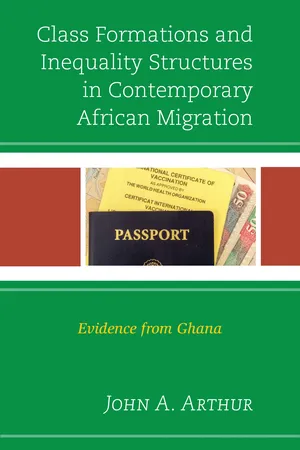
eBook - ePub
Class Formations and Inequality Structures in Contemporary African Migration
Evidence from Ghana
- English
- ePUB (mobile friendly)
- Available on iOS & Android
eBook - ePub
Class Formations and Inequality Structures in Contemporary African Migration
Evidence from Ghana
About this book
Information
Table of contents
- Title Page
- Preface
- Acknowledgments
- Social Class and Inequality Structures in Contemporary African Migration
- The Layers of Social Class Formations and Class Consciousness in Ghana
- Class Inequalities in Internal and Regional Migration in Ghana
- Class Profiles of Ghanaian Immigrants
- Economic Conditions of the Ghanaian Immigrant Underclass
- The New Black Immigrant Elites
- Influences of Class and Inequality Structures on African Diasporas and Homeland Development
- Bibliography
- Index
- About the Author
Trusted by 375,005 students
Access to over 1.5 million titles for a fair monthly price.
Study more efficiently using our study tools.
Frequently asked questions
Yes, you can cancel anytime from the Subscription tab in your account settings on the Perlego website. Your subscription will stay active until the end of your current billing period. Learn how to cancel your subscription
No, books cannot be downloaded as external files, such as PDFs, for use outside of Perlego. However, you can download books within the Perlego app for offline reading on mobile or tablet. Learn how to download books offline
Perlego offers two plans: Essential and Complete
- Essential is ideal for learners and professionals who enjoy exploring a wide range of subjects. Access the Essential Library with 800,000+ trusted titles and best-sellers across business, personal growth, and the humanities. Includes unlimited reading time and Standard Read Aloud voice.
- Complete: Perfect for advanced learners and researchers needing full, unrestricted access. Unlock 1.5M+ books across hundreds of subjects, including academic and specialized titles. The Complete Plan also includes advanced features like Premium Read Aloud and Research Assistant.
We are an online textbook subscription service, where you can get access to an entire online library for less than the price of a single book per month. With over 1.5 million books across 990+ topics, we’ve got you covered! Learn about our mission
Look out for the read-aloud symbol on your next book to see if you can listen to it. The read-aloud tool reads text aloud for you, highlighting the text as it is being read. You can pause it, speed it up and slow it down. Learn more about Read Aloud
Yes! You can use the Perlego app on both iOS and Android devices to read anytime, anywhere — even offline. Perfect for commutes or when you’re on the go.
Please note we cannot support devices running on iOS 13 and Android 7 or earlier. Learn more about using the app
Please note we cannot support devices running on iOS 13 and Android 7 or earlier. Learn more about using the app
Yes, you can access Class Formations and Inequality Structures in Contemporary African Migration by John A. Arthur in PDF and/or ePUB format, as well as other popular books in Politics & International Relations & African Politics. We have over 1.5 million books available in our catalogue for you to explore.