The book ventures into the explanation of intra-state communal conflict, more narrowly of the conflict between majority and minority communal groups, and develops arguments that highlight the causal impact of intergroup economic inequality. Its quest for empirical support has led to the compilation of three large, inter-related datasets, typifying the condition of minorities worldwide. They are mainly based on the Ethnic Power Relations, Minorities at Risk, and Quality of Government data, yet also involve information from a multitude of other sources, such as national statistics, cross-national demographic surveys, and the World Directory of Minorities and Indigenous Peoples.
The group-level data, featuring 860 communal groups, show that an impressive forty-five percent of the world's population do not belong to the majority communal group in their country. As reasonably feared, minorities are in general politically less empowered than their pluralities, and also poorer. Results from multivariate regression analysis corroborate the deleterious impact of horizontal economic inequality on inter-group hostility, measured either as group grievance or violent conflict. The double measurement substantiates the intuition that not all low-to-medium strength hostility is doomed to develop into violent conflict. In fortunate conditions, intergroup disputes can be solved, or compromises may be reached without turning to violence. Part of the analytical efforts have been directed towards detecting the differences between the causes of communal and non-communal social conflicts; and also towards deciphering which institutional conditions aggravate and which mitigate communal conflicts. A large number of variables in the regression models attempt to operationalize constellations that influence the evolution of conflicts either toward peaceful solutions or toward armed collision.
The policy implications of the findings are not trivial. Positive discrimination, which in the United States is known as Affirmative Action, is often resisted by denying the unfortunate facts that make it necessary. In addition, currently the policies recommended for heterogeneous societies are also fiercely debated between advocates of power-sharing arrangements and those who would like to facilitate the communal homogenization of each state. This latter type of constitutional engineering is at variance with the political empowerment of minorities, a measure that could alleviate tensions rooted in economic disadvantages.
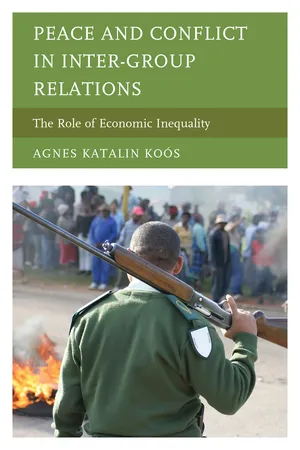
eBook - ePub
Peace and Conflict in Inter-Group Relations
The Role of Economic Inequality
- English
- ePUB (mobile friendly)
- Available on iOS & Android
eBook - ePub
About this book
Information
Table of contents
- Cover-Page
- Half-Title
- Title
- Copyright
- Contents
- List of Tables
- List of Figures
- List of Acronyms
- Acknowledgments
- 1 Introduction and Roadmap to the Book
- 2 Why Believe in the EI-PC Nexus?
- 3 Explanatory Model and Hypotheses: May the Odds Be in My Favor?
- 4 Presentation of the EPR_MAR_EXT Dataset
- 5 Analyzing the EPR_MAR_EXT Dataset
- 6 Analyses Based on MAR_EPR_MI Data
- 7 A Country-Level Analysis
- 8 Conclusions and Questions for Further Research
- Appendices
- Bibliography
- Sources of Information for the Datasets
- Index
- About the Author
Trusted by 375,005 students
Access to over 1.5 million titles for a fair monthly price.
Study more efficiently using our study tools.
Frequently asked questions
Yes, you can cancel anytime from the Subscription tab in your account settings on the Perlego website. Your subscription will stay active until the end of your current billing period. Learn how to cancel your subscription
No, books cannot be downloaded as external files, such as PDFs, for use outside of Perlego. However, you can download books within the Perlego app for offline reading on mobile or tablet. Learn how to download books offline
Perlego offers two plans: Essential and Complete
- Essential is ideal for learners and professionals who enjoy exploring a wide range of subjects. Access the Essential Library with 800,000+ trusted titles and best-sellers across business, personal growth, and the humanities. Includes unlimited reading time and Standard Read Aloud voice.
- Complete: Perfect for advanced learners and researchers needing full, unrestricted access. Unlock 1.5M+ books across hundreds of subjects, including academic and specialized titles. The Complete Plan also includes advanced features like Premium Read Aloud and Research Assistant.
We are an online textbook subscription service, where you can get access to an entire online library for less than the price of a single book per month. With over 1.5 million books across 990+ topics, we’ve got you covered! Learn about our mission
Look out for the read-aloud symbol on your next book to see if you can listen to it. The read-aloud tool reads text aloud for you, highlighting the text as it is being read. You can pause it, speed it up and slow it down. Learn more about Read Aloud
Yes! You can use the Perlego app on both iOS and Android devices to read anytime, anywhere — even offline. Perfect for commutes or when you’re on the go.
Please note we cannot support devices running on iOS 13 and Android 7 or earlier. Learn more about using the app
Please note we cannot support devices running on iOS 13 and Android 7 or earlier. Learn more about using the app
Yes, you can access Peace and Conflict in Inter-Group Relations by Agnes Katalin Koós in PDF and/or ePUB format, as well as other popular books in Politics & International Relations & Economic Policy. We have over 1.5 million books available in our catalogue for you to explore.