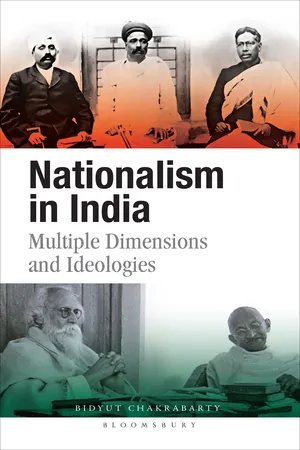
This book explores the diverse ideational visions of key leaders in India's freedom struggle, highlighting both their differences and similarities. While rooted in distinct political and ideological contexts, these visions shared a common goal: India's political emancipation. Though ideologically divergent, many nationalist leaders did not directly challenge Mahatma Gandhi's nonviolent resistance campaign against British rule, despite their differing approaches.
The book traces the evolution of Indian nationalism through three distinct phases, each shaped by the political and ideological priorities of the time. The Moderates, while supporting British rule as a necessary stage in India's development, still called for independence, albeit under British supervision. The arrival of the New Nationalists, including leaders like Aurobindo and the Lal-Bal-Pal trio (Lala Lajpat Rai, Bal Gangadhar Tilak, and Bipin Chandra Pal), marked a shift in the nationalist vision. They advocated for active resistance and redefined opposition strategies, favoring passive resistance as a tool for political independence.
The rise of Gandhi in 1918, following his success in the Champaran Satyagraha, ushered in a new phase of Indian nationalism. While Gandhi's approach differed from his predecessors, the central aim of achieving independence remained unchanged. This book examines these evolving ideologies and their contributions to shaping the Indian nationalist movement.
- English
- ePUB (mobile friendly)
- Available on iOS & Android
eBook - ePub
About this book
Information
Table of contents
- Cover
- Halftitle Page
- Dedication Page
- Title Page
- Contents
- Preface and acknowledgements
- Introduction
- 1 Reinventing nationalism: The moderate version
- Part 1 Prioritizing political freedom: Aurobindo Ghose and Gandhi
- Part 2 In quest of social equality: Rabindranath Tagore and Nazrul Islam
- Part 3 Identity politics: B.R. Ambedkar as an exponent
- Conclusion
- Notes
- Bibliographical notes and a select bibliography
- Index
- About the Author
- Imprint
Trusted by 375,005 students
Access to over 1.5 million titles for a fair monthly price.
Study more efficiently using our study tools.
Frequently asked questions
Yes, you can cancel anytime from the Subscription tab in your account settings on the Perlego website. Your subscription will stay active until the end of your current billing period. Learn how to cancel your subscription
No, books cannot be downloaded as external files, such as PDFs, for use outside of Perlego. However, you can download books within the Perlego app for offline reading on mobile or tablet. Learn how to download books offline
Perlego offers two plans: Essential and Complete
- Essential is ideal for learners and professionals who enjoy exploring a wide range of subjects. Access the Essential Library with 800,000+ trusted titles and best-sellers across business, personal growth, and the humanities. Includes unlimited reading time and Standard Read Aloud voice.
- Complete: Perfect for advanced learners and researchers needing full, unrestricted access. Unlock 1.5M+ books across hundreds of subjects, including academic and specialized titles. The Complete Plan also includes advanced features like Premium Read Aloud and Research Assistant.
We are an online textbook subscription service, where you can get access to an entire online library for less than the price of a single book per month. With over 1.5 million books across 990+ topics, we’ve got you covered! Learn about our mission
Look out for the read-aloud symbol on your next book to see if you can listen to it. The read-aloud tool reads text aloud for you, highlighting the text as it is being read. You can pause it, speed it up and slow it down. Learn more about Read Aloud
Yes! You can use the Perlego app on both iOS and Android devices to read anytime, anywhere — even offline. Perfect for commutes or when you’re on the go.
Please note we cannot support devices running on iOS 13 and Android 7 or earlier. Learn more about using the app
Please note we cannot support devices running on iOS 13 and Android 7 or earlier. Learn more about using the app
Yes, you can access Nationalism in India by Bidyut Chakrabarty in PDF and/or ePUB format, as well as other popular books in Politics & International Relations & Colonialism & Post-Colonialism. We have over 1.5 million books available in our catalogue for you to explore.