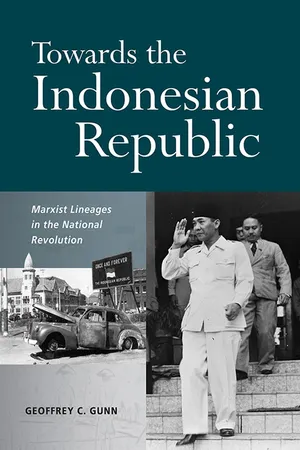
Drawing on little known archival sources, this work brings to the fore the salience of a schism in the Indonesian communist movement between pro-Moscow loyalists and "national-communists" reaching back to the 1920s, which survived even the Japanese occupation and surfaced in the throes of the National Revolution (1945–49). At the heart of the rift lay contrasting visions of revolutionary tactics, the salience of Islam in an Islamic majority society, the vexed question of alliance between leftists and other anti-colonial forces, and even the concept and definition of state and national ideology. As such, we cannot ignore the lineages of Marxism in the National Revolution, which trace their roots to the pioneer actions on Java by Dutch communists, themselves influenced by the Bolshevik Revolution. Contrary to the image of a non-revolutionary peasantry and a nationalist leadership broken or tamed by colonial carceral practices, the picture that emerges is one of acute agency on the part of an awoken population at a critical historical moment at the end of World War II.
- 448 pages
- English
- PDF
- Available on iOS & Android
eBook - PDF
About this book
Information
Table of contents
- Contents
- List of Figures
- Acknowledgements
- Note on Archival Sources
- Note on Orthography
- Abbreviations and Acronyms
- Glossary
- Introduction
- PART 1: OPPRESSION
- PART 2: THE WORLD IN MOTION
- PART 3: THE JAPANESE OCCUPATION
- PART 4: DEFENCE OF INDEPENDENCE
- PART 5: STRUGGLE/DIPLOMACY
- Epilogue
- Bibliography
- Index
- About the Author
Trusted by 375,005 students
Access to over 1.5 million titles for a fair monthly price.
Study more efficiently using our study tools.
Frequently asked questions
Yes, you can cancel anytime from the Subscription tab in your account settings on the Perlego website. Your subscription will stay active until the end of your current billing period. Learn how to cancel your subscription
No, books cannot be downloaded as external files, such as PDFs, for use outside of Perlego. However, you can download books within the Perlego app for offline reading on mobile or tablet. Learn how to download books offline
Perlego offers two plans: Essential and Complete
- Essential is ideal for learners and professionals who enjoy exploring a wide range of subjects. Access the Essential Library with 800,000+ trusted titles and best-sellers across business, personal growth, and the humanities. Includes unlimited reading time and Standard Read Aloud voice.
- Complete: Perfect for advanced learners and researchers needing full, unrestricted access. Unlock 1.5M+ books across hundreds of subjects, including academic and specialized titles. The Complete Plan also includes advanced features like Premium Read Aloud and Research Assistant.
We are an online textbook subscription service, where you can get access to an entire online library for less than the price of a single book per month. With over 1.5 million books across 990+ topics, we’ve got you covered! Learn about our mission
Look out for the read-aloud symbol on your next book to see if you can listen to it. The read-aloud tool reads text aloud for you, highlighting the text as it is being read. You can pause it, speed it up and slow it down. Learn more about Read Aloud
Yes! You can use the Perlego app on both iOS and Android devices to read anytime, anywhere — even offline. Perfect for commutes or when you’re on the go.
Please note we cannot support devices running on iOS 13 and Android 7 or earlier. Learn more about using the app
Please note we cannot support devices running on iOS 13 and Android 7 or earlier. Learn more about using the app
Yes, you can access Towards the Indonesian Republic by Geoffrey Gunn in PDF and/or ePUB format, as well as other popular books in Politics & International Relations & Colonialism & Post-Colonialism. We have over 1.5 million books available in our catalogue for you to explore.