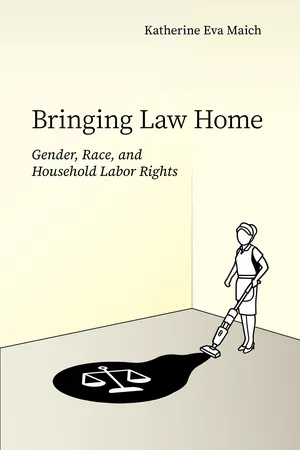
The personal nature of domestic labor, and its location in the privacy of the employer's home, means that domestic workers have long struggled for equitable and consistent labor rights. The dominant discourse regards the home as separate from work, so envisioning what its legal regulation would look like is remarkably challenging. In Bringing Law Home, Katherine Eva Maich offers a uniquely comparative and historical study of labor struggles for domestic workers in New York City and Lima, Peru. She argues that if the home is to be a place of work then it must also be captured in the legal infrastructures that regulate work. Yet, even progressive labor laws for domestic workers in each city are stifled by historically entrenched patterns of gendered racialization and labor informality. Peruvian law extends to household workers only half of the labor protections afforded to other occupations. In New York City, the law grants negligible protections and deliberately eschews language around immigration. Maich finds that coloniality is deeply embedded in contemporary relations of service, revealing important distinctions in how we understand power, domination, and inequality in the home and the workplace.
- 216 pages
- English
- ePUB (mobile friendly)
- Available on iOS & Android
eBook - ePub
About this book
Information
Publisher
Stanford University PressYear
2025Print ISBN
9781503643239
9781503642201
Edition
1eBook ISBN
9781503643246
Table of contents
- Cover
- Series Page
- Title Page
- Copyright
- Dedication
- Contents
- List of Figures and Tables
- Acknowledgments
- One: Conceptualizing the Home as a Site of Work, as a Site of Law
- Two: Architecture of Access: Race, Space, the City, and the Peruvian Colonial Imaginary
- Three: Colonial Domesticity: Constructing Insider Vulnerability in Lima’s Homes
- Four: From Slavery to Service: Continuing Struggles to Regulate Domestic Worker Rights in the United States
- Five: Immigrant Domesticity: Producing Outsider Vulnerability in New York City
- Six: Toward New Sites of Labor, Toward New Labor Rights
- Methodological Appendix
- Comparative Law Appendix
- Notes
- References
- Index
- Series List
Trusted by 375,005 students
Access to over 1.5 million titles for a fair monthly price.
Study more efficiently using our study tools.
Frequently asked questions
Yes, you can cancel anytime from the Subscription tab in your account settings on the Perlego website. Your subscription will stay active until the end of your current billing period. Learn how to cancel your subscription
No, books cannot be downloaded as external files, such as PDFs, for use outside of Perlego. However, you can download books within the Perlego app for offline reading on mobile or tablet. Learn how to download books offline
Perlego offers two plans: Essential and Complete
- Essential is ideal for learners and professionals who enjoy exploring a wide range of subjects. Access the Essential Library with 800,000+ trusted titles and best-sellers across business, personal growth, and the humanities. Includes unlimited reading time and Standard Read Aloud voice.
- Complete: Perfect for advanced learners and researchers needing full, unrestricted access. Unlock 1.5M+ books across hundreds of subjects, including academic and specialized titles. The Complete Plan also includes advanced features like Premium Read Aloud and Research Assistant.
We are an online textbook subscription service, where you can get access to an entire online library for less than the price of a single book per month. With over 1.5 million books across 990+ topics, we’ve got you covered! Learn about our mission
Look out for the read-aloud symbol on your next book to see if you can listen to it. The read-aloud tool reads text aloud for you, highlighting the text as it is being read. You can pause it, speed it up and slow it down. Learn more about Read Aloud
Yes! You can use the Perlego app on both iOS and Android devices to read anytime, anywhere — even offline. Perfect for commutes or when you’re on the go.
Please note we cannot support devices running on iOS 13 and Android 7 or earlier. Learn more about using the app
Please note we cannot support devices running on iOS 13 and Android 7 or earlier. Learn more about using the app
Yes, you can access Bringing Law Home by Katherine Eva Maich in PDF and/or ePUB format, as well as other popular books in Social Sciences & Labour & Employment Law. We have over 1.5 million books available in our catalogue for you to explore.