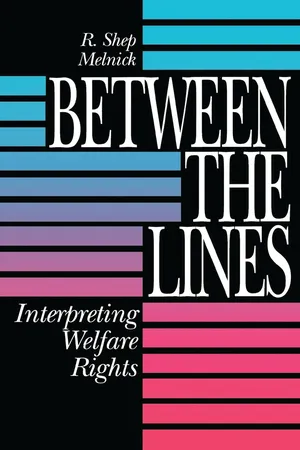
Judicial interpretation of federal statutes has often been at the center of political controversy in recent years. In fact, it would be difficult to find a major domestic policy area in which statutory interpretation by the federal courts has not played a significant role in shaping the activities of government. In most important cases, judges base their interpretation not on the letter of the law, but on their reading of its history, purpose, and spirit. What judges discover between the lines of statutes often has major policy consequences.
This book examines how statutory interpretation has affected the development of three programs: Aid to Families with Dependent Children, education for the handicapped, and food stamps. It explores how these decisions have changed state and national policies and how other institutions—especially Congress—have reacted to them. Although these three programs differ in several important ways, in each instance court action has expanded program benefits and increased federal control over state and local governments.
R. Shep Melnick ties trends in statutory interpretation to broader policy developments, including the expansion of the agenda of national government, the persistence of divided government, and the resurgence and decentralization of Congress. He demonstrates that Congress frequently modifies or overturns court rulings, and he explains why statutory interpretation became so controversial in the 1980s.
Between the Lines also explores the understanding of welfare rights that has guided the development of welfare policy over the past fifty years. What basic beliefs about the welfare state underlie court decisions interpreting these statutes? To what extent do members of Congress share these views? How have the assumptions of judges and members of Congress changed over time? These are some of the questions addressed in this detailed study of American welfare policy.
- English
- ePUB (mobile friendly)
- Available on iOS & Android
eBook - ePub
About this book
Information
Table of contents
- Foreword
- PART 1 ISSUES AND CONTEXT
- PART II AID TO FAMILIES WITH DEPENDENT CHILDREN
- PART III EDUCATION FOR THE HANDICAPPED
- PART IV THE FOOD STAMP PROGRAM
- PART V CONCLUSIONS
- Notes
Trusted by 375,005 students
Access to over 1.5 million titles for a fair monthly price.
Study more efficiently using our study tools.
Frequently asked questions
Yes, you can cancel anytime from the Subscription tab in your account settings on the Perlego website. Your subscription will stay active until the end of your current billing period. Learn how to cancel your subscription
No, books cannot be downloaded as external files, such as PDFs, for use outside of Perlego. However, you can download books within the Perlego app for offline reading on mobile or tablet. Learn how to download books offline
Perlego offers two plans: Essential and Complete
- Essential is ideal for learners and professionals who enjoy exploring a wide range of subjects. Access the Essential Library with 800,000+ trusted titles and best-sellers across business, personal growth, and the humanities. Includes unlimited reading time and Standard Read Aloud voice.
- Complete: Perfect for advanced learners and researchers needing full, unrestricted access. Unlock 1.5M+ books across hundreds of subjects, including academic and specialized titles. The Complete Plan also includes advanced features like Premium Read Aloud and Research Assistant.
We are an online textbook subscription service, where you can get access to an entire online library for less than the price of a single book per month. With over 1.5 million books across 990+ topics, we’ve got you covered! Learn about our mission
Look out for the read-aloud symbol on your next book to see if you can listen to it. The read-aloud tool reads text aloud for you, highlighting the text as it is being read. You can pause it, speed it up and slow it down. Learn more about Read Aloud
Yes! You can use the Perlego app on both iOS and Android devices to read anytime, anywhere — even offline. Perfect for commutes or when you’re on the go.
Please note we cannot support devices running on iOS 13 and Android 7 or earlier. Learn more about using the app
Please note we cannot support devices running on iOS 13 and Android 7 or earlier. Learn more about using the app
Yes, you can access Between the Lines by R. Shep Melnick in PDF and/or ePUB format, as well as other popular books in Politics & International Relations & Social Policy. We have over 1.5 million books available in our catalogue for you to explore.