Selected as a 2025 Doody's Core Title
Virtual services have been part of health sciences libraries for a long time in various forms, including the provision of reference and research services via email or chat, availability of online instruction, access to electronic materials, and the curation of virtual research guides. But when the COVID-19 pandemic forced many libraries to close their doors and pivot to virtual services almost overnight. Moving all services remote, even for just a short time, did highlight what worked well and what did not. The situation increased visibility of these services and made patrons more aware of what was available, perhaps making them more likely to expect and use those services in the future. In some ways, the pandemic showed us ways in which virtual services could even be better than in person services for providing prompt patron services. The situation increased visibility of existing services, making users more aware of what was available, and revealed gaps and needed improvements in virtual services.
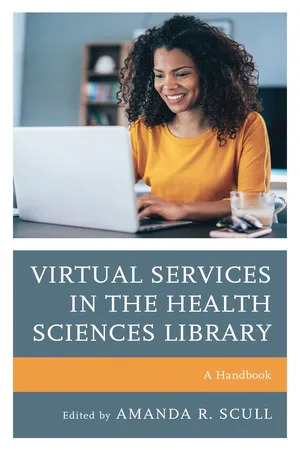
In this book copublished by the Medical Library Association, librarians from academic to hospital health sciences libraries, from rural to urban areas, and across a range of service specialties provide blueprints and best practices for building and maintaining sustainable virtual services in health sciences libraries. Each chapter in this volume addresses aspects of providing virtual services in information and access services, reference and instruction, collections, and clinical services written by contributors who have been involved in this work in their own libraries.
Whether you are just beginning an implementation, assessing and refining current offerings, or strategizing for sustainability and looking to the future, this book will provide practical advice, tools, and considerations for maximizing user engagement and satisfaction with virtual library services and resources.
- English
- ePUB (mobile friendly)
- Available on iOS & Android
eBook - ePub
About this book
Information
Table of contents
- Preface: Introduction to Virtual Services in the Health Sciences Library
- Part I: Information Services, Engagement, and Access
- 1 Community Engagement in the Virtual Library Julie Evener and Matthew Chase (University of St. Augustine for Health Sciences)
- 2 Countway Library: Building a Brand and Creating Community through Strategic Communication Meredith Solomon, Yasmina Kamal, Stephanie Worrell Rubens, and Robin Horst (Harvard Medical School)
- 3 Research and Information Services: Empowering and Supporting Staff in Virtual and Hybrid Environments Amanda Scull (Dartmouth College)
- 4 Digital Access to Educational Materials: Publishing Models and Open Educational Resources for Medical and Professional Students Katie Harding (McMaster University) and Amanda Scull (Dartmouth College)
- Part II: Research, Instruction, and Clinical Support
- 5 Developing and Sustaining a Virtual Reference Service with a Small Library Team Charlotte Beyer, KatieRose McEneely, Claressa Slaughter, and Chelsea Eidbo (Rosalind Franklin University of Medicine and Science)
- 6 Adapting Instruction and Outreach at a Large Academic Health Sciences Library and Archive Andy Hickner, Nicole Milano, Vanessa Puig, Judy Stribling, Drew Wright (Weill Cornell Medicine)
- 7 Automating the Hospital Library: A Rural Odyssey Virginia Trow (Hunter-Rice Health Sciences Library)
- 8 Connect, Guide, Motivate: A Model for Conducting Research Consultations Online Rosie Hanneke (University of Illinois Chicago)
- 9 Meeting the Needs of Online Students through Creative Reimagining and Collaboration with Instructors Jennifer Monnin and Beth Nardella (West Virginia University)
- 10 Scaffolded, Virtual Systematic Review Workshop Series: Taking Evidence Synthesis to the Next Level Alix Hayden (University of Calgary) and Zahra Premji (University of Victoria)
- About the Editor and Contributors
Trusted by 375,005 students
Access to over 1.5 million titles for a fair monthly price.
Study more efficiently using our study tools.
Frequently asked questions
Yes, you can cancel anytime from the Subscription tab in your account settings on the Perlego website. Your subscription will stay active until the end of your current billing period. Learn how to cancel your subscription
No, books cannot be downloaded as external files, such as PDFs, for use outside of Perlego. However, you can download books within the Perlego app for offline reading on mobile or tablet. Learn how to download books offline
Perlego offers two plans: Essential and Complete
- Essential is ideal for learners and professionals who enjoy exploring a wide range of subjects. Access the Essential Library with 800,000+ trusted titles and best-sellers across business, personal growth, and the humanities. Includes unlimited reading time and Standard Read Aloud voice.
- Complete: Perfect for advanced learners and researchers needing full, unrestricted access. Unlock 1.5M+ books across hundreds of subjects, including academic and specialized titles. The Complete Plan also includes advanced features like Premium Read Aloud and Research Assistant.
We are an online textbook subscription service, where you can get access to an entire online library for less than the price of a single book per month. With over 1.5 million books across 990+ topics, we’ve got you covered! Learn about our mission
Look out for the read-aloud symbol on your next book to see if you can listen to it. The read-aloud tool reads text aloud for you, highlighting the text as it is being read. You can pause it, speed it up and slow it down. Learn more about Read Aloud
Yes! You can use the Perlego app on both iOS and Android devices to read anytime, anywhere — even offline. Perfect for commutes or when you’re on the go.
Please note we cannot support devices running on iOS 13 and Android 7 or earlier. Learn more about using the app
Please note we cannot support devices running on iOS 13 and Android 7 or earlier. Learn more about using the app
Yes, you can access Virtual Services in the Health Sciences Library by Amanda R. Scull in PDF and/or ePUB format, as well as other popular books in Languages & Linguistics & Library & Information Science. We have over 1.5 million books available in our catalogue for you to explore.