This book rectifies a much neglected area in the conceptualization and treatment of attachment disorders. The interface between attachment, psychic structure, and character pathology has been largely ignored in the clinical literature until recent years, and when discussed, it has been generally relegated to the domain of child psychopathology. Because human attachment is such a basic aspect to motivation and adjustment, attachment disruptions in childhood color psychic development and often leave deep and enduring deficits in personality and adaptive functioning. The author shows that patients with attachment deficiencies and associated characterological vulnerabilities have fundamental structural deficits in personality organization that lie at the heart of our current understanding of disorders of the self.
Offering the first comprehensive paradigm on the psychoanalytic treatment of adult and adolescent attachment disorders, Jon Mills argues that attachment pathology is a disorder of the self based on developmental trauma that predisposes patients toward a future trajectory marked by structural deficits, character pathology, and interpersonal discord that fuel and sustain myriad forms of clinical symptomatology. This pivotal work constitutes a treatise on the governing psychic processes of attachment on self-organization, adaptation, and conflicted intersubjective dynamics in non-childhood populations, and on the intervening relational parameters in treating their emergent clinical pathologies.
Through conceptually astute technical strategies grounded in sold clinical practice, the author offers one of the most extensive and original frameworks in the psychoanalytic treatment of attachment disorders.
- English
- ePUB (mobile friendly)
- Available on iOS & Android
eBook - ePub
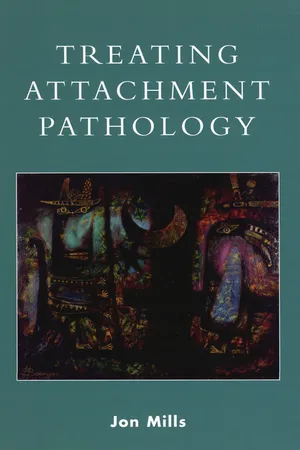
Treating Attachment Pathology
About this book
Information
Table of contents
- Cover
- Half title
- Title
- Copyright
- Dedication
- Contents
- Preface
- Introduction
- Part I Theoretical and Diagnostic Considerations
- Part II Treatment Perspectives
- Part III Extended Case Studies
- Postscript from the Unconscious
- References
- Index
- About the Author
Trusted by 375,005 students
Access to over 1.5 million titles for a fair monthly price.
Study more efficiently using our study tools.
Frequently asked questions
Yes, you can cancel anytime from the Subscription tab in your account settings on the Perlego website. Your subscription will stay active until the end of your current billing period. Learn how to cancel your subscription
No, books cannot be downloaded as external files, such as PDFs, for use outside of Perlego. However, you can download books within the Perlego app for offline reading on mobile or tablet. Learn how to download books offline
Perlego offers two plans: Essential and Complete
- Essential is ideal for learners and professionals who enjoy exploring a wide range of subjects. Access the Essential Library with 800,000+ trusted titles and best-sellers across business, personal growth, and the humanities. Includes unlimited reading time and Standard Read Aloud voice.
- Complete: Perfect for advanced learners and researchers needing full, unrestricted access. Unlock 1.5M+ books across hundreds of subjects, including academic and specialized titles. The Complete Plan also includes advanced features like Premium Read Aloud and Research Assistant.
We are an online textbook subscription service, where you can get access to an entire online library for less than the price of a single book per month. With over 1.5 million books across 990+ topics, we’ve got you covered! Learn about our mission
Look out for the read-aloud symbol on your next book to see if you can listen to it. The read-aloud tool reads text aloud for you, highlighting the text as it is being read. You can pause it, speed it up and slow it down. Learn more about Read Aloud
Yes! You can use the Perlego app on both iOS and Android devices to read anytime, anywhere — even offline. Perfect for commutes or when you’re on the go.
Please note we cannot support devices running on iOS 13 and Android 7 or earlier. Learn more about using the app
Please note we cannot support devices running on iOS 13 and Android 7 or earlier. Learn more about using the app
Yes, you can access Treating Attachment Pathology by Jon Mills in PDF and/or ePUB format, as well as other popular books in Psychology & Developmental Psychology. We have over 1.5 million books available in our catalogue for you to explore.