Intentional practice is an impact-driven way of thinking and working that places a museum's raison d'être—achieving impact—at the center of its work. A prerequisite to achieving impact is articulating the kind of impact the museum would like to achieve. An impact statement embodies three essential ideas: staff members' passions for their work, the museum's distinct qualities, and notions of what is relevant to audiences. The statement, as well as other work generated from intentional practice, becomes part of an Impact Framework that serves as a guidepost for all subsequent work, as any and all museum work should focus on achieving its intended impact. If the museum chooses work that moves it away from its central purpose, it is wasting resources—dollars and staff time.
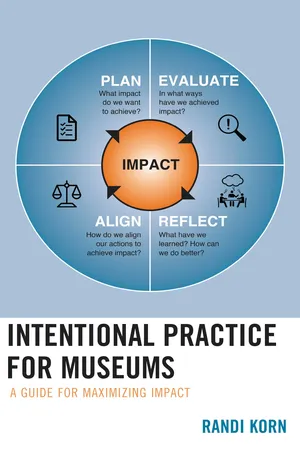
Intentional Practice for Museums: A Guide for Maximizing Impact first explains how the idea of intentional practice grew from a confluence of political concerns, observations of museum in the marketplace, and the increasingly-deafening call for museums to be accountable. The book presents and deconstructs the Cycle of Intentional Practice, which includes four quadrants with actions and corresponding questions situated around the centerpiece—impact. In no particular order:
The Plan quadrant asks "What impact do you want to achieve?"; The Evaluate quadrant asks "In what ways have you achieved impact?"; The Reflect quadrant asks "What have you learned? What can you do better?"; and, The Align quadrant asks "How do we align our actions to achieve impact?"
The Cycle is symbolic, too, as impact-driven work is ongoing, and museums that choose to pursue impact through intentional practice will benefit—as will their audiences; both will continually learn, albeit through very different means.
Intended for intentionally-minded museum professionals, the book also describes the seven principles of intentional practice and provides basic intentional-practice strategies, exercises, and facilitation questions so they can begin facilitating impact-driven workshops at their museums.
- English
- ePUB (mobile friendly)
- Available on iOS & Android
eBook - ePub
About this book
Information
Table of contents
- Contents
- Acknowledgments
- Preface
- Chapter 1: Toward a Philosophy of Intentionality
- Chapter 2: Origins of the Cycle of Intentional Practice
- Chapter 3: Learning about the Cycle of Intentional Practice
- Chapter 4: Intentional-Practice Principles
- Chapter 5: Intentional-Practice Exercises
- Chapter 6: Case Studies
- Chapter 7: Learning, the Continuous Journey
- Appendix A
- Appendix B
- Glossary
- Notes
- Bibliography
- About the Author
Trusted by 375,005 students
Access to over 1.5 million titles for a fair monthly price.
Study more efficiently using our study tools.
Frequently asked questions
Yes, you can cancel anytime from the Subscription tab in your account settings on the Perlego website. Your subscription will stay active until the end of your current billing period. Learn how to cancel your subscription
No, books cannot be downloaded as external files, such as PDFs, for use outside of Perlego. However, you can download books within the Perlego app for offline reading on mobile or tablet. Learn how to download books offline
Perlego offers two plans: Essential and Complete
- Essential is ideal for learners and professionals who enjoy exploring a wide range of subjects. Access the Essential Library with 800,000+ trusted titles and best-sellers across business, personal growth, and the humanities. Includes unlimited reading time and Standard Read Aloud voice.
- Complete: Perfect for advanced learners and researchers needing full, unrestricted access. Unlock 1.5M+ books across hundreds of subjects, including academic and specialized titles. The Complete Plan also includes advanced features like Premium Read Aloud and Research Assistant.
We are an online textbook subscription service, where you can get access to an entire online library for less than the price of a single book per month. With over 1.5 million books across 990+ topics, we’ve got you covered! Learn about our mission
Look out for the read-aloud symbol on your next book to see if you can listen to it. The read-aloud tool reads text aloud for you, highlighting the text as it is being read. You can pause it, speed it up and slow it down. Learn more about Read Aloud
Yes! You can use the Perlego app on both iOS and Android devices to read anytime, anywhere — even offline. Perfect for commutes or when you’re on the go.
Please note we cannot support devices running on iOS 13 and Android 7 or earlier. Learn more about using the app
Please note we cannot support devices running on iOS 13 and Android 7 or earlier. Learn more about using the app
Yes, you can access Intentional Practice for Museums by Randi Korn in PDF and/or ePUB format, as well as other popular books in Business & Museum Administration. We have over 1.5 million books available in our catalogue for you to explore.